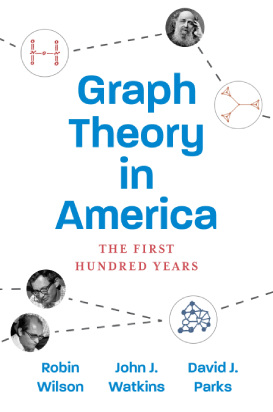
Robin Wilson, John J. Watkins, and David J. Parks
PRINCETON UNIVERSITY PRESS 2023, 320 PAGES
PRICE (HARDBACK) £30.00 ISBN 978-0-691-19402-8
The casual reader may wonder why the history of graph theory in America warrants a book all of its own, but the book itself does a good job of answering that question: graph theory was actively pursued in America between the years covered by the book (1876–1976) and appears as part of the story of the establishment of an American mathematical research community. The book thus combines a discussion of the latter with material on the evolution of graph theory, both in North America and elsewhere. The text derives from the Open University PhD dissertation of the third author.
A thread that runs throughout the book is the famous four colour problem/theorem: the question of whether every map can be coloured using no more than four colours so that no two adjacent regions share the same colour. Indeed, the problem serves to bookend the text, the main thrust of which starts with J.J. Sylvester’s arrival at Johns Hopkins University in 1876, where he studied, among other things, the four colour problem. At the other end, we finish with the final computer-assisted proof of the theorem in 1976 by Kenneth Appel and Wolfgang Haken.
The overall structure of the book is chronological, detailing the growth of graph theory in America decade by decade, punctuated by interludes exploring the developments that were going on in Europe at the same time. It first sets the scene by filling in some background on the state of American mathematics in the second half of the nineteenth century, before turning in Chapter 1 to Sylvester and his effect on the American mathematical research community.
Chapter 2 takes us into the early 20th century, and the beginnings of the strong influence of figures such as Oswald Veblen and G.D. Birkhoff, and the steering of graph theory in a topological direction. The chapter concludes with a view of the wider historical backdrop, noting the activities of the mentioned mathematicians in the First World War. Chapter 3 continues the story into the 1920s, focusing most particularly on the work of Philip Franklin, a student of Veblen’s.
Graph theory seemingly had a rough start in the early decades of the twentieth century, being deemed by many mathematicians to be trivial and uninteresting, but Chapter 4 shows us how it was given a boost in the 1930s via the contributions of Hassler Whitney and Saunders Mac Lane. Again, the wider landscape of American academia during the 1930s provides a backdrop to the mathematics discussed.
Much of the graph-theoretical work of the people mentioned above was concerned with colouring problems, but the mid-twentieth century marked a period of diversification in the subject, with graph theory finding applications in the study of electrical networks, transportation, and computing. Central figures here include Claude Shannon and Bill Tutte (whose presence extends the discussion from the USA into Canada), and a core theme is the increasing use of algorithms in graph theory, spurred by the growth of computing after the Second World War.
The final numbered chapter (Chapter 6) documents graph theory’s maturation in America in the 1960s and 1970s, with a detailed discussion of the circumstances surrounding the proof of the four colour theorem. A final ‘Aftermath’ comments briefly on further developments during these decades. The book ends with a useful glossary, and suggestions for further reading.
A nice feature to see is that the book does not shy away from mathematical detail, the discussion of which is supported by well-chosen illustrations. Summaries of important papers appear in boxes separate from the main text. The focus on the four colour problem occasionally risks overshadowing other aspects of graph theory (a point that the authors acknowledge), and the presence of the European interludes means that the book could maybe have been framed less narrowly as a general history of graph theory in this period. But these are minor complaints about what is a nicely produced and accessible book that should appeal to the general mathematical reader.
Christopher D. Hollings FIMA
Book review published directly onto IMA website