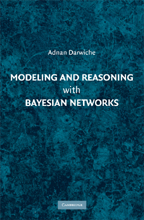
Adnan Darwiche
CAMBRIDGE UNIVERSITY PRESS 2009, 562 PAGES
PRICE (HARDBACK) £58.00 ISBN 978-0-521-88438-9
 One of the key themes underlying mathematics, and especially mathematical proof, is that of bringing together separate elements and combining them so that they tell a whole new story. Whether it’s in the common theme that unites two apparently disparate branches of work, or in the combination of approaches that together create a complicated proof, amalgamating pieces of evidence (or knowledge) in a reasoned fashion is a critical aspect of the continued progress of mathematics.
It is perhaps no surprise then that automated knowledge-based reasoning has received considerable attention. This attention has come from a number of different perspectives, including: statistics; cognitive modelling; philosophy; and, probably most importantly, Artificial Intelligence (AI). Bayesian networks are a key tool in this area and this means that this text should have a wide appeal.
The first chapter provides a general introduction, which includes a brief summary of the historical motivation for knowledge- based reasoning. Even at this early stage detailed concepts are being introduced, such as the additional flexibility that a ‘degree of belief’ in each of several possibilities provides over an assumption that a single possibility pertains.
The following two chapters provide some necessary background, specifically in propositional logic and probability calculus. The inclusion of this material means that this text has few pre-requisites. Additional background material is provided in a small number of appendixes, which cover items like information theory and constrained optimisation. The appendixes are, however, too brief to be of any real value. But this is not a significant limitation, since a simple Internet search will easily yield suitable information for those that require it.
The remaining sixteen chapters are structured in a logical manner: from a simple description of the main features of a Bayesian network; on to how to build them; through various inferential methods and their complexity; to thoughts on sensitivity analysis and learning (which is highly relevant in the AI context). With the exception of the introduction, each chapter ends with bibliographic remarks (which highlight opportunities for further reading) and a number of exercises. Where necessary, proofs of relevant theorems are included as the final section of a chapter. From a mathematician’s perspective it was slightly irritating to see the proofs relegated in importance in this manner, almost as if they were an embarrassing uncle at a wedding. However, taking a wider view, this editorial style does mean that the main text flows freely, which should appeal to many potential readers.
The author, who is a well-known expert in the field, has made some deliberate choices, both in the material that is included in the book, and the way that it is presented. For example, the focus is deliberately placed on Bayesian networks, rather than a more general consideration of graphical methods (e.g. Markov networks). Some might argue that this conscious narrowing of scope prevents readers understanding the wider collection of approaches that could be used. However, from my perspective, it allows the main topic to be pursued with clarity and purpose, which is highly advantageous.
In terms of presentation, in the introduction the author notes that some very classical ideas are presented in ways that may appear unorthodox to the expert. Here, again, I believe that the correct decision has been made: the text is intended to help new readers get to grips with both the theoretical and the practical issues associated with Bayesian networks and presenting topics in an intuitive way greatly assists this goal.
The text strikes an excellent balance between the different desires of its potential audience. It provides information for the researcher, who wishes to understand the full details of the approaches that are discussed, as well as information for the practitioner, who is more concerned with simply getting something to work. In addition, the prose is clearly written, with the author’s experience shining a light onto potential difficulties so that they can be understood and avoided.
Overall, this book provides an accurate, well-presented discussion of a topic that is important in a number of fields. As such, it should prove very useful to a wide audience.
Rob Ashmore CMath FIMA CSci
Defence Science and Technology Laboratory
Mathematics Today August 2012
The views and opinions expressed herein are those of the author and do not necessarily reflect those of the Defence Science and Technology Laboratory.
Modelling and Reasoning with Bayesian Networks can be purchased at Amazon.co.uk