Ilya Shmulevich and Edward R. Dougherty
SIAM 2010, 267 PAGES
PRICE $59.00 (PAPERBACK) ISBN 978-0-898-71692-4
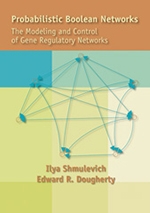 Advances in genetic sequencing in the late twentieth century have been accompanied by an increased emphasis on the factors influencing how and when genes are expressed. For example, a skin cell and a liver cell contain the same DNA but regulate it differently, leading to divergence in gene expression and thus distinct forms and functions for the cells. This timely book discusses the use of probabilistic Boolean networks as a systems-level model of such interactions.
The first quarter of the book develops the concept of gene regulatory networks as discrete valued dynamical systems from basic principles. This part of the book has few mathematical prerequisites beyond familiarity with Boolean notation and Markov chains, and new concepts are clearly defined.
Later chapters cover more advanced topics such as the inference of network structure from experimental data, and models where network updating is not synchronous. Algorithms for computational network analysis, together with theorems and lemmas, are set out in a more formal fashion. Some of the proofs here appeal to results from advanced-undergraduate level probability and stochastic processes, but their role is usually explained so readers without a background in probability can still follow the logic of the derivations.
This text focuses on modelling techniques and contains very little biological background, although it does make use of real-world examples to motivate the development of particular techniques. It is clearly written, with generous provision of diagrams, tables and graphs throughout to make difficult content more comprehensible. My only real criticism is directed at the index, which is unhelpful and lacks any cross-referencing, making it harder to dip into particular sections of interest or to revise the groundwork of more advanced topics.
Anyone with a moderate grounding in probability and an interest in systems-level biological modelling will appreciate this book, while students in computational biology will find the extensive bibliography invaluable for further reading.
Paul Taylor AMIMA
Book review published directly onto IMA website (February 2013)