We explore the cooking of pancakes using a combination of kitchen experiments and mathematical theory. The properties of a pancake are characterised in terms of a dimensionless geometrical measure of aspect ratio ( ) and the baker’s ratio that describes the mass ratio of water or milk to flour (
 ). The patterns on the top and bottom of pancakes are analysed in a kitchen study and explained in terms of how the vapourised liquid in the batter escapes. We determine the properties of a perfect pancake.
1 Introduction
 Pancakes are a starch-based comestible created by pouring batter onto a hot solid surface and cooking until solid [1]. They come in a lot of different shapes from the large, thin, circular French crêpes to small, thick, circular drop scones from Scotland or ball-shaped æbleskiver found across Scandinavia. The purpose of this light-hearted article is to show how by using different mathematical techniques (dimensional analysis, groups classification, and applied mathematics) we can understand the subtleties and complexities about how pancakes cook and, in some sense, determine how to make a perfect pancake; this is timely because Candlemas is on 2 February and Pancake Day is on Tuesday 9 February 2016.
There is archaeological evidence that pancakes are one of the first cereal foods eaten in ancient societies. Pancakes have been around since Neolithic times and were probably cooked on flat rocks covered with grease [1]. These were mentioned by Cato the Elder (in the early Roman Republic) who described the recipe for libum – a sort of flat pancake [2] – in his agricultural manual [3]. The first recipe for a pancake referred to as a crêpe appears in a 14th century medieval guidebook written by a Parisian aristocrat for the moral and domestic teaching of his young spouse [4].
By the 16th century, modern pancake recipes can be found in French cooking books using ingredients such as flour, drawn butter, eggs and white wine [5], as well as in English books with the first one printed in 1588 [6]. From that time, recipes for pancakes became more common [7]. They are described in fairy tales such as the 19th century story of Hansel and Gretel who were served sugared pancakes in the witch’s house [8].
Eating pancakes is associated with some religious celebrations. It forms part of two major western Christian events. The first is referred to as La Chandeleur or Candlemas, and is celebrated 40 days after Christmas every year on 2 February to mark the presentation of baby Jesus at the temple in Jerusalem. It was originally referred to as ‘La Festa Candelarum’ by Romans to celebrate the change of season before it was banned by the Christian Church; pancakes were allegedly supposed to represent the solar disk with their golden round shape. In France, it is still traditional to eat pancakes on that day and to light candles. Pancakes are eaten on Shrove Tuesday, often known as Pancake Day, which falls 47 days before Easter Sunday. On this day, Christians went to confession and were shriven (absolved of their sins). Shrove Tuesday was the last opportunity to use up dairy and meat products such as eggs, milk and fat, before embarking on fasting during Lent. Pancake Day is also known as Mardi Gras or Fat Tuesday in North America. Fried potato pancakes or latkes are also eaten on the Jewish festival of light, Hannukkah, while Orthodox Christians celebrate Maslenitsa with blini. Finally, throughout Scandinavia, it is traditional to eat æbleskivers – spherical pancakes – as part of breakfast on Christmas morning [1].
2 Pancake categorisation
To understand how to best make a pancake, we need a simple way to categorise them. Two metrics are used to characterise their geometry and the properties of the batter mixture. The use of dimensionless metrics is the key for understanding most physical problems. Since pancakes are cooked by pouring a volume  of batter to create a pancake of diameter
  , a dimensionless measure of the pancake geometry can be defined as
(1) 
When a circular pancake of uniform thickness  is created,
  , so the larger the value of , the thinner is the pancake or the larger it is.
Pancake batter is made by mixing together a solid component (flour) and a liquid component (either milk or water). Additional ingredients or processes are needed to bind the flour and liquid together in a batter, for example eggs, which is then poured. Cooking a pancake leads to steam being generated by water vaporisation and this plays a crucial element in the cooking process. The proteins in the egg denature, with weaker chemical bonds being broken and stronger interlinking bindings being formed during cooking, changing the batter from a free flowing liquid to a soft solid. A measure of how much liquid is available during cooking is the ratio of the mass of liquid that is added to the recipe  (either water or milk) to the mass of flour (
 ). This is known as the baker’s percentage [9] and is defined as
(2) 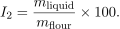
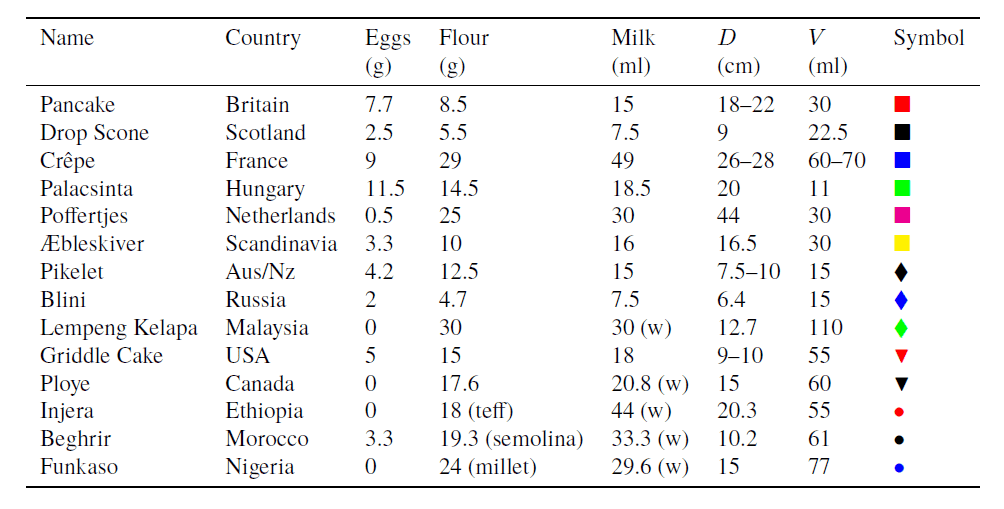
Figure 1 shows a scatter plot of versus for pancakes across the world. The aspect ratio shows a remarkable variation from  to 300. This gives a lower bound of
  for a completely spherical ball to
  for a thin crêpe-like pancake. Certainly, as we move across the range, the cooking principles change.
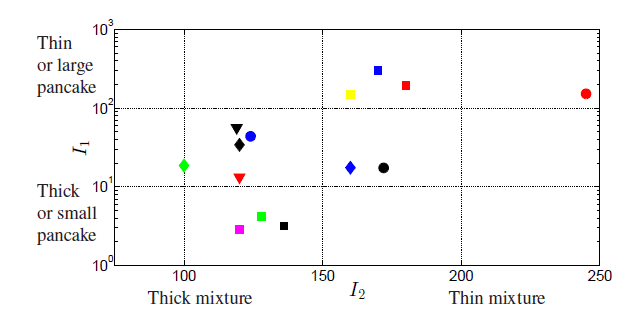 (equation (1)) against a measure of the liquid content (equation (2)) for the pancakes listed in Table 1
The baker’s percentage shows a much smaller range from approximately 100 to 175. The outlier is the Injera pancake from Ethiopia with a baker’s percentage of 244. This batter is somewhat different since it does not contain eggs and is left to stand for three days to ferment and unlike most breads, it can be poured and therefore be categorised as a pancake.
3 Kitchen study and pattern categorisation
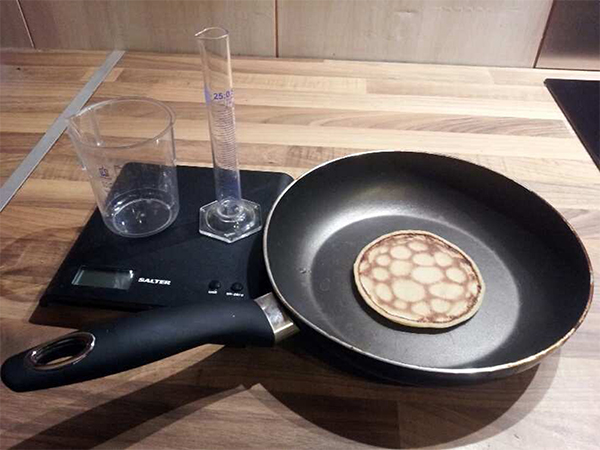
Since we have identified two dimensionless groups, it would be useful to explore experimentally their influence on how a pancake cooks. Experiments were undertaken in a kitchen using a frying pan of 24 cm diameter as shown in Figure 2. The fresh batter consisted of flour, milk and eggs. The mass of flour was fixed at  g and the amount of milk varied from 100 g to 225 g to give a variation of from 100 to 225. A fixed relative mass of eggs
  was used. Each volume of batter was weighted using the Salter kitchen scale 1066 BKDR15 (HoMedics House, Tonbridge) with a resolution of 1g. The batter was carefully poured in the centre of a hot non-stick pan on a hob. The pan was fixed and the batter was allowed to flow freely on the flat surface. For very large values of above 125, the pan was rotated to spread the batter. The pancake was cooked over a constant heat. The cooking patterns and shapes provide an indelible and permanent integrated measure of the cooking process.
Although mathematics usually involves solving well-defined systems of equations, a powerful but abstract technique is to identify general patterns and assign them to distinct categories. This type of categorisation technique applied to a seemingly random sequence was made famous with Luke Howard’s 1802 classification of clouds [10] into three main groups which has provided a foundation for modern meteorology. By cooking pancakes in a systematic and reproducible manner, general trends emerged. Two different types of categorisation are used based on (a) the shape and (b) the pattern on the top/bottom of the pancake. When the pancake batter had to be rotated around the pan to create a large , it may have had a non-circular shape which was noted as a ‘No’.

The top and bottom of the cooked pancakes were photographed and reported in Figure 3 after stripping out their backgrounds to illustrate the five patterns: islands ( ), ring (
 ), craters (
 ), smooth (
 ) and smooth with dark spots (
 ) for different values of and .
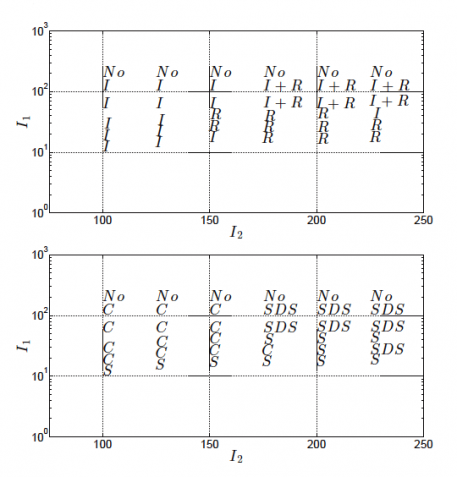
Figure 4 shows the categorisation of the cooked patterns. With a sufficiently large value of , there is a clear trend with for the bottom of the pancake to go from craters () to a smooth base () before the appearance of dark spots on the smooth base (). For thick mixtures, the vapour tends to be trapped and lifts the pancake non-uniformly resulting in the appearance of craters; as the mixture gets thinner, the part of liquid increases and the vapour from cooking is released smoothly at the base of the pancake. For small pancakes (low ), the pattern on the bottom is smooth (), irrespective of the baker’s ratio . On the top surface, we first notice the appearance of islands () due to the craters on the bottom lifting non-uniformly the top surface. While the bottom surface becomes smoother, the pancake thickness tends to be constant across the pancake, hence the disappearance of islands leading to the presence of a ring () around the pancake, the location where the batter is the thinnest. As increases, the mixture gets thin enough ( ) so that the vapour can escape through the batter as well, hence the presence of a smooth base with dark spots (), which corresponds to the points of release of the vapour. In this case, the top part will show a ring because of the smooth base, with a pitted surface due to the numerous locations across the batter where the vapour is released (+).
4 Physical description
We can now try to explain the regime diagram shown in Figure 4. The first component to analyse is the influence of pouring. Physically, we expect an upper limit of due to the influence of contact forces. A pool of liquid will spread until a balance is achieved between hydrostatic forces and contact forces, i.e.\  leading to
  giving a limit of
  where
where  is the surface tension. For pancakes which lie in the region of
  , the batter must be spread with a pancake rake, for instance, for crêpes. is greater than
  which corresponds to spherical pancakes. When is too low, the batter mixture is too thick to pour and is not therefore a pancake.
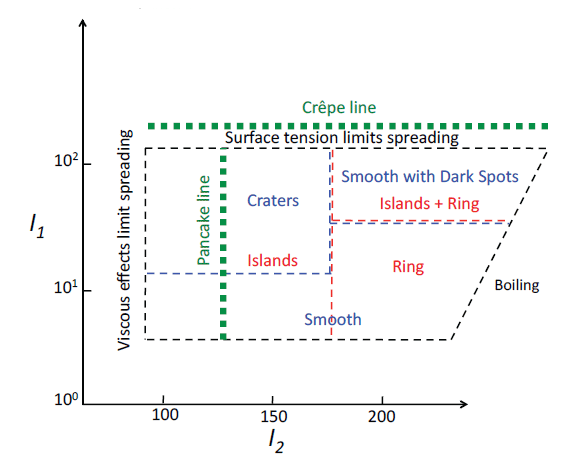
During the cooking process, the escape path of vapour from the bottom of the pancake largely determines how the pancake cooks and the patterns. For thick pancakes made of thin mixtures, we essentially have a shallow layer of boiling mixture with vapour escaping through vertical channels in the pancake. This generates a pitted texture on the pancake top and typically, if  , an incoherent layer. As the mixture becomes thicker ( decreases), a coherent layer begins to cook with vapour being trapped in the central region of the pan which rises and generates a dome. The pressure builds up in time due to the mass of water vapour increasing which dominates over the pressure decrease due to the dome volume increasing. When the pressure is sufficiently high that the resistance at its edge is overcome, the water vapour escapes generating radial spokes in the pancake pattern and the dome height then decreases. The vapour escape routes are cooked permanently into the pancake and form the radial spokes in the pancake pattern. For a small or thick pancake (
 ) with a smooth pattern on the bottom, the vapour generated by evaporation leads to a vapour flow underneath the pancake. The physical process can be understood using a lubrication analysis applied to a circular pancake with a uniform gap between the pancake and pan. This vapour flow is resisted by viscous stresses on the pancake and pan leading to a large pressure underneath the pancake which provides the lift which supports and lubricates the pancake. This vapour lubricated movement is similar to the low friction movement of water droplets in a hot pan (the Leidenfrost phenomenon [11], translated in [12]). Once the pancake base is cooked, the pancake behaves like a soft solid. The vapour flux is greatly reduced compared to cooking before the pancake is flipped. The vapour flow is not sufficient to completely separate the pancake from the pan and some regions are still in contact with the pan leading to overcooked ridges that generate the crater patterns of the top surface. The different regimes and physics are summarised in Figure 5.
5 Conclusions
The physics of pancake cooking is complex! Some systematic trends emerge which we studied by reducing their characteristics to a two-parameter family characterised by a geometrical measure of aspect ratio () and a mixture measure – the baker’s ratio (). Looking at Figure 1 and the regime diagram in Figure 5, we can see two noticeable trends. Most pancakes fall along the ‘pancake line’  or along the ‘crêpe line’
  . This is not accidental. Along the pancake line, the pancake spreads easily in a pan and has a smooth surface pattern due to much less burning because it is lubricated by the vapour flow. Along the crêpe line, the thin pancake can only be created by physically spreading the batter across the pan. In this case, the vapour leaves either through vapour channels or diffusion through the thin pancake.
The serious side to this research is that medical and technology devices that are used, for example in ophthalmology, are based on understanding how sheets deform due to fluid flows and some of the physical processes are common to the pancake problem. Enjoy Pancake Day!
Ian Eames FIMA
Department of Mechanical Engineering, University College London
Peng T Khaw
NIHR Biomedical Research Centre at Moorfields Eye Hospital NHS Foundation Trust and UCL Institute of Ophthalmology
Yann Bouremel
NIHR Biomedical Research Centre at Moorfields Eye Hospital NHS Foundation Trust and UCL Institute of Ophthalmology
References
- Albala, K. (2008) Pancake, A Global History, pp. LXXV.
- Giacosa, I.G. (1994) A Taste of Ancient Rome, University of Chicago Press.
- Cato (160 BCE) De AgriCultura, University of Chicago Press.
- Pichon, J. (1847) Le Ménagier de Paris. Traité de Morale et d’Économie Domestique Composé vers 1393 par un Parisien pour l’Éducation de sa Femme, Janet, Techener et Potier.
- Albala, K. and Tomasik, T.J. (2014) The Most Excellent Book of Cookery: An Edition and Translation of the 16th-century ‘Livre Fort Excellent De Cuysine’, Prospect Books.
- Peachey, S. (1992) The Good Huswifes Handmaide for the Kitchen: Period Recipe Book (Historical Cookery Books), Stuart Press.
- Glasse, H. (1747) The Art of Cookery.
- Grimm, J. and Grimm, W. (1812) Kinder- und Hausmärchen, pp. KHM15: Hänsel und Gretel.
- Figoni, P.I. (2011) How Baking Works: Exploring the Fundamentals of Baking Science, 3rd edition, John Wiley & Sons, Incorporated.
- Howard, L. (1804) On the Modifications of Clouds, and on the Principles of their Production, Suspension, and Destruction: being the substance of an essay read before the Askesian Society in the session 1802–3, J. Taylor, London.
- Leidenfrost, J.G. (1756) De Aquae Communis Nonnullis Qualitatibus Tractatus (A tract about some qualities of common water). Duisburg on Rhine.
- Wares, C. and Bell, K.J. (1966) On the fixation of water in diverse fire, Int. J. Heat Mass Transfer, vol. 9, pp. 1153–1166.
Reproduced from Mathematics Today, February 2016
Download the article, How to Make the Perfect Pancake (pdf)