Remarkable! There I was, reading about shoelaces in Professor Ian Stewart’s brilliant book The Magical Maze [1], when a simple diagram that looks something like Figure 1 below jumped out at me. Citing a 1995 paper published by Professor John Halton (University of North Carolina), he refers to these graphs respectively as the American, European and shoe-store patterns for tying shoelaces. These patterns connect eight pairs of eyelets from top to toe of a shoe, alternating between left and right. The aim is to use the least amount of shoelace possible and, by cleverly using reflective symmetry for these graphs, Halton proved that the American pattern is the most efficient of all such arrangements, regardless of the number of pairs of eyelets, the distance between successive eyelets and the gap between left and right eyelets. He also proved that the European pattern is necessarily less efficient, albeit more decorative, and that the shoe-store pattern always uses even more shoelace.
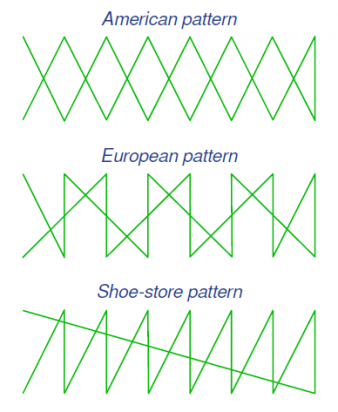
And then it occurred to me. Another excellent book by Eastaway and Haigh [2] recently inspired me to investigate arrangements of alternating odd and even numbers around a dartboard. I used three graphs that were almost identical to those in Figure 1, each with a row of 10 even numbers in descending order (20,…,2) and a row of 10 odd numbers in ascending order (1,…,19). I sought a layout for which the sums of adjacent numbers around the dartboard are as similar as possible, by minimising the maximum absolute difference between the sum of any two adjacent numbers and the average sum of 21. These three patterns were the main contenders for best layout and, amazingly, the same order results: the American pattern is uniquely best overall, whereas the European and shoe-store patterns are progressively less optimal.
Of course, these discrete optimisation problems are analogous and the apparently surprising results are not coincidental. They even led me to present a conference paper this summer, which proposes a new arrangement for the numbers around a roulette wheel. Before reading this article about shoelaces, however, I struggled to think of similar optimisation problems. Now it seems easy to spot other applications that involve connecting pairs sequentially and efficiently, particularly in communications, transportation, distribution and scheduling. Last summer, for example, we hired a skip for some gardening work. Suppose that a skip hire van has to deliver and collect six skips per day to and from different locations, after emptying the load each time. Which feasible route minimises the total distance travelled? What about merchant ships and cruise liners that load and unload precious cargos sequentially at predetermined ports?
Somewhat intrigued and inspired, I now want to learn more about optimal graphs, algorithms and trees. Bayesian belief networks have proven to be very useful for modelling conditional independencies among random variables for several decades, though a more recent development by Bedford and Cooke [3] seems to offer new possibilities in this regard. This concerns vine copulas, which are powerful methods for modelling conditional dependencies among random variables, so offering a generalisation that might deliver advantages in some circumstances. An even more recent development by Aslett et al. [4] is that of survival signature, which provides a simple method for summarising the structure of a network or complex system. This generates helpful information for measuring the safety and reliability of a system, and for determining appropriate maintenance actions. Opportunities galore – fascinating!
In the early days of space exploration, US Astronaut John Glenn declared that,
Knowledge begets knowledge. The more I see, the more impressed I am not with how much we know but with how tremendous the areas are that are yet unexplored.…
The same is surely true today. Perhaps this tale illustrates the benefits of acquiring complementary knowledge through studying the peripheries of a subject as well as the core matter. Although most of us shall only ever know a small subset of all the mathematics that exists, we can have a lot of fun trying to discover it all. I believe that we are living in very happy mathematical times and that our discipline is prospering, though we cannot afford to become complacent. Over recent years, there appear to have been increasing numbers of high-profile and low-profile professionals and amateurs, who are happy to share their enthusiasm for our wonderful subject, in formal and informal surroundings, and using a variety of different media. Equally importantly, governments continue to invest heavily in maths teachers for the future.
The IMA is a major contributor to this current popularity of our subject, through its network of contacts and the generosity of its volunteers and members. One of the many ways in which it achieves this is through the activities of its regional branches. At present, there are seven such branches that cover Scotland, Ireland and five regions of England (North West, West Midlands, East Midlands, West of England and London). Perhaps you are interested in finding out more or in establishing a new branch, such as Wales, North East England or international. If so, the Chairman of the Branches Committee, Dr Martine J. Barons, will gladly provide further information and discuss your proposals. Most branch meetings are free to attend and are accessible to all. You will always be welcome whether the content is directly relevant to you or in the peripheries of your specialist interests. For current Branch events see page 191 or visit www.ima.org.uk/activities/branches.cfm.html
Whichever region you are in, do go along to some branch meetings soon if you have the opportunity, as they can be very enjoyable. So far in 2015 alone, the North West Branch has hosted some fabulous presentations including Dame Celia’s Presidential Address at Manchester Metropolitan University, a sixth form talk by Dr Ron Knott on Polygonal numbers, pictures and proof at the Manchester Grammar School, and lectures by Professor Ray Hill – Mathematics on trial, Dr Edmund Chadwick – Manoeuvring in fluids and Mr Mike Tanner – Call-centre modelling with simulation and queuing theory. Other branch activities include careers talks, joint meetings with other professional bodies and industrial partners, visits to museums and maths trails. If you have any suggestions, do contact your local branch committee. Who knows what fruitful opportunities and beneficial collaborations might arise?
The IMA also holds regular research conferences around the UK, which might interest you. In 2015, there have already been seven such meetings on the themes of: Research in Mathematics and its Applications; Early Career Mathematicians; Mathematics 2015; Flood Risk; Mathematical Education of Engineers; Barriers and Enablers to Learning Maths and Mathematics in Finance. Other conferences planned for this year include meetings on the themes of: Numerical Methods for Simulation; Mathematics of Robotics;
Early Career Mathematicians once again; Mathematics in Defence and Cryptography and Coding. The last of these will be the fifteenth biennial IMA conference on this subject and the content is just as significant to modern life as it was three decades ago. Another highly topical IMA conference on Mathematical Challenges of Big Data was held in London last December and was so successful that a sequel is planned for 2016. For details of current conferences see page 192.
Meanwhile, this issue of Mathematics Today contains interesting articles on a variety of topics, including applied probability, genetic theory, historical notes, car park design and a board game that you can play, along with our regular news bulletins. So put the kettle on, make yourself comfortable and prepare for a good read!
David F. Percy CMath CSci FIMA
References
- Stewart, I.N. (1997) The Magical Maze, London: Weidenfeld & Nicolson.
- Eastaway, R. and Haigh, J. (2011) The Hidden Mathematics of Sport, London: Portico.
- Bedford, T. and Cooke, R.M. (2002) Vines – a new graphical model for dependent random variables, The Annals of Statistics, vol. 30, no. 4, pp. 1031–1068.
- Aslett, L.J.M., Coolen, F.P.A. and Wilson, S.P. (2014) Bayesian inference for reliability of systems and networks using the survival signature, Risk Analysis, doi: 10.1111/risa.12228.
Reproduced from Mathematics Today, August 2015
Download the article, Editorial August 2015 (pdf)