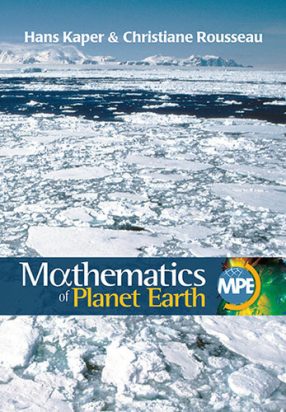
 Hans Kaper and Christiane Rousseau (Eds)
SIAM 2015, 206 pages
PRICE (PAPERBACK) £26.00 ISBN 978-1-61197-370-9
This book is a collection of English language blogs on the website of the Mathematics of Planet Earth 2013, a project with UNESCO patronage. There was the opportunity to blog in French but translations of these are not included. Any blogs solely announcing workshops, conferences and special lectures were also omitted. The posts are grouped in four parts as follows.
A Planet to Discover has four chapters on Planet Earth, Ocean and Atmosphere, Weather and Climate and Beyond Planet Earth. Planet Earth is mainly about geology including the age of the earth, solar noon, the earth’s inner core, earthquakes, and echo location for seismic data. The second chapter covers a wide range including the dynamics of the ocean and atmosphere, waves in both, tsunami growth, fractal sea coasts, ice floes, the Gulf Stream, lightning and thin ice. The Weather and Climate chapter makes the interesting claim that because of chaos theory atmospheric prediction is only possible two weeks ahead however accurate the measurements or how fast computers become. Beyond Planet Earth considers the motion of planets and spacecraft and even the Big Bang Singularity.
A Planet Supporting Life contains two chapters on the Biosphere and Ecology and Evolution. The Biosphere chapter has blogs on vegetation, bird species distribution and plankton distribution. There is nothing on evolution in the Ecology and Evolution chapter but blogs on species co-operation, fishery protection and tree harvesting.
A Planet Organized by Humans consists of four chapters on Communication and Representation, Energy, Economics and Finance and Human Behaviour. Despite the title the Communication and Representation chapter is concerned with the earth’s oblateness, summertime, satellite imaging and GPS. Energy covers renewable energy, batteries, solar and hydrogen fuel cells, modelling energy efficiency and geothermal energy. Economics and Finance covers a wide variety of topics, environmental control problems in economics, solar renewable energy certificates, carbon dioxide trading, the social cost of carbon, carbon footprints, air travel and the sustainable development and utilisation of mineral resources. The modelling of Human Behaviour is considered along with game theory, conflict resolution, social segregation and social and cultural networks.
A Planet at Risk has three chapters on Climate Change, Biological Threats and Predicting Catastrophes and Managing Risk. Climate Change covers global warming, sea levels and Antarctic sea ice. The Biological Threats considered are the mathematics of biological invasions, surges in latent infections, the prevention of HIV using drugs and using random networks and graph theory to model its spread, using mathematical modelling to eradicate diseases, neglected tropical diseases and contagious behaviour. Predicting Catastrophes and Managing Risk includes earthquake modelling and prediction, wildfire simulation, natural hazard mitigation, storm surge effects on coastal vegetation, using extreme value theory in modelling floods and storm surges, financial risk and the risk of power grid failures.
Some of the blogs are written by the editors but most are from researchers around the world. The mathematical content of the blogs varies enormously from zero to a few with quite detailed equations. Some are just text whilst others contain pictures and diagrams and in most cases a few references.
The book says it is accessible to a general audience with a basic scientific background, but the large variation in content depth and subject matter means it is difficult to say who would benefit from reading it. It is also not clear whether any checks were made on the accuracy of the blogs, which are inevitably the personal opinions of the authors. The blogs were edited to streamline the text where necessary.
The book would seem to mainly appeal to attendees of MPE2013 who wish to have further information on some of the topics presented.
Nigel Heys MIMA
Book review published in Mathematics Today June 2017