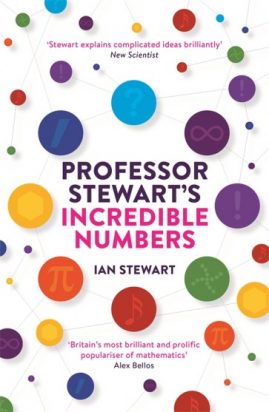
 Ian Stewart
PROFILE BOOKS 2015, 352 pages
PRICE (PAPERBACK) £14.99 ISBN 978-1-78125-410-3
This is an attractive and informative book. I enjoyed reading it. It is pitched at a level which will make it widely accessible to readers who have a curiosity about numbers, without requiring significant postgraduate experience.
Parts of it will be accessible to readers at undergraduate and even ‘high school’ level, perhaps with suitable guidance from teachers for some pupils in parts of the book. The adjective ‘incredible’ in the title is to be interpreted as ‘surprising’ rather than ‘hardly believable’ (although even that may be appropriate sometimes).
The author is, of course, well known for his books which seek to make mathematics widely accessible to curious readers. Indeed the title page is preceded by a list of 27 of his (solo) books of that general nature, including his Cabinet of …, Hoard of …, Casebook of …, etc. What are not listed (perhaps understandably in this context) are his research works, such as Catastrophe Theory and its Applications (with Tim Poston; 491 pages published by Pitman), which I bought in 1982, and which is equally thorough and informative, at that level.
As to numbers per se, one of the features of this new book is the range of historical facts about numbers which the author has elucidated, and tells us about, beginning with patterns found in the activities of primitive societies which have come down to us. The style is readable. The many illustrations, for example of historical artefacts, are informative, and perhaps some will be surprising to many. There are numerous ‘theorems’, but we are not deterred by having them called such. Instead they are attractively presented and developed sequentially. Geometry features strongly, because numbers describe so much of it in various guises.
There are numerous places where the detail, albeit provided in a balanced way, seems little short of astonishing. ‘How did he find that out?’ By hard work and sustained scholarship, of course.
The book is well organised, and the topics are divided into several different groups. ‘Small numbers’ describes (to cite just one example) Fermat’s claim that every prime number of the form 4k + 1 is the sum of two squares (e.g. for k = 1000, 4k + 1 = 40 x 40 + 49 x 49). Babylonian mathematics tablets are illustrated, and so is Cardano’s general solution for the canonical cubic. Fibonacci numbers, Fermat’s Last Theorem (1670–1994), magic squares, and the historical development of the decimal system, are all described.
The next four chapters give practical examples of the role of negative numbers, complex numbers, and rational and irrational numbers. Historical origins feature again, and that regular aspect of the book is very informative. Diagrams are frequent and helpful. Many formulae for π are given which might not be widely known.
There are chapters on ‘special small numbers’, in string theory for example, and in secret codes in WW2. Another chapter explains the ‘sausage conjecture’, that the arrangement of space whose ‘convex hull’ has the smallest volume is always a sausage for 56 or fewer spheres, but not for 57. The book concludes with an indication of ‘special big numbers’, with illustrations via the Rubik’s cube and Sudoku, a list of Mersenne primes, and more.
Professor M.J. Sewell CMath FIMA
Book review first published in Mathematics Today October 2016