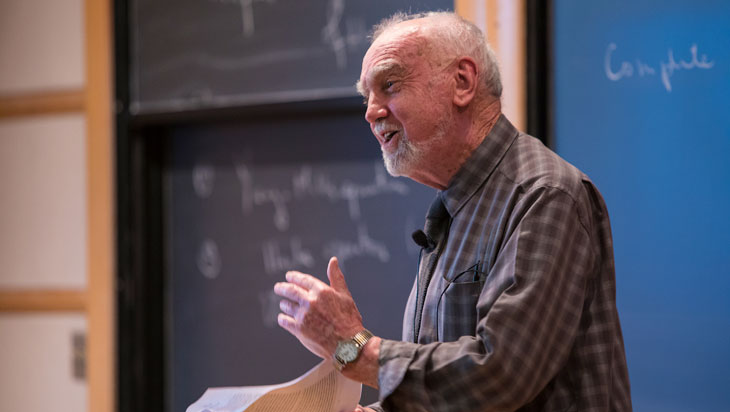
Robert P. Langlands is the 2018 recipient of the Abel Prize, an honour sometimes referred to as the Nobel Prize of mathematics. The citation recognises the profound impact of ‘his visionary program connecting representation theory to number theory’, a program that Langlands launched in 1967 as a 30-year-old associate professor at Princeton University. Given the far-reaching web of interconnections implied by the Langlands program, Edward Frenkel calls it a ‘Grand Unified Theory of mathematics’ [1]. In its original formulation, the program sought a correspondence between Galois representations, these being objects arising from number theory, and automorphic  -functions, objects created by Langlands and inspired by harmonic analysis.
The significance of the program lies not only in Langlands’ own work. The program has inspired and provided the framework for some of the greatest mathematical discoveries since the mid-20th century. Perhaps the most famous of these discoveries is Andrew Wiles’ proof [2] of Fermat’s last theorem, the 400-year-old claim that if  is an integer greater than 2, then there are no solutions in integers
  ,
,  , and
, and  to
to  with
with  . His work ultimately boiled down to proving (part of) the Shimura–Taniyama–Weil conjecture, now known as the modularity theorem. Essentially a special case of the Langlands program, this theorem asserts the existence of a correspondence between elliptic curves and modular forms. Modular forms are analytic objects and are the foundation for Langlands’ automorphic functions. Elliptic curves are fundamentally number-theoretic objects. One can obtain information about the points on the curve by reducing modulo
  , for each prime . Wiles had the insight that elliptic curves could be studied via Galois representations, cementing the relationship with the Langlands program.
Langlands’ ascent to the pantheon of mathematics had a humble beginning in British Columbia, Canada. He was born in New Westminster and moved just before the age of 10 to the town of White Rock, where he learned ‘pretty much nothing at all’ [3]. Despite signs of early talent he, along with most of his classmates, had no plans to attend university. A teacher in his final year of school convinced him otherwise with an hour-long impassioned plea in front of his class. He proceeded to the University of British Columbia and then to Yale for graduate study, where he was left largely to his own devices. On the strength of his work on elliptic operators and Lie groups, he was appointed Instructor at Princeton upon graduation in 1960.
He quickly absorbed himself in the mathematical life of the university and the nearby Institute for Advanced Study where he met with great figures such as Atle Selberg, Harish-Chandra, and André Weil. An early conversation with Selberg would prove fruitful. Selberg had been developing the theory of real analytic Eisenstein series for discrete subgroups  of
of  with quotients of finite volume. Classically, an Eisenstein series is a well-behaved function of a complex variable, holomorphic on the upper half-plane, that displays a certain symmetry (a functional equation) when acted upon by the group . They are the simplest examples of the modular forms that proved so crucial to Wiles’ argument. The archetypal Eisenstein series is
  , where the sum is over all integers
  and that are not both zero, and where
  is an integer. The Eisenstein series considered by Selberg are not necessarily holomorphic, but are square-integrable eigenfunctions of the hyperbolic Laplace operator
![\[ \Delta=-y^{2}\left(\frac{\partial^{2}}{\partial x^{2}}+\frac{\partial^{2}}{\partial y^{2}}\right). \]](https://ima.org.uk/wp/wp-content/ql-cache/quicklatex.com-e76ed172daf215f0a0e83f714b01f0f9_l3.svg "Rendered by QuickLaTeX.com")
In applied contexts, eigenfunctions and eigenvalues of the Laplace operator have physical significance. The frequencies produced by beating a drum are eigenvalues and the wave forms are eigenfunctions. The set of eigenvalues is the spectrum of the operator. Selberg showed that Eisenstein series represent the continuous spectrum of  and can be analytically continued to a meromorphic function on
  .
.
To unveil the discrete part of the spectrum, Selberg developed his trace formula. For a basic example of a trace formula, consider a diagonalisable matrix. The sum of the diagonal entries (the trace of the matrix) equals the sum of its eigenvalues. A more interesting example is the Poisson summation formula
![\[\sum_{n\in\mathbf{Z}}f(n) = \sum_{k\in\mathbf{Z}}\hat{f}(k)\]](https://ima.org.uk/wp/wp-content/ql-cache/quicklatex.com-d5f1d9d4326c96d2744ba95ebb8cd89d_l3.svg "Rendered by QuickLaTeX.com")
that associates the values of a function  with those of its Fourier transform
  .
.
Langlands pushed the work of Selberg to higher-rank groups by attempting to construct the continuous spectra in the case where is a discrete subgroup of any reductive group  , given that
  has finite volume. The effort involved was gargantuan and exhausting, but he managed to give a complete description of the spectral decomposition of
  .
.
While these investigations into harmonic analysis would influence Langlands’ automorphic -functions, another source of inspiration came from the earlier work of Emil Artin on class field theory. This theory arose from a desire to generalise Gauss’s law of quadratic reciprocity, a law that concerns whether an odd prime is a square modulo an odd prime  . The answer depends only on whether is a square modulo and on the residues of and modulo 4. Today, this law is vital in many cryptographic applications. Back in 1897, David Hilbert expressed quadratic reciprocity on
  as a product formula
  for non-zero rationals
  and
and  . Here,
  is a place of the field and represents either the real field or the -adic field for a prime . As varies, the Hilbert symbols
  encode information about the solutions to the quadratic equation
  over the real numbers and modulo each prime . This beautiful expression can be interpreted in more general number fields, such as the quadratic field
  . In the 1900 International Congress of Mathematicians, Hilbert posed, as his 9th problem, the question of finding and proving the most general reciprocity law. The question seemed all but resolved by 1927 when Artin found a reciprocity law for any field extension
  for which the corresponding Galois group is abelian. Artin’s approach required the development of an appropriate -function.
The simplest -function is the well-known Riemann zeta function
![\[\zeta(s) = \sum_{n = 1}^{\infty}n^{-s}.\]](https://ima.org.uk/wp/wp-content/ql-cache/quicklatex.com-08ee0b67ac0a67cb83579191992bb228_l3.svg "Rendered by QuickLaTeX.com")
It is convergent on the half-plane  and has an Euler product expansion
  . Artin’s initial plan involved Galois representations. If is a finite Galois field extension, a Galois representation is a group homomorphism
  . Artin expressed his -function as an Euler product
  , where the product is over certain prime ideals in
  and where each
  is a local factor into whose messy details I will not delve. Artin hoped that this arithmetic object could be associated with an analytic one. Unfortunately, he could only do this in the case where
  was a one-dimensional representation and hence, by Schur’s lemma, where was abelian. The correspondence was with Hecke -series,
  , summed over ideals
  , where
  is a Hecke character.
The Langlands program is an attempt to salvage this situation. Langlands keeps Artin’s original -function but replaces Hecke -series with his own automorphic -functions,  . Hecke characters are replaced with automorphic representations,
  . A further new element was Langlands’ dual group
  associated to a reductive group . His automorphic -function depends on a representation,
  , of .
Conjecturally, there should be a correspondence between the Artin -functions and Langlands’ automorphic -functions. This is Langlands’ reciprocity conjecture. Moreover, his functoriality conjecture suggests a deep structure to this edifice. Specifically, if  and are reductive groups and if is an -homomorphism from
  to , then for every automorphic representation
  of , there should be an automorphic representation of such that
  .
.
Langlands and others have proved the conjectures in special cases, but the general result remains out of reach. In the meantime, the Langlands program has been a great unifying force, fulfilling the aesthetic goal of mathematics – in Langlands’ words, ‘creating order from seeming chaos’.
Gihan Marasingha
University of Exeter
References
- Frenkel, E. (2013) Love and Math: the Heart of Hidden Reality, Basic Books.
- Wiles, A. (1995) Modular elliptic curves and Fermat’s Last Theorem, Ann. Math., vol. 142, pp. 443–551.
- Mueller, J. (2018) On the genesis of Robert P. Langlands’ conjectures and his letter to André Weil, Bull. Amer. Math. Soc., dx.doi.org/10.1090/bull/1609
Reproduced from Mathematics Today, June 2018
Download the article, Abel Prize for Langlands’ Unified Theory (pdf)