It is 200 years since the French mathematician Gaspard Monge (1746–1818) died, on 28 July. To me he is so important that the most difficult task in celebrating his life and work with this article was the process of choosing the points to tell. I met mathematics through Monge, and I believe that most of the geometry I was able to learn well was because of knowing how to use his technique of descriptive geometry.
Although Monge was only about 17 years old, he was put in charge of teaching a course in physics. During the summer holidays of the same year in which he completed his education in Lyon, young Monge drew the plan of his birthplace with such accuracy that with the help of an unidentified friend of the family, he was offered a position at the École Royale du Génie de Mézières, and began working there as a draftsman in the autumn. This school was well known for the teaching of fortification design, and it was there that Monge first envisaged a technique that became his major mathematical invention.
As part of his everyday work, Monge was given the task of determining the height of a fortification which was being designed. Until then, there were two methods used for this problem. One involved choosing the most characteristic points on the terrain surrounding the fortification, and constructing the triangles determined by the viewpoint, the point of the edge of the fortification and the height of the wall sufficient to offer effective protection. The other method was based on long calculations, with the height of each crucial point being measured directly on the terrain and noted on a plan. Monge had a different idea. His plan had two initial stages. Firstly, he chose a few of the highest points from the surrounding terrain. Through these, he drew tangents to the fortification (adding sufficient height to the wall to protect the fortification from missiles). He then used these tangent lines to generate a tangential surface to the terrain, being therefore able to reduce the length of the calculation process considerably [1].
The method, when first explained to his supervisors, and understood, was immediately ruled a military secret. From then on, Monge perfected his method but was unable to publish anything about it until a reform of the whole educational system took place during the Revolution. Monge was a revolutionary and hence not too popular in England at the time: his technique therefore did not have much success here, although one of his students, Claude Crozet, took it to the United States where it flourished and was taught for a century at West Point Military Academy [2].
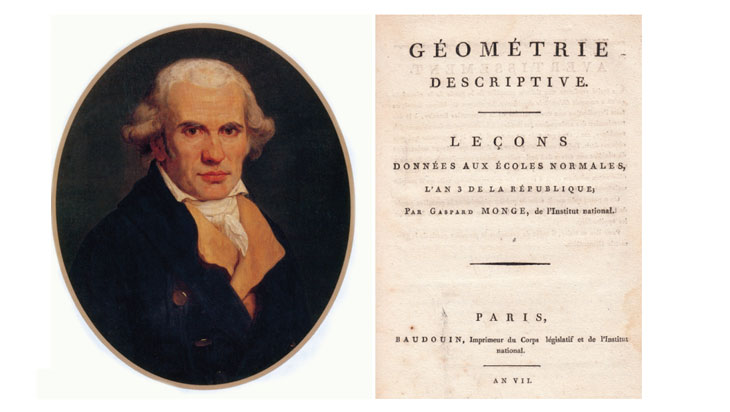
Monge was instrumental in the founding of the revolutionary centres of learning for the new Republic: first the École Centrale des Travaux Publics (now the École Polytechnique), which was established on 11 March 1794. In December of the same year, it opened its doors to its first students. During the summer of 1794, another school had been founded by decree, with the aim of educating teachers for the new Republic. This was the École Normale also situated in Paris. Its first lessons took place just after those of the École Centrale des Travaux Publics, in January 1795. There Monge gave his first course in descriptive geometry (Géométrie Descriptive); a book was eventually published in 1799 from the stenographic notes of this course [3]. This book was therefore not written by Monge, but was narrated by him – which means that his most important contribution to mathematics and mathematics education nationally (in France), and internationally (especially in French-speaking regions), came literally from his mouth.
And a wonderfully inspiring book it is. He began his narration full of enthusiasm for the new order that he had helped to bring about:
In order to raise the French nation from the position of dependence on foreign industry, in which it has continued to the present time, it is necessary in the first place to direct national education towards an acquaintance with matters which demand exactness, a study which hitherto has been totally neglected; and to accustom the hands of our artificers to the handling of tools of all kinds, which serve to give precision to workmanship, and for estimating its different degrees of excellence. Then the consumer, appreciating exactness, will be able to insist upon it in the various types of workmanship and to fix its proper price; and our craftsmen, accustomed to it from an early age, will be capable of attaining it [3, p. 4].
In most current popular explanations, descriptive geometry is portrayed as just one of the methods of graphical presentation of geometrical objects. But it is much more than that for those who understand its principles: descriptive geometry is a tool to gain and practise a visualisation of geometrical objects and processes. Monge argued that:
It is through numerous examples and through the use of the straight edge and compass in the classroom that one can acquire the habits of the constructions and can accustom oneself to the choice of the simplest and most elegant methods in each particular case. But also, as in analysis, when a problem is put into an equation, procedures exist for treating these equations and for deducing the unknown quantities; in the same way, in descriptive geometry, when the projections are produced, general methods exist for constructing all that results from the form and the position of bodies [3, p. 4, my translation].
This work, which he perfected over more than 20 years, from his first ideas about describing and communicating spatial relationships and geometrical constructs when he was 17, to his first lectures at the École Normale some 32 years later, is not the only significant mathematical work he is known for. There are quite a few more, but one I choose to mention is his use of tangential surfaces in his first published papers [4]. In these papers he gave the theory of developable surfaces. He established there, in one fell swoop, an entire theory to establish the differential geometry of space curves [5, 6], introducing the rectifying developable, and describing such crucial terms in the study of developable surfaces as normal plane, radius of first curvature, and the osculating sphere. And this all leads back to his first insight, when, as a young mathematician of 17, he had seen how to construct an imaginary tangential surface on the terrain surrounding a fortification.
Monge was not only a capable mathematician; by all accounts he was a good and loyal friend and teacher [2]. Many anecdotes testify to his helping the students in their hour of need, or defending the less fortunate, but unfortunately his downfall came via his association with Napoleon towards the end of his life.
So how to summarise Monge’s life and work? He has been very popular in his native country, and around the world where the French educational system, in particular in relation to mathematics, has been influential [7]. There are streets and hotels named after him in Paris around the original site of the École Polytechnique, just down towards the Seine from the Pantheon, and there are statues of him in Paris and Beaune. The Eiffel Tower features his name, and the Pantheon is now home to his remains.

His most inspiring work, his narrated principles of Géométrie Descriptive, carries the heavy load of political thought and bring to life a sense of what it must have been like to live during those early days of the French Republic. But the way he developed the narrative of how to train the habit of thinking about space is nonetheless impressive. Working through this book can bring one closer to understanding space in all its simplicity and complexity at once. His narration leads the reader of Géométrie Descriptive through the successive steps of learning how to move through space and witness the generation of surfaces and objects: it is a true jewel from the history of geometry. Its simplicity of explanation and its simple and even modern style recommend the treatise to learners of any age even now.
Descriptive geometry describes space by introducing the method of generation: a point is a generatrix of a line; similarly a plane is generated by two lines. The position of any element is determined by its position in relation to the projection planes, of which there are two — in Figure 3 these are brought into one plane by rotation, so that they coincide, and their line of intersection demarcates their position. In the drawing this line is given as  .
.
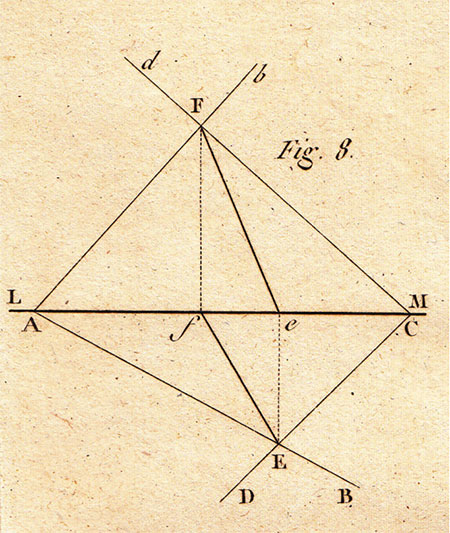
The two lines that determine the plane in full are called the traces of the plane: the first plane is then labelled through its two traces,  and
and  – this is the plane
  . The second plane is given as
  , with the traces it leaves as it passes through the projection planes being the lines
  and
and  . The two pairs of lines intersect – meets in
  , and meets
  in
in  . These points of intersection are in turn projected onto the intersection of the two projection planes, at . So is projected onto
  , and is projected onto
  . The lines
  and
and  are then two projections of the intersecting line between the planes and .
Naturally, Monge extended this idea in his course on descriptive geometry, and showed how by this generating principle all objects can be described in 3-dimensional geometry, and perceived and communicated through his 2-dimensional representation system. In the introduction to his course, he was aware that one has to learn how to both visualise and communicate using the technique of descriptive geometry, and suggested that it is therefore like a language which can be used for the design, communication and execution of all engineering and architectural projects throughout the territory in which this system was taught.
If we imagine mathematics to be like the infinite library of Borges [8], where one can find ‘indefinite and perhaps infinite number of hexagonal galleries  [and] from any of the hexagons one can see, interminably, the upper and lower floors,’ and in which one can search indefinitely for the perfect mathematics book, then Monge’s Géométrie Descriptive would certainly, for me, be on the list of the books that tend towards the asymptote of perfection. It is here that a student of geometry can for the first time meet the ‘golden’ slope, a tangent which opens the door to both imagining and describing space, and manipulating objects within it. Imagining how this first tangential surface was envisaged by a boy from Côte d’Or as if to cloak the imperfections of life with his beautifully smooth tangential surfaces is for me an ever enjoyable experience.
Snezana Lawrence FIMA
References
- Lawrence, S. (2011) Developable surfaces: their history and application, Nexus Netw. J., vol. 13, no. 3, pp. 701–711.
- Lawrence, S. (2002) Geometry of architecture and Freemasonry in 19th century England, PhD thesis, Open University UK.
- Monge, G. (1795) Géométrie Descriptive, Hachette, Paris.
- Monge, G. (1785) Mémoire sur les développées, les rayons de courbure, et les différents genres d’inflexions des courbes à double courbure, Mémoires de divers sçavans, vol. 10, pp. 511–550 (written 1771).
- Struik, D.J. (1993) Outline of a history of differential geometry I, Isis, vol. 19, no. 1, pp. 92–120.
- Struik, D.J. (1933) Outline of a history of differential geometry II, Isis, vol. 20, no. 1, pp. 161–191.
- Barbin, E., Menghini, M. and Vokert, K. (eds) (2018) Descriptive Geometry — The Spread of a Polytechnic Art, to be published by Springer.
- Borges, J.L. (1964) The Library of Babel, in Labyrinths, New Directions Publishing, New York, pp. 57–64.
Reproduced from Mathematics Today, June 2018
Download the article, Historical Notes: The Golden Slope of French Geometry – A Celebration of Monge’s Life (pdf)