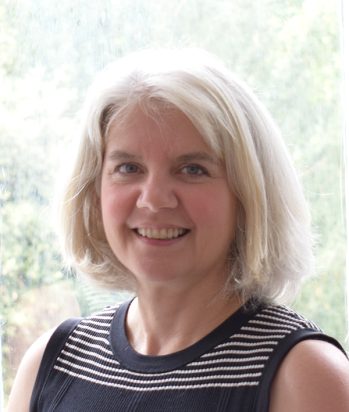
We welcome Heather Tewkesbury as the IMA President for 2026 and 2027. Heather is Chief of Strategic Relationships at the Smith Institute and was CEO from 2017 to 2023. She is actively involved in our community and has previously held various roles within the IMA, including as Vice President for Professional Affairs and Industry from 2010 to 2013.
Congratulations on being elected as IMA President. What plans do you have for your term?
I’m really excited to make the range of mathematical sciences being deployed in business and government more visible.
I’m looking forward to engaging with lots of different companies and government departments, being able to share some of their contributions and connecting them with the IMA. Many people will be surprised by some of the unexpected places where mathematical sciences are used, so I’m hoping that we can share some of those stories with the really broad audience that the IMA is so good at being able to reach – from the general public to school teachers, students, early career mathematicians, and people in business, government and academia. I’m hoping that we’ll be able to uncover some of the stories behind different sectors of the economy and on some of the biggest societal challenges that we have as well. These stories can really help to inspire current and future generations of mathematical scientists.
One of the important aspects, which is more inward facing, is helping to look at the governance model and the infrastructure for the IMA and updating it. It’s important that we have something that’s sustainable for the IMA into the future.
What do you see as the Institute’s most important role?
It’s a really good question. The IMA has many facets, but I think the most important are to provide a place where mathematicians – wherever they work – feel a sense of identity, and engaging in activities that makes the case for mathematics in government, business, universities and education. It’s really important that we are visible and that we provide role models for future generations.
So as well as giving a place where existing mathematicians can feel they can contribute and learn, it’s also about trying to inspire the next generation. Obviously, Professor Hannah Fry HonFREng FIMA has done an amazing job of that all through her career, so I’m really looking forward to taking over from her and bringing different sorts of things to the IMA.
It’s about visibility and identity.
What encouraged you to become a Chartered Mathematician?
Peer recognition.
At the time, I was the sole mathematician working in the technical development department at Cadbury’s. We had a lot of engineers that met as a group, and when those engineers achieved chartered status, they got a pay rise and a promotion. And so I set about thinking, what can I do?
I wanted to be able to feel that I had some kind of benchmark, so I was on a par with a Chartered Engineer. Even though I had done a PhD in an engineering department, I didn’t have the relevant qualifications to become a Chartered Engineer, but I knew that I could be a Chartered Mathematician.
I felt that if I had Chartered Mathematician status, it would give me that recognition and benchmark for my career going forward.
Do you have any advice for a member thinking about CMath?
Go for it! You don’t need to prepare your application alone. Reach out for support or mentoring, as that can often bring a fresh perspective on how to describe your achievements. It makes the process easier if you can talk to someone about it.
Make it known to your employer that you want to become chartered. In my experience it’s usually welcome and they might be able to help you find a mentor or someone who can support the application. You can also find help through the IMA’s mentoring platform.
How can the IMA enhance the visibility of mathematics and mathematicians in business, industry and government?
Well, I’m glad you asked!
I’m really excited that we’ll be able to launch a new expanded series of Mathematics Matters, focusing on contributions from companies and government departments. These might be things that already exist as stories, case studies, videos, blogs, articles, infographics or podcasts – we’re really open to ideas about how we share the work that mathematicians do and how the mathematical sciences are used in these organisations.
They’re going to be co-branded with the IMA and we’re going to be sharing them on the website, in the newsletter and on social media. So I really want to expand the visibility that we have, and I’m hoping very much that the volunteers from the Early Career Mathematicians (ECM) group will help and support with the effort of gathering all this content and getting it into some good formats.
We’re aiming to have different target audiences for different articles and we’ll be grouping content together in various ways so there should be something for everyone.
And is the aim of the series to include uses of mathematics as well as mathematical research?
Yes, absolutely, and maybe stories of what it’s like to work as a mathematician in various organisations. I’m thinking quite broadly about the definition of mathematical sciences to include data science and all the allied subjects and the terms that mathematicians use to describe what they do.
I’m hoping that there will be some really cool examples of everyday things that a general audience didn’t realise, ‘Oh, there’s some maths behind that, wow, you know, that’s interesting.’ It’s to inform people about the societal and environmental problems that we want to bring mathematics to, but also fun things that might get the attention of school children, teachers and the general public. I’m hoping we’ll get a lot of different sorts of content that will mean we can find something for everyone.
Your work at the Smith Institute involves working with different groups of diverse stakeholders. Could you share a memorable collaboration that had a positive impact?
It’s so difficult to pick one thing. I’ve been at Smith Institute for almost 25 years, and we’ve facilitated so many different types of industry–academic collaborations, and also collaborations between Smith Institute and our customers in business and government. Some of those projects have really amazing outcomes, for example, working with organisations like Ofcom and their counterparts worldwide to auction radio spectrum was recognised with the Queen’s Award for International Trade in 2021.
The work we do there makes sure that the algorithms behind the rules of those auctions are implemented appropriately and the results they get are correct. We’ve supported those processes for something like half a billion people around the world to be connected with mobile communications. It’s really rewarding work, especially when you think about how important it is to be able to talk to our friends and families on mobile phones or broadband, particularly at times like the pandemic.
One of the auction designs in the US was a huge simultaneous auction to release radio spectrum and then auction it off at the same time. This approach revealed the prices that licence holders were willing to accept to release spectrum – to give up, say, a TV channel – while simultaneously identifying what mobile operators and other users were prepared to pay.
It was this incredibly complicated auction design, and it went round by round with a huge number of constraints. We were trying to minimise the number of people, within a defined upper bound of a tiny percentage, that would be adversely affected by this auction process. It was a huge combinatorial optimisation problem.
There are some videos that the US Federal Communications Commission created to explain the different aspects of it.
How can the work that you do at the Smith Institute contribute to sustainability, particularly in respect to the IMA Strategy?
Another example of our work is in helping the National Energy System Operator (NESO) to improve the way they decide to balance the energy grid.
Some of that involves legacy systems; the algorithms they had for balancing the grid didn’t really include the fact that we now have a lot of renewables providing energy into the grid. We needed to incorporate things like energy use as a function of weather forecasts.
We’ve been working with them and again it’s very much a collaborative team. We’re aiming to modernise the way that their dispatch algorithms take account of different variables, and also helping them to work out how much reserve energy they need to buy to cover those peaks in demand. So, if there’s a heat wave, you need to be prepared for people using air conditioning, but also for a lot of solar energy going into the grid.
We’ve found ways to improve how they calculate the amount of reserve energy to buy into the grid, while maintaining the same level of risk. It’s also important to do that in a way that their control room engineers understand. The engineers then have confidence in the decisions that they’re making because they can see the explanations behind those calculations.
In the first trial that we did with NESO on that, we helped them to save a whole nuclear power station’s worth of energy (1GW) in the two-hour trial. When it’s fully integrated, the updated algorithms could be saving a lot of energy, with a conservative estimate of over £20 m a year from more effectively balancing forecasts. This should give us more resilience as a country and bring down the price of energy bills for people.
Let me come on to the sustainability aspects of the IMA Strategy; it talks about environmental sustainability, social inclusivity and digital security, among others. The mathematical sciences is at the heart of all these, as shown by the example I’ve just given. But it’s not only about designing the algorithms, it’s also about the way that we behave. There are other projects that use smart meter data to look at how people can be persuaded to move their energy use to different times of the day, especially at those times when the grid will have a lot of excess energy. So NESO has a highly collaborative team, covering all of that mathematical science, to make sure that the impact can reach its full potential.
And do we need to engage with politics to get that change?
We definitely need the mathematical sciences to be part of tackling those big challenges. Again, it comes back to the visibility of mathematics, and that’s why I’m hoping to share some of these stories about how the mathematical sciences are used in business and government. Raising awareness among the public – and politicians – will help steer the mathematical sciences into evidence for political decisions. The Academy for the Mathematical Sciences and other learned societies are also keen to help us promote this new series of Mathematics Matters.
When working in knowledge exchange, how do you encourage collaboration across different backgrounds and expertise?
I think it all comes down to actively listening and also asking when you don’t understand something.
People have really different experiences and things that they’ve learnt and discovered along their careers, and they also have different ways of communicating so you need to try to create an environment where everyone can contribute.
When you’re running a knowledge exchange activity, you want to encourage new ideas and create new things. Those ideas can come from anyone so it’s essential to find ways that help everyone to contribute – and that means listening as well as talking.
Do you have any advice for women who are new to maths, and how can the IMA further support them?
I work with a lot of women in mathematical roles at the Smith Institute, and based on that experience, I just try to encourage people to have confidence in their ability and their views. I really strongly believe that for women in mathematical roles, it should be business as usual, not an unusual thing at all.
There are so many initiatives and organisations, such as Women in Data and Stemettes, that are doing great work to encourage women into those mathematical or technical roles. And that’s fabulous. Good leadership is needed to create and maintain an inclusive culture in the maths community – otherwise these initiatives will come and go.
The IMA has a role to play in providing visible role models and the leadership and culture that’s welcoming for women in mathematics. It’s not just about making it welcoming for women, because if it’s welcoming for women, it’s better for everybody. Women, men and non-binary people – we all have a role to play. So, I think it’s good that the IMA has an EDI strategy and we need to hold firm on that and lead the culture.
Does this come back to what you were saying at the beginning about helping people find their mathematical identity?
Yes, though I can speak more to roles in business. A lot of mathematicians in business or government don’t have a job title of mathematician. They may be a business analyst, data scientist or management consultant. But people who have a mathematical way of thinking bring that approach to whatever job they do and I want people to embrace their mathematical identity because if we don’t, then who will?
Your PhD was on the maths of chocolate. Can you tell us a bit about the maths you used and how it can persuade people that maths matters in their daily lives?
The whole experience of doing a PhD in the methods of chocolate was just amazing. I was modelling heat transfer in chocolate moulding. When you do that, you’re putting some liquid chocolate into a mould and then you’re cooling it down to solidify it.
I was trying to model that because chocolate has some different kinds of crystalline form, so if you cool it too quickly, you get this horrible chalky white chocolate, which is fine to eat; it’s just a different kind of crystal form. But it doesn’t look very nice and it’s a bit crumbly. I was working with Cadbury at the time and they don’t want to be making chocolate like that, they want to make nice glossy tempered chocolate. My work was using a modelling approach to see if we could make production lines more efficient.
The good thing about chocolate is that everybody knows something about it and most people like it. Next time you eat a piece of chocolate, I encourage you to let it melt in your mouth and you can feel there’s a cooling effect and that’s due to the latent heat that needs to be absorbed to turn it from a solid into a liquid.
Well, the modelling I was doing was the reverse of that, where this latent heat evolved during the solidification process. So, there’s a direct link between the research I was doing and an experience that any person can have, and that’s really powerful.
It doesn’t have to be chocolate, but thinking about the maths behind something that’s in our everyday lives that matters to the person that you’re talking to is the way I try and convey to people that the maths matters in their lives.
Again, I’m hoping that with the revitalised Mathematics Matters project we’ll get some really good examples and I would encourage every IMA member to think about how they can use some of these stories to show people who aren’t mathematicians that there’s something really relatable there that’s important to them.
Can you tell us a bit about your role as a cold water swimming coach?
I try and help people who are curious about this whole cold water craze that really grew a lot in the pandemic but perhaps were a bit anxious or apprehensive about the idea of it. I help people who are keen to have that experience (for advice on how to try cold water swimming safely, see the RNLI webpage on Cold Water Shock).
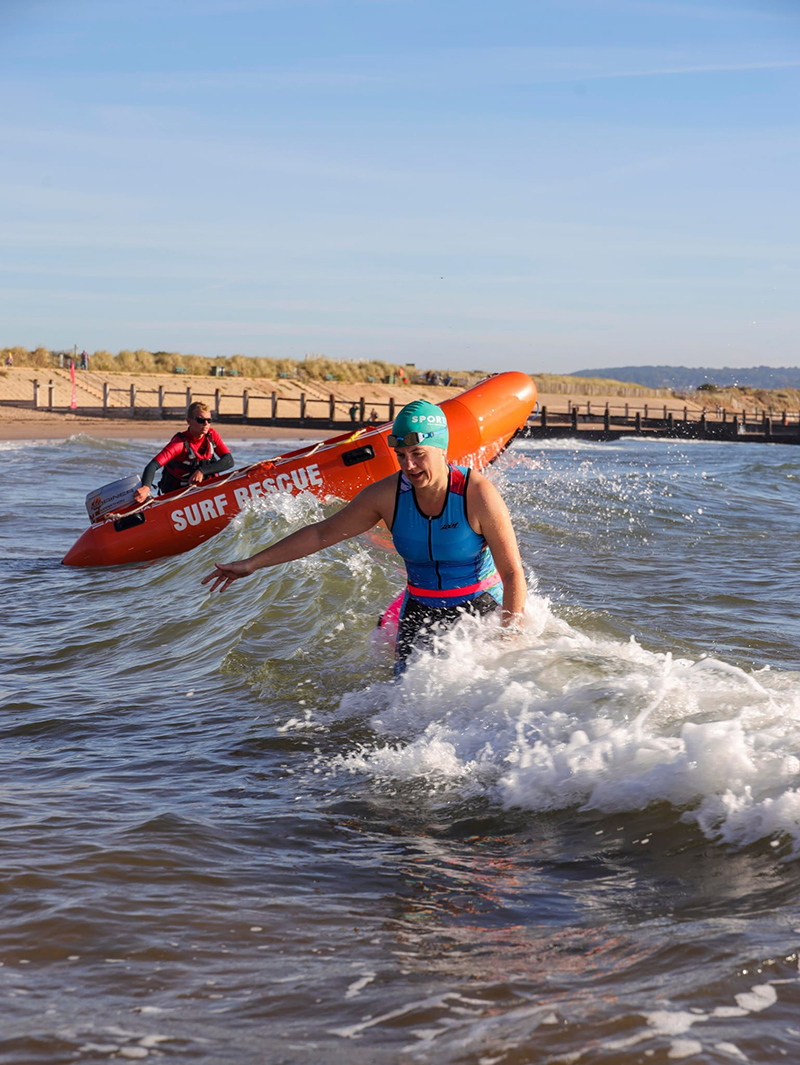
I find that once people have tried it, most of them want to do it again, and then you start to see people building a resilience to swimming in cold water; they can tolerate the temperature shock for a little bit longer. I find that resilience also feeds through into everyday life; it’s like, ‘Well, if I could get into water at five degrees, then I can cope with this situation at work or I can cope with this stressful thing that’s going on at home a bit better.’
I love the feeling of being outdoors, first of all, even when it’s cold, maybe if it’s raining, and getting into the cold water and everything just disappearing from your mind so you can be truly in that moment. And then, of course, there’s a hot cuppa and a piece of cake, usually with friends. The euphoria from that experience when you’re with friends is just such a wonderful way to spend time. What’s not to love, really?
At the Smith Institute there are several of us who meet before team meetings to go for a swim; it’s a great way to start the day.
And finally …
I’m looking forward to my term, visiting the branches, meeting some of the members and seeing the IMA through to the end of 2027. I’m really happy to hear from people; they can reach me at president@ima.org.uk
Rebecca Waters
Editorial Executive
Reproduced from Mathematics Today, February 2026
Download the article, Interview with Dr Heather Tewkesbury CMath FIMA (pdf)