When I was recently asked to do a little interview on Radio Essex about John Pell (1611–1685) and his contribution to mathematics, I was struck by how many erroneous references had seemingly conspired to refer to both his work and life. Even the reason for the interview was slightly misleading – although Pell became the vicar of Fobbing in Essex in 1661, and in 1663 was presented the rectory of Laindon (district of Basildon) by Bishop Sheldon (1598–1677), he seemed not to have done much in his role there. In fact, the last years of his life were spent travelling and staying with friends and family (in relative poverty – he was even imprisoned for a while due to his debts) and he died in his lodgings in Westminster.
But what are the exciting facts about Pell? What was Pell’s contribution to mathematics? The radio presenter sought to make some of the history of mathematics more accessible to a wide audience of prime-time radio listeners. Did Pell invent some mathematical symbols? Here I had to disappoint slightly – he did not invent the equality sign, he only shortened it (it was invented by Robert Recorde in 1557), and he probably did not invent the division sign either (although some attribute it to Pell). This was done, or at least first published, by his student Johann Rahn (1622–1676), a Swiss mathematician.
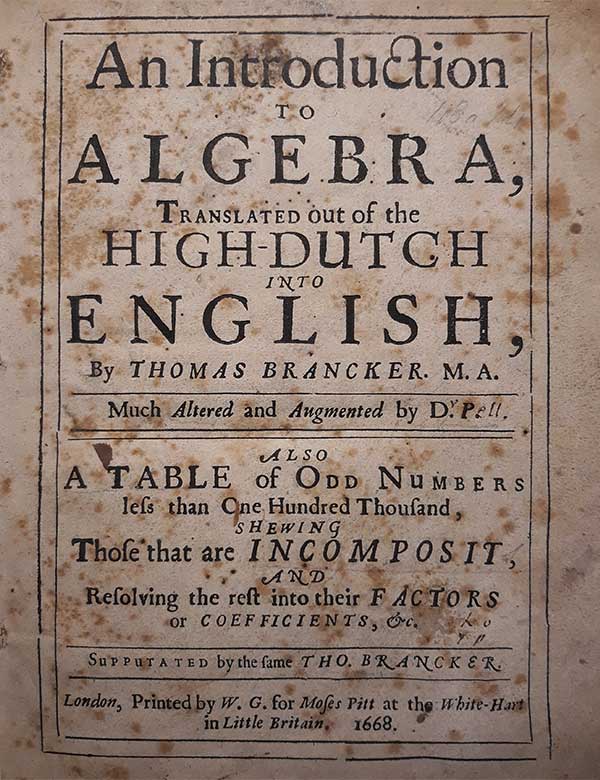
The story becomes even more confusing when we begin unwrapping the work of Pell. What about his equation and his numbers? Was the Pell equation really Pell’s or Brouncker’s or Rahn’s? William Brouncker (1620–1684) was a founder and the first president of the Royal Society, and there are multiple references to Pell using the equation that was subsequently named after him, but which is sometimes attributed to Brouncker. This equation and Pell’s other (not completely clearly demarcated) contributions are also to be found in Thomas Branker’s (1633–1676) translation of a book by Johann Rahn An Introduction to Algebra [1] (published 1668).
Pell’s equation, which was named after Euler attributed it to Pell in his letter to Goldbach, dated 10 August 1750 [2], is from the family of Diophantine equations (only the integer solutions are sought or studied) of the form  , or as Pell would have put it
  . Its use and beauty lie in finding the (accurate) approximations of the square root of
  by rational numbers of the form
  . Some of these appear in Branker’s Introduction to Algebra, mentioned above, as well as showing the three-column method, which Pell used to attack algebraic problems. The method consisted of writing the list of unknown quantities in the left-hand column, the line numbers of the process in the middle, and the known relationships on the right. As a method it is not only a problem-solver’s kit, but also an easy way to present, communicate, and teach mathematics.
The Branker (or Brancker) family name originates from Brouncker – it is possible that there is a direct link between Thomas and William therefore. Both Branker and Pell resided for a while with William Brereton, 3rd Baron Brereton, who was also a mathematician (as well as a politician). Brereton (1631–1680) was Pell’s student at Breda and hosted Pell for years in Brereton Hall in Cheshire. There is an obvious connection between the men – Brouncker, Branker, Brereton and Pell: they were all members of the Royal Society, at the heart of political life of the country at the time, and all apart from Pell of Irish descent.
Pell was, for a while, also an envoy for Oliver Cromwell between 1654 and 1658, and was sent to Zurich on a mission to join the Swiss protestant cantons with the English Protestant League. On this mission, Pell worked with Rahn and acted as editor to his original Teutsche Algebra [3] published in 1659. It is therefore conceivable that Pell’s guidance underpinned the work of his student Rahn, and perhaps Pell discovered his equation – but we cannot of course be sure either way.
Through Pell’s various correspondence with the learned men of his time, his mathematical work and political and mathematical friendships, we can see that his most important contribution to the development of mathematics can be found [4] in how he continued to be a student and a teacher of mathematics interchangeably: he sought to rationalise, modernise, popularise and communicate all that mathematics stands for. The priority for him was to understand and help others do so. The fact that, from the thousands of pages of his manuscripts which can be found in the British Library, his only mathematica
l work was printed through his students Rahn and Branker, also speaks for itself.
His pamphlet on mathematics An Idea of Mathematics [5] deals with the advancement of the study of the discipline — and it is here that he states what is needed for the advancement of mathematics. He begins by stating that ‘As long as men want will, wit, means or leisure to attend those studies, it is no marvail if they make no great progress in them’ [5, p. 1] – and in order to remedy this he suggests three simple questions that should be asked of every student of mathematics, given here slightly paraphrased:
- What ‘fruit or profit’ arises from the study of Mathematics?
- What ‘helps’ are there and how could one get them for attaining better knowledge of the discipline?
- And finally in which order should one use such ‘helps’?
These remain the questions that to this day interest mathematicians and mathematics teachers alike. Pell’s idea about ‘helps’ was to accumulate, systematise, and organise mathematical study by giving a prospective student access to every mathematical text there is, and to list each mathematician that has ever contributed to the discipline. A task of encyclopaedic proportions indeed, but one he had begun to do with his students Rahn and Branker – and it is therefore no mean contribution to say that through them and with them, he had shown how the study of algebra is to be done.
The sequence produced by Pell’s equation generates Pell’s numbers and, by means of a recurrence relation similar to the Fibonacci sequence, is directly related to the silver ratio  . And so not having an entirely clear story as to his opus (a work that still awaits to be done) we can still say with certainty that his contribution to mathematics is to be found in the cloud of his correspondence, and in his support for his younger colleagues and students. It is to this silver lining that we turn, in which the equation, and the numbers it produces are firmly embedded in the study of algebra and number theory.
Snezana Lawrence FIMA
References
- Rahn, J.H., Brancker, T. and Pell, J. (1668) An Introduction to Algebra, Translated
 by Thomas Brancker, Much altered by Dr Pell , W.G. for Moses Pitt, London.
 - Euler, R. (1843) Lettre IX. Euler à Goldbach, dated 10 August 1750, in Correspondance Mathématique et Physique de Quelques Célèbres Géomètres du XVIIIeme Siècle
 (Mathematical and Physical Correspondence of Some Famous Geometers of the 18th Century), vol. 1, ed. Fuss, P.H., St Petersburg, Russia, p. 37.
 - Rahn, J.H (1659) Teutsche Algebra, J.J. Bodmer, Zürich.
- Noel, M. and Stedall, J. (2004) John Pell and His Correspondence with Sir Charles Cavendish, Oxford University Press, Oxford.
- Pell, J. (1638) An Idea of Mathematicks, William Du-Gard, London.
Reproduced from Mathematics Today, October 2018
Download the article, Historical Notes: Pell’s Contribution to Mathematics (pdf)