New Scientist Live is an award-winning, mind-blowing festival of ideas and discoveries for everyone curious about science and why it matters.
For four days in September, more than 140 speakers and 100 exhibitors came together into the ExCeL Arena, to create an unrivalled atmosphere and energy, packed with thought-provoking talks, ground-breaking discoveries, and interactive experiences, workshops and performances. On the first day, those attending could look over one shoulder and see the astronaut Tim Peake and then look over their other shoulder and see the brilliant Dr Hannah Fry.
For the second year running, the IMA have shared a stand with The OR Society, Isaac Newton Institute, ICMS, Institute for Mathematical Innovation, Turing Gateway to Mathematics and UK Mathematics Trust. The stand had a great theme: Maths in the Real World. Furthermore, this year I was invited to be a speaker on the New Scientist Live Technology stage!
When I informed the IMA Executive Board in February, that I would be speaking, the President asked me what I would present? My answer was ‘I haven’t got a clue’. No pressure then.
My homework was set. I researched the other mathematical sciences speakers and a recurring theme was ‘How can humans adapt and co-exist with the rising presence of Artificial Intelligence (AI)’? Now the late, great Stephen Hawking once said [1]:
The development of full artificial intelligence could spell the end of the human race.
He also went on to state that he advocated research into precautionary measures to ensure future super-intelligent machines remain under human control. So one question occurred to me: What is the risk of AI takeover and can we calculate this probability? Furthermore, could we come up with a strategy to minimise the probability of an AI takeover? I decided to focus on one aspect of this. In my scenario, a business enters the marketplace and then uses its superior AI to put all of its competitors out of business. If a few companies with superior AI ruled the world economy, would it make decisions conducive to social cohesion?
Come April, New Scientist wanted a title, an abstract and a YouTube video advertising my talk – see https://www.youtube.com/watch?v=d5_N67la9tw. I submitted the title Maths versus AI. In the video I posed the question: Can mathematics minimise the probability of AI takeover?
In order to help me with this research, I jointly supervised an MSc Mathematical Modelling student, Spiros Bogdos, with Professor Roger Smith from Loughborough University. In this project we had to adapt my PhD (Extension of the Gambler’s Ruin Problem Played over Networks) simulation algorithm to model an AI takeover.
The race was on! Could a simulation algorithm find a strategy to minimise the probability of an AI takeover before my talk in September? With three weeks to go the answer was ‘no’. However, at the 11th hour a potential breakthrough was found. I instructed Spiros to test the strategy thoroughly.
The day of the presentation, 20 September, had arrived. That morning, I was still putting the finishing touches to my presentation because I wanted to get the logical argument to flow. New Scientist had changed my title to The Maths that can Stop an [AI] Apocalypse! Now, this was a bold statement about the power of mathematics, even by my standards! Could the potential strategy cheekily named as the ‘Obama-Hood’ fit the bill? Briefly, the Obama-Hood is a hybrid algorithm of Robin Hood’s strategy and Obamacare: Take from the AI and give to the Humans!
Now, a few months earlier, I had entered the Big Internet Math-Off competition, which I was fortunate to win. Moreover, this competition was a big learning curve for me and I developed some new tricks. Most notably, turning part of my mathematical presentation into a musical production.
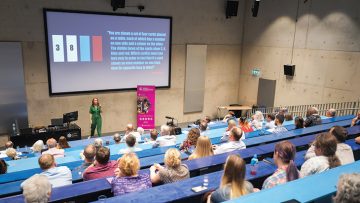
On the day, the two highlights were the simulation animations of an AI Apocalypse and the Obama- Hood in action! I decided to turn this part of the presentation into a hip-hop musical production. This, as well as the mathematical content, was well received by the 400-strong audience. My conclusion was a rallying call to research mathematicians and STEM partners to not only ‘further the capabilities of AI but also develop your own Obama-Hoods whatever form they take!’
Straight after my talk the session chairman went onto the stage and declared that ‘AI was toast!’ and moments later New Scientist tweeted about my talk calling it ‘amazing’.
All in all, I have enjoyed this journey. Our research will not stop here. If AI says: ‘I’ll be back!’, then I will say: ‘Can mathematics stop an AI apocalypse? – Yes we can!’
Nira Chamberlain CMath CSci FIMA
IMA VP Professional Affairs and Industry
References
- Cellan-Jones, R. (2014) Stephen Hawking warns artificial intelligence could end mankind, BBC News, https://www.bbc.co.uk/ news/technology-30290540 (accessed 17 October 2018).
Reproduced from Mathematics Today, December 2018
Download the article, Diary of a New Scientist Live Speaker (pdf)