Inspired by the homage to farm machinery made famous by the West Country band the Wurzels, Alan Champneys considers the role of mathematics in the new era of so-called precision agriculture.
Following a Knowledge Transfer Net-work (KTN) workshop on the topic, he reflects on the outcomes of several short mathematics study groups with industry in which the problems require a modern quantitative approach to food production. We touch upon cow herd synchronisation and monitoring, optimal harvest timing, and the science of hydroponics. It seems our understanding of what constitutes high-tech industrial mathematics needs re-imagining.
I’ve got a brand new combine harvester
There is a genre of popular music affectionately known as Scrumpy and Weston. This is a kind of pop-folk fusion, sung in the West of England vernacular, typically paro-dying mainstream popular songs (ooh aah!). The lyrics, often full of double entendres, tend to refer to West Country farming traditions, especially the production (and drinking) of the local strong apple cider known as scrumpy. The genre name comes from the title of an early 1967 EP from the original and most famous Scrumpy and Weston band, known originally as Adge Cutler and the Wurzels, later just the Wurzels.
The Wurzels’ biggest hit, ‘The Combine Harvester’ reached number one in the UK charts in 1976, here is an excerpt:
I drove my tractor through your haystack last night
(ooh aah ooh aah)
I threw me pitchfork at your dog to keep quiet
(ooh aah ooh aah)
Now something’s telling me
That you’re avoiding me
Come on now darling you’ve got something I need
[Chorus] Cuz I got a brand new combine harvester
An’ I’ll give you the key
Come on now let’s get together
In perfect harmony
I got twenty acres
An’ you got forty-three
Now I got a brand new combine harvester
An’ I’ll give you the key
In fact, this was not actually penned by them. With lyrics by Brendan 0′ Shaughnessy, the song had already been taken by Brendan Grace to the top of the Irish charts the year before. The song is itself a parody of the 1971 hit ‘Brand New Key’ by Melanie Safka in which the protagonist (a woman) has a brand new pair of roller skates rather than a combine harvester and is entreating a man to use his brand new key.
I am reminded of a brand new combine harvester I encountered a few years ago when I attended a one-day meeting on mathematics in agriculture at Harper Adams University. To my shame, until invited to the meeting, I had never heard of that university, let alone knew where it is located. Among aficionados though it is recognised as one of the UK’s premier agricultural colleges. It is located just outside the small Shropshire town of Newport – which is hardly the most no-table among the 10 or so towns of that name in the UK, nor is it a port, being nowhere near the sea. Harper Adams College was founded in 1901, named after Thomas Harper Adams, a wealthy Shropshire gentleman farmer who had died in 1892 and bequeathed his estate. The college began with just six students. Now with more than 5000 students, the heart of the campus is still built around the original working farm.
What in particular reminded me of the Wurzels’ song occurred during a tour of the facilities, when we were shown round the engineering department, led by Professor Simon Blackmore. They showed us various demos of robotic farming aids in the so-called National Centre for Precision Farming. One particular demo gave a glimpse of the future, with a new kind of weeding device. Mounted on a small tractor or even a quadcopter UAV (unmanned aerial vehicle), the technology they were developing had a camera with image recognition software that could recognise the difference between crop shoots and weeds. Then the software could locate the meristem (main growing point) of the weed and fire a laser to kill it. Seeks, shoots and weeds.
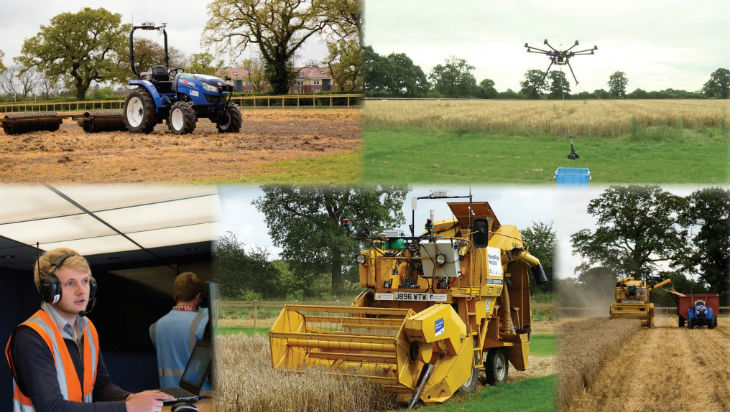
We also heard about a trial, then in the planning stage, in which a field of barley would be completely managed remotely, from seed to harvest, using only robots and drones. The award-winning project, now in its second year, is a collaboration between a team from the university and the company Precision Decisions. It is known as the Hands Free Hectare (www.handsfreehectare.com) – see Figure 1.
The original project began by fitting a small tractor with a self-driving system using GPS positioning to sow barley. Small autonomous rovers then take soil samples to monitor conditions constantly so that agronomists can remotely decide on necessary fertiliser and other treatments. The robot tractor then applies sprays, while drones take images of the crops to monitor growth. When it came to harvest time, the self-driving technology was fitted to a combine harvester, so that once again this could be carried out remotely. A brand new combine harvester indeed, one that the BBC dubbed robocrop [1].
The one-day meeting was organised by the Knowledge Transfer Network (ktn-uk.co.uk/interests/industrial_maths) on the topic of Mathematics for Precision Agriculture. Although the agrifood sector might traditionally be viewed as a low-tech industry, the modern reality is very different. The tour and other presentations gave a glimpse of how cutting-edge technology is now being employed to address challenges such as feeding a rising world population, reducing environmental impacts, and improving food quality and safety. As with other industries, all these technologies generate massive data sets, and have the potential to make food production systems more complex, leading to the need to model and optimise multiple processes.
The meeting was attended by about 50 delegates, both agricultural specialists in industry and research organisations as well as mathematicians from the tradition of industrial applied mathematics. There was a plenary presentation from Graeme Wake of Massey University in New Zealand, a country for which agriculture has always been a vital part of the economy. He was quoted as saying [2]:
Modern-day applied mathematics can be used with high impact on farm systems and precision agriculture. It provides excellent decision-support tools and brings a degree of rigour to the industry, which has often been lacking in the past. The agricultural industry has been relatively late in choosing to bring mathematics to bear on the processes involved.
He went on to describe how he and his collaborators used research on models rooted in systems biology, in conjunction with purpose-built experimental data and a deep understanding of animal-plant physiology.
A notable presentation was from G’s Group, one of Europe’s largest fresh produce companies, which manages the whole process from seed to shop shelf, through growing, production and marketing. They described a key problem they face: to maximise revenue from growing iceberg lettuce. This is one of the most popular salad vegetables in UK supermarkets, but its price can vary considerably depending on both supply and demand. The whole growing process takes about 10 weeks, and the optimisation problem is to allow the crop to reach maturity precisely when the price is high. Although the growth process can be sped up if necessary, or slowed down, it is fundamentally dependent on the weather. They have a model for growth, a so-called heat map, that enables rudimentary control of the process. But, how can this be combined with machine learning or pattern analysis to predict when the British public will want to buy more lettuce than is easily on supply? That demand is also dependent on weather and the fickle nature of shoppers’ preferences, as well as the behaviour of competitor growers.
After the meeting, this problem was taken forward by the Smith Institute, a mathematical consultancy who have a long track record of supporting knowledge exchange. Their solution, written up as a case study [3], provided a practical tool that was built on a combination of statistical modelling and linear programming.
Another problem I recall presented was from a company that was seeking to market dairy herd monitoring systems, based on devices attached to the cow that can track their movements. The data was to be fed to a remote system held by the company, and combined with data from other farms. This data could be used to characterise what constitutes a healthy herd, but installation on a new farm would typically require careful calibration. The question posed was whether machine learning or other statistical techniques could be used in real time to update what represents healthy or unhealthy behaviour.
This reminded me of a paper that Mason Porter and collaborators published in Physica D in 2011 on a dynamical systems explanation of cow synchronisation [4]. While really not attempting to explain real-world phenomena, they analysed a simple model of a herd of animals, each of which can be in one of several states – eating, lying down or standing. They use the theory of non-smooth dynamical systems to analyse the transitions and the propensity for a lone cow to act as an autonomous oscillator that cycles between these three states. The main thrust is then to use the concept of synchronisation of weakly coupled oscillators (see [5]) to see if there is herd behaviour in which a network of such oscillators will behave en masse. The paper contains several mathematical puns including networks of spherical cows and the lack of grazing bifurcations observed in the dynamics.
More seriously, mathematical modelling has been used with data from the cow monitoring company Omnisense, through the work of Professor Edward Codling FIMA and team in the mathematics department at the University of Essex. I encountered a demo of their work at the Festival of Mathematics in Manchester as part of the IMA 50th anniversary celebrations. They were presenting to schoolkids the results of their study into cow welfare.
Along with cow welfare experts at Writtle University College, Essex and other collaborators, the first paper from that group appeared last year in the Journal of Dairy Science [6]. They developed a decision tree algorithm to include position and accelerometer data from the sensor. They classify cows in a barn as being in one of three states: feeding, not feeding or out of the pen for milking.
A comparative analysis of the classified cow behaviours was undertaken using a t-test to determine the differences in the number or duration of different behavioural states between two test groups: lame and non-lame cows. Analysis showed that lame cows feed significantly less than healthy ones, with this being especially acute in the afternoons. The results suggest such behavioural differences could be used in the development of predictive algorithms for the prompt detection of lameness in a commercial cow monitoring system.
The main conclusion of the exploratory Harper Adams meeting was that there is a rich possibility for applied mathematicians and statisticians to get involved with agri-tech modelling. As a direct consequence, the KTN have organised two subsequent study groups dedicated to mathematics in agriculture. Since their instigation at the University of Oxford in 1968, the concept of such mathematical study groups with industry has been exported around the world, evidence of which is collected at the Mathematics In Industry website: www.maths-in-industry.org. In the time-honoured format, teams of mathematicians, from PhD students all the way down to professors, work on open problems posed by industry. The only fixed points in these week-long events is that open problems are presented on the Monday and the ‘solutions’ are presented on the Friday. The next UK-wide study group, the 145th European Study Group with Industry, will take place in the University of Cambridge from 8 to 12 April 2019.
The new brand of KTN-sponsored study groups subverts the genre: they last just half a week and are dedicated to one particular industry sector. The first Agri-Food Mathematical Science Study Group with Industry was co-organised with the Institute of Mathematical Innovation at the University of Bath in January 2017. One problem presented there was from Mondelez International, famous for brands such as Cadbury and Toblerone, who asked delegates to determine a methodology to determine bounds on likely cocoa yields in a particular region, given predictions on climate variability.
Another problem was presented by Phytoponics Ltd, a small Welsh start-up developing a new hydroponic system in which plants are grown in nutrient-rich water. Their novel technology is called the Hydrosac™, which is a flexible polythene growbag that has inflated sides to keep it rigid. This product has the potential for greater scale-up and optimisation compared with current hydroponic systems, and could provide sustainable food in disaster relief situations. Our goal then was to understand the mechanics of what keeps the bag rigid and enables the plant to be sufficiently anchored so that its roots, but not the plant itself, are suspended in the fluid. Adam Dixon, CEO of Phytoponics, was quoted afterwards as saying [7]:
The mathematicians immediately gained a full appreciation of our problem; it was a real pleasure seeing their minds at work. After the Agri-Food Study Group we really feel we have a thorough understanding of the equations describing our product and are incorporating them into our design.
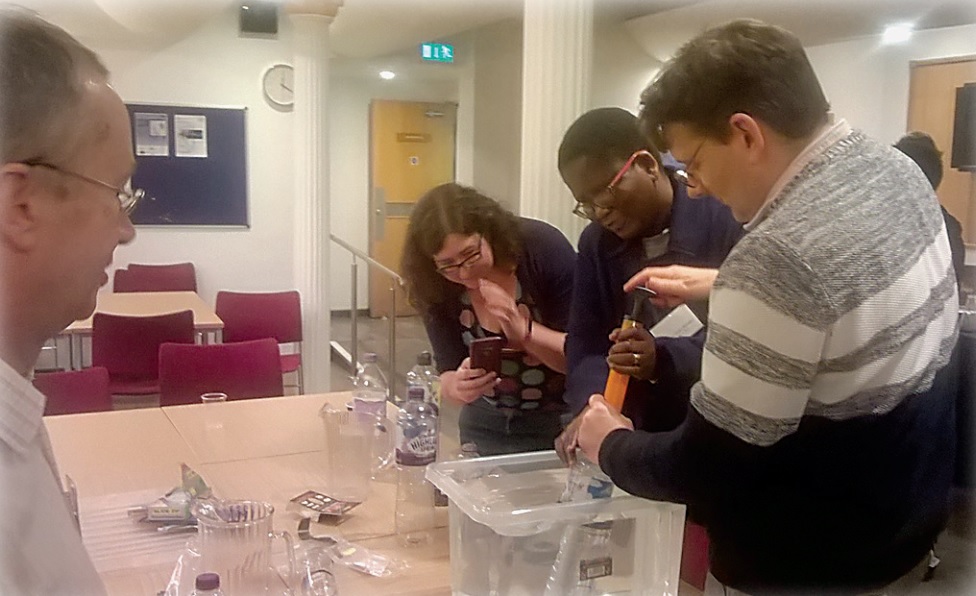
A second agri-food study group was held in February 2018, co-organised with the ICMS in Edinburgh. Here, PepsiCo, owners of the Tropicana fruit juice brand, delivered a presentation asking delegates to understand the life cycle of orange trees in California. Phytoponics presented the more challenging problem of how to optimally aerate the Hydrosac. Our brief was to understand how bubbles form and rise from air holes in the bottom of the Hydrosac to oxygenate the surrounding fluid. Would big bubbles be better than small bubbles? In order to uncover the length and timescales involved, we found we needed to conduct some simple table top experiments, as shown in Figure 2.
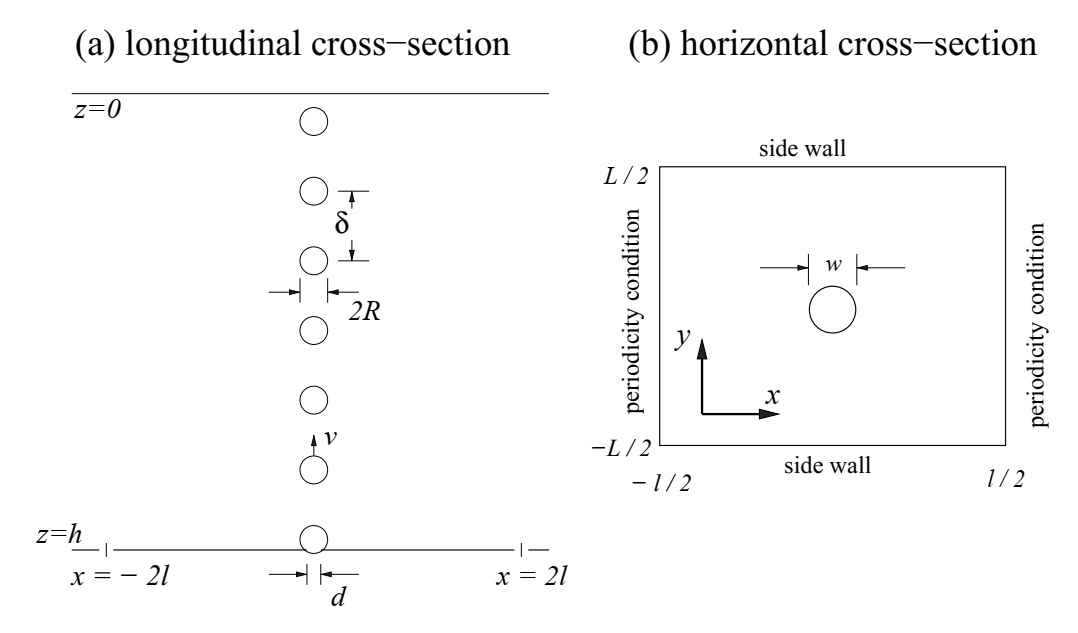
A visit to the local pound shop provided us with a plastic water tank and a set of needles of different sizes with which to puncture holes in submerged empty plastic water bottles. The observation of a plume of bubbles that rose approximately uniformly led us to a mathematical model of diffusion of oxygen in a horizontal layer, as in Figure 3.
Seeing mathematicians working with an exciting start-up like Phytoponics has been a pleasure. They brought a yet more challenging problem still to the UK Study Group with Industry in Bath in Summer 2018, where a group of talented PhD students developed innovative flow approximations to study the spread of nutrients around each Hydrosac. The company goes from strength to strength. In 2017, Adam Dixon was awarded the UN Young Champion of the Earth prize. In 2018, they successfully completed their first large-scale trial in Aberystwyth and they attracted over half a million pounds of investment. Companies like this using high-tech solutions backed up by mathematical modelling might yet provide the future of agriculture.
Back to the Wurzels. On the strength of ‘Combine Harvester’ and the follow-up ‘I am a Cider Drinker’ later the same year, the band grew from being a Bristol and Somerset novelty act into a national phenomenon. Their most famous songs have become party classics, and a lineup that contains original members is still touring today. In fact, as this article was about to go to press, the Wurzels played the ‘Swift Half’ bar after Bath Rugby hosted the Leicester Tigers in their post-Christmas fixture (my daughter was working behind the bar).
Sadly though, original frontman Adge Cutler never lived to see any of this fame. He died in May 1974 after falling asleep at the wheel of his sports car, returning from a Wurzels gig in Hereford. He is buried in the Somerset town of Nailsea. In 2016, a bronze statue of him was erected outside the Royal Oak pub in the town, where the Wurzels had recorded their first song 50 years previously.
But what of mathematical modelling in agriculture? Could it be said that it is something of a novelty act too? It seems to me that, outside of countries like New Zealand, until recently, such studies have been considered somewhat fringe activities compared with ‘mainstream’ applications of mathematics to mechanics, physics, finance or medicine. But, one of the many challenges facing us as a species is sustainable food production. As we are starting to understand more and more about the processes involved and with the amount of quantitative science and technological innovation being applied to food production, perhaps it is time for more mathematicians to engage in agri-tech problems. Precision agriculture indeed!
Alan Champneys CMath FIMA
University of Bristol
References
- Gregory-Kumar, D. (2017) Robocrop: growing barley with robots and drones, BBC News, www.bbc.co.uk/news/uk-england-39785097 (accessed 7 Dec 2018).
- KTN (2018) Agri-Food Study Group with Industry, https://ktnuk.co.uk/events/agri-food-study-group-with-industry (accessed 2 Jan 2019).
- Smith Institute for Industrial Mathematics and Systems Engineering (2018) Optimising lettuce growth case study, www.smithinst.co.uk/case-studies/optimising-lettuce-growth/ (accessed 7 Dec
2018). - Sun, J., Bollt, E.M., Porter, M.A. and Dawkins, M.S. (2011) A mathematical model for the dynamics and synchronization of cows, Phys. D, vol. 240, pp. 1497–1509.
- Champneys, A. (2018) Westward Ho! Follow the Leader, Math. Today, vol. 54, no. 3, pp. 98–101.
- Barker, Z.E., Vazquez Diosdado, J.A., Codling, E.A. at al. (2018) Use of novel sensors combining local positioning and acceleration to measure feeding behavior differences associated with lameness in dairy cattle, J. Dairy Sci., vol. 101, pp. 6310–6321.
- University of Bath (2017) Pigs and chocolate: Using maths to solve problems in farming, http://www.bath.ac.uk/imi/news/AgriFood.html (accessed 2 Jan 2019).
Reproduced from Mathematics Today, February 2019
Download the article, Westward Ho! Musing on Mathematics and Mechanics (pdf)