Eight points  ,
,  ,
,  ,
,  ,
,  ,
,  ,
,  and
and  are marked sequentially at equal
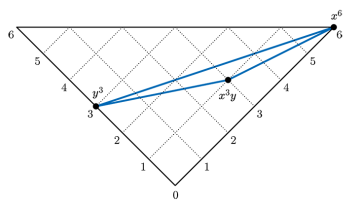
  intervals around a circle. We wish to find out how many distinct triangles can be drawn that have their corners at three of those points. Reflected or rotated triangles that have the same shape are to be regarded as the same, and therefore not distinct. The answer is that five distinct such triangles can be drawn. The reader may find it informative to draw the associated five diagrams. The proof is as follows. This problem was posed to me in a coffee shop by my wife Bridgid, at a time when she was teaching mathematics in a primary school.
We can distinguish the following two different cases.
Case 1 has at least one side joining adjacent points, say  .
.
Then either
- the second side omits no points, such as
 (= in length), so that the complete typical triangle is
  , which is isosceles; or
 - the second side omits one point, say , so that it is
 and the complete typical triangle is
  , which is not isosceles; or
 - the second side omits two points, say and , so that it is
 and the complete typical triangle is
  , with a right angle at because
  is a diameter, and is also not isosceles.
It can be seen that, apart from reflections,  would repeat , that
  would repeat , and that
  would repeat , so that nothing new is provided by those three choices.
Case 2 has no side adjoining adjacent points, and one side omitting one point, say  . Then either
- the second side, say
 , omits one point, in which case the third side is a diameter
  , and the consequent isosceles triangle
  has a right angle at ; or
 - the second side, say
 , omits two points, in which case the third side is
  in length, and the triangle is also isosceles.
Some thought will show that there are no other solutions that are fundamentally different from these five.
The question just asked and answered can be extended as follows. Now let  points be equally distributed around a circle, at equal intervals of
  . How many (say
  ) distinct polygons having
  (
( ) sides can be drawn that have vertices at (
 ) of those points? Again, rotations and reflections are not counted as distinct cases. (Plainly when
  the answer is
  , with a regular polygon, which is why we leave aside that case in what follows, and consider problems only for the cases when
  .)
.)
For  , the only solution is an isosceles right-angled triangle. Direct investigation of the individual cases
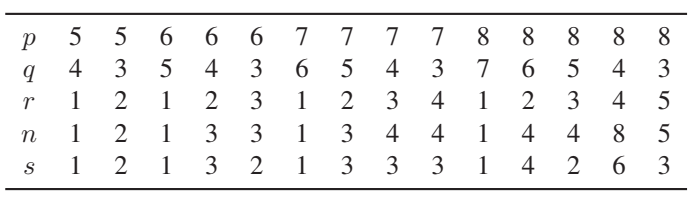
  provides the following results, which the reader will be able to illustrate in diagrams. If we define
  , we find that only in some cases do we have
  , as emerged in the solution described above for the case
  . In Figure 1, we show the diagram for the case
  ,
,  , for which there are eight distinct polygons.
One method of approach to drawing the diagrams is to join one pair of adjacent points, and exhaust the consequent possibilities for the other joins; then join a pair omitting one intermediate point, and exhaust those possibilities without repeating previous cases, and so on. Table 1 lists the consequent values of in each case, and it also notes the associated number  of polygons that are symmetric about at least one diameter. No general formula relating or to and , which might have been hoped for, seems to suggest itself. There is a total of 44 distinct diagrams for the cases
  ,
,  ,
,  ,
,  , which the reader may find informative to construct.
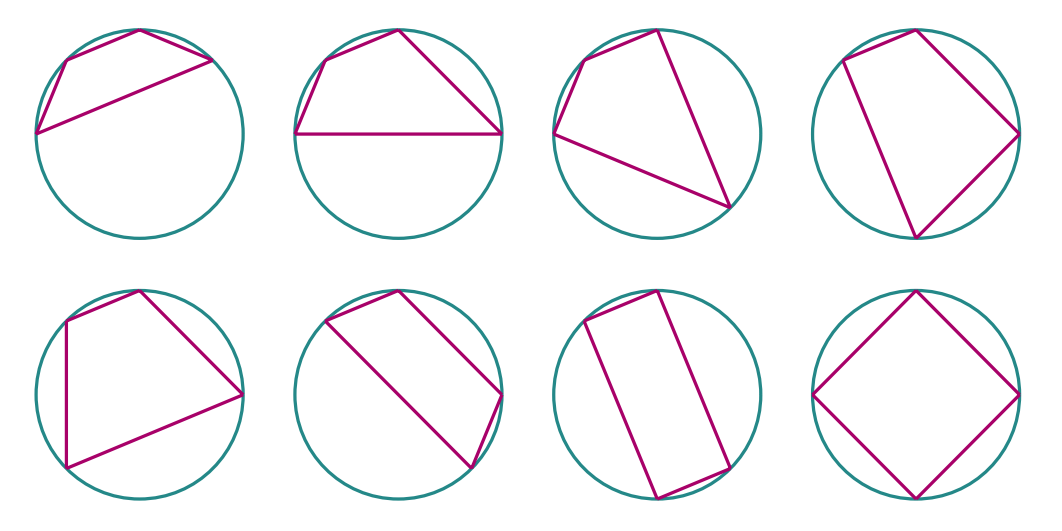 points, sides
Michael Sewell CMath FIMA
University of Reading
Reproduced from Mathematics Today, April 2019
Download the article, A Coffee Break Problem (pdf)