Westward Ho! Musing on Mathematics and Mechanics
In the latest Westward Ho!, Alan Champneys ponders on the construction currently taking place at Hinkley Point in Somerset and asks whether it is worth it. The environmental credentials of nuclear energy currently divide opinion. Nevertheless, Hinkley Point C will be one of the first generation III pressurised water reactors; thought to be safer than ever. An often ignored aspect of nuclear power stations is that, just like in coal and gas plants, water is heated to pass steam through spinning turbines. In fact, Hinkley Point A failed catastrophically, not due to nuclear meltdown, but through turbine failure. Steam turbines are just one example of mechanical systems that rely on the smooth operation of a spinning rotor. Touching on recent mathematical developments in rotor dynamics, it is clear there is still plenty that remains to be understood about these fascinating dynamical systems.
Hinkley Point – A new spin on nuclear energy
Over a 30-hour period in December 2018, 2000m of concrete was poured to complete the first significant milestone of what is thought to be Western Europe’s largest current construction project. A 230 acre (93 hectare) site on the coast of the Bristol Channel beneath Somerset’s beautiful Quantock Hills was the location chosen for Hinkley Point C; the UK’s first new nuclear power station in 30 years.

The plot of land, more than twice the size of the home to the obsolete Hinkley Point A and the currently operational Hinkley Point B nuclear power stations, was purchased in 2011 from the Fairfield estate. The sale was somewhat controversial at the time. The land was rumoured to be either for a wind farm or for a new nuclear power station, leading to protests from two mutually orthogonal protest groups. As the government’s nuclear strategy began to take shape, the true purpose became clear.
So, does the UK’s decision to return to nuclear power make sense? In shaping an answer I shall try to steer away from controversy and provide some dispassionate thoughts.
All serious scientists agree that climate change is a real phenomenon with many undesirable consequences, and the prevention of further damage requires worldwide decarbonisation of energy production. Paraphrasing Joe Quarini, my colourful and entertaining mechanical engineering colleague at the University of Bristol, at a fundamental level, the solution is simple. Our predicament has come about because for more than 200 years we have been mining our energy from the ground and burning it. In future we must learn instead to harvest our energy renewably from the sun, either directly or through wind, waves, electrical storage, etc.
A simple order-of-magnitude calculation shows that the sun’s energy will be sufficient for thousands of generations to come. Nation states need to invest in these technologies as effectively as possible to progress them to a point of economic competitiveness with fossil-fuel energy.
So, we must invest in renewables: solar farms in sunny spots, wave energy, tidal barrages, hydroelectric schemes, and both onshore and offshore wind farms. Simples. But what about nuclear energy? Is it renewable? Is it sustainable? Is it safe? And, crucially, is it necessary?
A decade ago, the dearly missed David MacKay, younger brother to the former IMA president Robert, published his influential book [1], which opens with the simple statement:
I’m concerned about cutting UK emissions…
His weapons of choice in achieving this aim are numbers. Using the UK as a case study, in simple units of kilowatt hours per person per day, he sets out the nature of the challenge we all face if we are going to meet emissions targets while keeping our energy supply secure. The above quote continues:
emissions of twaddle – twaddle about sustainable energy. Everyone says getting off fossil fuels is important, and we’re all encouraged to ‘make a difference’, but many of the things that allegedly make a difference don’t add up.
If you have not done so already, I recommend you read David MacKay’s book. In looking at what is necessary in the next 20–50 years he argues that investment in all low-carbon technologies is necessary, and [1, p.169]:
Please don’t get me wrong: I’m not trying to be pro-nuclear. I’m just pro-arithmetic.
Part of the argument goes that most renewable energy sources are intermittent but not unpredictable (it is usually possible 24 hours ahead to accurately predict the availability of wind and solar energy). We therefore need cheap, low-carbon energy that is available all the time as a backup. Nuclear power has a much lower carbon footprint than traditional fossil-fuel power stations, even when taking so-called embedded carbon into account. Most of the running costs of nuclear power stations are cheap, and future generations being designed are able to use recycled nuclear waste as a fuel source, thus potentially making it renewable.
OK, so nuclear energy may be a low-carbon source of power, but is it clean energy? Not really. While next generation nuclear reactors may be clean, efficient and lead to very little waste, the legacy of all the nuclear waste from past and present reactors is a problem that still does not have a workable solution. For example, the costs of decommissioning the Sellafield site in Cumbria are becoming enormous, and this is before any long-term solution to storing the waste can be found.
One problem is that we simply don’t understand the effects of sustained small doses of radiation poisoning. So, to maintain public confidence, it can be argued that all containment strategies err on the side of safety. Nevertheless, nuclear waste is a potentially lethal hazard that we are leaving as a legacy to many future generations. This is hardly sustainable, nor fair. Such thinking, along with the risk of a hideous accident causing unspeakable damage, were key drivers behind the ‘Nuclear Power, No Thanks!’ car stickers that were common from the 1970s.
Is nuclear energy safe? That is, what is the risk of an accident or terrorist incident causing a massive nuclear disaster? Here, I believe we can be more optimistic. While doubtless great risks were taken with the early designs of nuclear reactors, modern power stations have numerous overlapping safety features.
Hinkley Point C, for example, will be a pressurised water reactor (PWR). These are thought to be the safest kind of nuclear reactor and currently account for more than two-thirds of worldwide nuclear electricity generation [2]. As well the type of reactor, nuclear power station design is classified into generations, which broadly measure the maturity of the technology in terms of efficiency and safety. Hinkley Point C will be one of the first generation III reactors [3]. Safety features include four independent emergency cooling systems, each providing the required cooling for 1 to 3 years after a reactor’s initial shutdown. Not only is there complete leak-tight containment of the reactor, but an additional containment building designed to withstand an impact by an aeroplane or any explosion from the reactor itself.
The Fukushima Daiichi Nuclear Power Plant contained a suite of generation II boiling water reactors (BWRs), designed in the 1960s and 1970s. In March 2011, following the largest tsunami wave recorded in modern history, flood damage to the generators that powered its emergency cooling system caused the reactors to go into meltdown. Following the disaster, the environmental commentator George Monbiot wrote [4]:
You will not be surprised to hear that the events in Japan have changed my view of nuclear power. You will be surprised to hear how they have changed it. As a result of the disaster at Fukushima, I am no longer nuclear-neutral. I now support the technology.
A crappy old plant with inadequate safety features was hit by a monster earthquake and a vast tsunami. … Yet, as far as we know, no one has yet received a lethal dose of radiation. …
Atomic energy has just been subjected to one of the harshest of possible tests, and the impact on people and the planet has been small.

What of the sinister view that nuclear power is really just a smokescreen for atomic weapon production? This was undoubtedly the case with generation I reactors. The now obsolete Hinkley Point A was an early gas cooled reactor (GCR) with a graphite core, known as a magnox reactor because of the magnesium–aluminium alloys used in its fuel rods. Unlike modern reactors, it used natural rather than enriched uranium and thus could produce plutonium, for use in nuclear weapons, as a byproduct.
All UK magnox reactors are now shut down and they were replaced in the 1970s and 1980s by generation II GCRs, which are better optimised for power production and are thus unable to produce weapons grade nuclear material. Hinkley Point B, opened in 1976 was, along with Hunterston B, the first such reactor to be connected to the grid. They are both scheduled to be shut down in 2023, and significant research and development is underway to understand the true safe operating lifetimes of these plants.
Hinkley Point C will be the UK’s second PWR, after Sizewell B, but the first to use generation III technology. When built, it is planned to provide 7% of the UK’s electricity demand over a lifetime of 60 years. The current estimate of the total build cost is almost £20 billion. To put such a figure in perspective, at today’s prices these production costs are about the same as for the Channel Tunnel, and ten times those of the Burj Khalifa in Dubai; the world’s tallest building.
Is such a huge cost worth it? In terms of pure economics, probably not. To turn the project into a reality, investment has had to be sought from French and Chinese state-owned companies, to whom the UK government has guaranteed a so-called energy strike price of about £90/MWh, in 2017 prices, for 35 years. This is significantly more (perhaps even by a factor of two) than current estimates for the cheapest wind energy by the time Hinkley Point C comes on stream in the mid-2020s. This additional cost will ultimately be met by increased energy bills for consumers. Also, critics say, nuclear power plants are not ‘turn-on-and-offable’, as David MacKay terms it. Restarting a nuclear power station after any shutdown can take days, or even weeks. So nuclear power stations are not necessarily useful after all as backup energy for windless, cloudy days.
An alternative argument though is that Hinkley Point could be considered a loss leader; an expensive first example of what will become a cheaper, more economically sustainable technology. Maybe.
But, what is it that makes Hinkley Point C so costly? Why should one power station cost ten times as much as the world’s tallest building? Basically, it is the cost of ensuring safety. The stringent regulation of the nuclear industry and the complete safety consciousness that pervades the operation of any new power station comes at a huge price. Each part of the plant needs fail-safe mechanisms and triple redundancy.
Other than their huge construction and decommissioning costs, nuclear power stations are cheap to run. They are highly instrumented, and are inspected regularly during scheduled shutdowns. Given the length of time for restarting, turning the plant off for either routine or emergency maintenance is expensive. Expensive that is, in terms of the effective cost of lack of revenue to pay back the construction costs.
Despite all the different evolutions in reactor design, from the point of view of electricity generation, the vast majority of nuclear power stations are really rather similar. Just like coal or gas fired power stations, they generate electricity by heating water to form steam. That steam is then used to spin a massive turbine and thus to generate electricity by the dynamo principle. The inertia of such turbines, not present in most renewables, is important to the short-term stability of the National Grid. Thus, including nuclear power in the mix of new generation technologies to replace fossil fuels has an additional benefit.
One of the inherent safety features of PWR reactors is that the steam circuit is totally separate from that for the pressurised water that cools the reactor. Moreover, to further simplify matters, PWR reactors are designed to use the same tried-and-tested steam turbines as in fossil-fuel power stations. This choice reflects the fact that the design and safe operation of any machine involving a massive spinning element is a complex business.
For example, in 1969 there was a catastrophic failure of Hinkley Point A’s turbine generator [5]. A material failure in one of the spinning discs caused it to be completely destroyed, with fragments destroying two further discs, requiring the whole steam turbine unit of the plant to be replaced. In fact in 1963, during commissioning of the plant, there had been a failure in the gas circuit part of the plant, due to damage causing rotating vanes to impact with stationary components. The noise from this faulty rotor could be heard up to 5 miles away, and the gas system had to be dismantled and rebuilt.
In neither of these incidents would it seem there was any radiation risk. Rather, they illustrate how costly it can be in terms of downtime to put right any problem with the steam turbine part of a nuclear power plant.
It is well known that poorly designed or defective spinning turbines are liable to become unstable. A small eccentricity in any rotating machine will cause it to start vibrating. Even if a tiny portion of the energy stored in a massive spinning generator is transferred into lateral vibrations, the results can be catastrophic. There is therefore a lot of a engineering know-how that goes into avoiding and mitigating rotor instability. Yet, at a fundamental, mathematical level it would be fair to say that the mechanisms of rotor dynamic instability are poorly understood.
At the recent Mathematics Study Group with Industry at the University of Cambridge, our group worked on a problem brought by Faraday Predictive faradaypredictive.com. A small to medium-sized enterprise based in Cambridge, they have a particular novel solution to monitoring large rotating machines for signs of incipient failures that can lead to instability. More of that shortly. Working with them caused me to think again about the mathematics of spinning rotors, a topic in which I have dabbled over the years with some of my engineering colleagues.
The simplest model, the so-called Jeffcott rotor, for the lateral vibrations of an isotropic rotor spinning at constant speed  can be written in a stationary frame in the form
(1) 
(2) 
Here,  and
and  are the lateral displacements of the rotor in two orthogonal directions perpendicular to the rotor shaft,
  is the mass of the rotor,
  and
and  are the linear stiffness and damping coefficients of the rotor bearings,
  is the rotor’s eccentricity (distance between centre of mass and centre of rotation), and
  are components of external forces, including any non-linear effects.
Typically, damping and external forces are small and so we should expect large-amplitude vibrations at the fundamental resonance speed
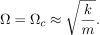
The situation is worse for long thin rotors like the spinning shafts of generator turbines, because there are many critical speeds  at which there can be a resonance with lateral or torsional modes of vibration.
Most industrial rotating machines such as power station turbines are carefully tuned so that no resonant vibration frequency is in a simple integer ratio with the normal operating speed ( Hz in the UK for an electrical generator). Such fine-tuning can be problematic because natural frequencies tend to slowly drift as bearings and other parts wear in. Also, and this is one of the reasons rotor dynamics is seen as a somewhat specialist field within engineering, gyroscopic effects mean that vibration modes are non-normal. That is, each static natural frequency
  splits into two different frequencies (called forward and backward whirl) that vary with rotation speed. Also, stiffness and damping matrices when linearised about such modes have large skew-symmetric off-diagonal terms, as can be seen when equations of motion such as (1) and (2) are written in a rotating frame.
So, avoiding all resonances becomes extremely difficult, especially during spin up to (or down from) the operating frequency . Helicopters, for example, operate at a fixed rotor speed, but typically have large dampers fitted between blades to avoid resonances in the lead-lag degree of freedom as the rotor is spun up before take-off.
Vibrations in large rotating machines are problematic for a number of reasons. First, vibration causes enhanced fatigue in bearings and machine parts, which can eventually lead to catastrophic failure such as in Hinkley Point A in 1969. Second, most rotors are designed to have small clearances with their stator, and vibrations can cause unwanted rubs, bounces and rolling contacts. Such contacts typically cause significant noise, such as during Hinkley Point A’s commissioning, and lead to rapid failure scenarios. Finally, while rotor bearings are typically designed to soak up small amounts of vibration, the so-called journal bearings used on most large industrial turbines show complex non-linear behaviour due to the squeeze-film effect of their lubricant.
So, rather than simply avoiding resonances, engineers often seek to minimise vibration amplitudes by ensuring that the imbalance is small, preferably vanishingly small. Making fine adjustments to compensate for tiny manufacturing defects is an important part of the process. For example, when getting a new car tyre fitted, you may have noticed how small masses get added to the wheel rim after fitting, to counteract any asymmetry.
As an aside, some rotors simply cannot be balanced, especially when the very purpose of the machine means out-of-balance forces  are necessarily large and unpredictable. For example, think of a domestic washing machine during its spin cycle. Here is large due to the washing load not being evenly spread around the circumference. As the spin speed is either increased or decreased through the rotor bearing’s natural frequency, significant lateral vibrations occur, especially when washing large heavy items such as a duvet or a pair of trainers. The manufacturer’s solution is to design bearings that allow large clearances and to put a massive breeze block in the base of the device to stop the machine bouncing across the floor.

 . Reprinted from [6] with permission.
This phenomenon can be analysed mathematically. In simple terms, a system with  autobalancing masses of mass
  at radial distance
  from the spin axis creates forces of the form
(3) 
(4) 
on the right-hand sides of (1) and (2). Here  represents the circumferential position of the
  th mass, whose motion is governed by an equation of the form
(5) 
where  is a linear drag coefficient.
Analysis of these equations shows that if is large enough and  provides sufficient moment to counterbalance the eccentricity, then a stable equilibrium is possible in which
  and the rotor is perfectly balanced. Unfortunately though, non-linear bifurcation analysis shows that such stabilisation is not always achieved and the additional masses can actually make things worse. Much worse.
There are several complicating factors, that I will spare you the details of, many of which can be verified experimentally [8]. Results from the simplest model [6] show that, while perfect balance can be achieved for sufficiently high rotation speed , there is coexisting large-amplitude whirling motion that resembles a Lissajous curve when plot in the rotating frame (see Figure 2). Such non-linear mode-locked periodic motions can be explained by the mathematical theory of Arnol’d tongues, see [9]
Multi-stability, where more than one form of recurrent motion is possible, depending only on initial conditions or random excitations, is a hallmark of non-linear behaviour and is generally regarded as something to be avoided in vibration engineering. More generally, even with modifications that exclude large-amplitude whirling motions, it is hard to convince an engineer to add loose parts to a rotating machine.
Nevertheless, the question of multi-stability in rotor dynamics is a key concept in trying to model, simulate and ultimately prevent undesirable effects of rotor/stator contact. Such systems are also fundamentally non-linear because the force terms  and
and  in (1) and (2) are non-zero only when
  , for some clearance
  .
.

In recent work, with Alex Shaw and Mike Friswell at the University of Swansea, we are attempting to understand the origins of experimentally observed bouncing-type motion in which an eccentric rotor intermittently contacts its stator. See Figure 2 for two examples of such periodic motion in the rotating frame. Red crosses mark the location of the isolated contact points.The mechanism of the creation of these non-linear bouncing motions appears to involve non-smooth bifurcations associated with grazing contact with the rigid stator close to internal resonances between different linear whirling modes.
See [10] for a first paper on this topic; although the work is ongoing.
But what has all this rotor dynamics got to do with Hinkley Point? Whether generation III nuclear energy should form a part of the UK’s energy to ensure both security of supply and to meet emissions targets is a matter of opinion, and depends on one’s attitude to risk. I would merely like to suggest that the risks are not primarily associated with environmental contamination, but with economic cost. Of course, the two are closely linked, because the numerous fail-safe mechanisms and regular scheduled downtimes are major contributors to the cost of nuclear power. Perhaps the key is to better understand the different possible failure mechanisms and to adopt a condition-based monitoring approach. That is, if we had better methods for monitoring and controlling all aspects of the plant in real time, less redundancy might be required to ensure safety.
This is where technologies such as that developed by Faraday Predictive might prove pivotal. Strictly speaking, Faraday Predictive deals with rotating machines, rather than rotating generators. That is, devices that transfer electrical energy into mechanical energy via spinning a large mass, rather than transferring mechanical energy into electricity. But the principle is the same: to monitor mechanical vibrations of a machine to check for fatigue or incipient failure it is far easier to monitor the electrical side than the mechanical side. Ohm’s law tells us that dividing voltage by current tells you the resistance – strictly, complex impedance for an alternating current device. In terms of energy balance, this electrical resistance must be matched by the mechanical loss.
Faraday Predictive’s unique approach is to take a real-time measurement of the error between the measured current and a current calculated from the voltage and the linear impedance you would expect if the device were operating ‘normally’. This error signal contains any non-linearity, other un-modelled effects or real-world imperfections in the systems, which are precisely what we want to know about. Taking a Fourier transform, leads to a rich spectrum that contains many peaks, troughs and other features. Each spectral feature can be associated with a particular physical effect such as a vibration mode or an intermittent rub or contact. Not all features may be undesirable, but crucially, subtle changes in the spectrogram over time can be used to identify worsening internal conditions of the rotor; for example imbalance, bearing rubs, impacts or cracks, or induced turbulence flow. Essentially, instead of lots of invasive mechanical measurements, simply monitoring the electrical signal in principle
gives all information necessary to diagnose faults and to monitor the evolution of their severity. Neat, huh?
Alan Champneys CMath FIMA
University of Bristol
References
- MacKay, D.J.C. (2009) Sustainable Energy – Without the Hot Air, UIT, Cambridge, www.withouthotair.com.
- Nuclear reactor, Wikipedia, en.wikipedia.org/wiki/Nuclear_reactor (accessed 21 June 2019).
- EPR (nuclear reactor), Wikipedia, en.wikipedia.org/wiki/EPR_(nuclear_reactor) (accessed 21 June 2019).
- Monbiot, G. (2011) Why Fukushima made me stop worrying and love nuclear power, The Guardian, 11 March 2011.
- Hinkley Point A nuclear power station, Wikipedia, en.wikipedia.org/wiki/Hinkley_Point_A_nuclear_power_station (accessed 21 June 2019).
- Green, K., Champneys, A.R. and Lieven, N.J. (2006) Bifurcation analysis of an automatic dynamic balancing mechanism for eccentric rotors, J. Sound. Vib., vol. 291, pp. 861–881.
- Rodrigues, D.J., Champneys, A.R., Friswell, M.I. and Wilson, R.E. (2011) Two-plane automatic balancing: a symmetry breaking analysis, Int. J. Nonlin. Mech., vol. 46, pp. 139–1154.
- Rodrigues, D.J., Champneys, A.R., Friswell, M.I. and Wilson, R.E. (2011) Experimental investigation of a single-plane automatic balancing mechanism for a rigid rotor, J. Sound. Vib., vol. 330, pp. 385–403.
- van der Heijden, G.H.M. (1995) Mode-locking in nonlinear rotordynamics, J. Nonlin. Sci., vol. 5, pp. 257–283.
- Shaw, A.D., Champneys, A.R. and Friswell, M.I. (2016) Asynchronous partial contact motion due to internal resonance in multiple degree-of-freedom rotordynamics, Proc. Roy. Soc. A, vol. 472, art no. 20160303.
Reproduced from Mathematics Today, August 2019
Download the article, Westward Ho! Musing on Mathematics and Mechanics (pdf)