We are sorry to report that Edward Stansfield passed away after a short illness in early November. A tribute will follow in the next issue. We hope you enjoy reading this, his last editorial.
Welcome to this December 2019 issue of Mathematics Today which should drop through your letter box in good time for Christmas. I was very impressed by the most informative editorial in the October 2019 special issue written by Ellen Brooks-Pollock and Reidun Twarock. They worked hard to collect the wide-ranging, informative articles on mathematics in biology and medicine, which you may have noticed were mostly written by female authors. Prior to reading through the issue, I had not appreciated just how many different areas of medicine and biology involve non-trivial and quite detailed mathematics. I applaud Ellen and Reidun for their efforts – thank you.
As someone more familiar with the mathematics of signal processing applied to communication and navigation (amongst other things) I did find some of the articles quite difficult to understand. However, the article about the mathematics of imaging was an exception, and has some personal relevance. I am currently jaundiced and having scans at the local hospital to identify the cause. I first had an ultrasound scan and I am now waiting for an appointment for a Computed Tomography (CT) scan which should give more clarity. This uses the more familiar (to me) Radon Transform mentioned in the article.
I also particularly enjoyed reading the article A Doctor Writes in the October 2019 issue. Some readers may recall that I have previously expressed a certain amount of scepticism about some of the applications of artificial intelligence (AI). Some writers have suggested that by 2040 AI will be as good as a human brain, but others say that it can never achieve the same level of intelligence as human beings. Time will tell! In passing, I am sure you know that the initials ‘AI’ do not always mean ‘artificial intelligence’. In my early career I undertook research into speech recognition and voice coding techniques, and to me at that time AI stood for ‘articulation index’, which is a measure of the intelligibility of speech that has been encoded in some way. It is also used in audiology as a measure of a patient’s loss of hearing. On the other hand, a colleague once pointed out to me that if you mention AI to a livestock farmer it stands for ‘artificial insemination’ so one has to be sure of context.
In the last few months the press has continued to report on the developments and applications of many mathematically based technologies. Cryptocurrency has continued to come in for much criticism, partly due to its lack of transparency, although some banks seem to be in favour of it. It relies on a blockchain to maintain a permanent record of every transaction, and a significant problem here is that large amounts of energy are required to maintain the ever increasing associated database records.
The reported number of uses for AI (artificial intelligence) also continues to increase at quite a rate. As usual, uses of AI include driverless cars, but also: language translation; poker playing; classical music creation; ‘smart’ sensors to detect elderly people falling; searching for evidence in stored data; detecting money laundering; enabling improved student tuition; and selecting candidates from interview results. Of historical interest is its use with X-rays to reveal hidden art in masterpieces, and with reading Isambard Kingdom Brunel’s ‘illegible’ handwriting. There have also been reports of studies looking into the ethics of AI and its impact on people’s well-being.
Another mathematically-based technology which is often seen in the press is the use of face recognition technology to identify missing persons and/or criminals on our streets. Some people say this is controversial as it intrudes on personal privacy, and one problem here seems to be a lack of information about false negative and false positive rates. A much less controversial application of face recognition is in a London bar where it is used to help bar tenders determine who should be served next. Voice recognition technology is also getting a new airing as some banks have started introducing this to replace pass codes. Personally, I think this application will soon run into difficulty when the cold weather strikes and people have sore throats, colds, etc.
On a historical note I came across a couple of other interesting snippets. At Bletchley Park, home of the Second World War code breakers, they recently found documents relating to the design of the first Electronic Random Number Indicator Equipment (ERNIE), which was used to select premium bond numbers for the first time on 1 June 1957. Older readers may remember that when they were first introduced premium bonds came in for criticism as they were claimed by some people to be a form of gambling. Interestingly, Bletchley Park is where the recently decommissioned fourth generation of ERNIE will spend its retirement, inside the National Museum of Computing, alongside the rebuilt Colossus used for wartime code breaking. In connection with this, but from a completely different source, I came across a story about the 85-year-old Dame Stephanie Shirley, who was responsible for checking the randomness of the early premium bond computer. She was just five years old in 1939 when she came to England from Poland as an unaccompanied child refugee on the Kindertransport. She became a software pioneer, and founded a company which in 2007 was worth $2.8bn. She is a real entrepreneur who still lives in England and is enjoying her retirement.
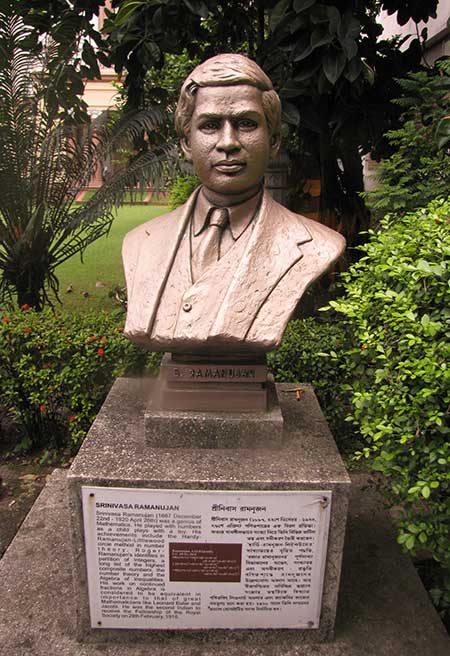 An article in the 13 July 2019 issue of New Scientist caught my attention [1]. This was about the Indian self-taught mathematician Srinivasa Ramanujan after whom the Ramanujan Machine was named. Ramanujan didn’t like ‘the formal proofs favoured by most mathematicians’ and ‘was known for coming up with unconventional mathematical ideas’. The Ramanujan Machine contains ‘software that poses conjectures for generating equations whose output is fundamental mathematical constants such as π and e’. Intrigued by this I read on. Many of the Ramanujan conjectures were later formally proven, but not all. His theorems often involved continued fractions, and one such was the following infinite continued fraction conjecture for the natural number e, sometimes also known as Euler’s number:
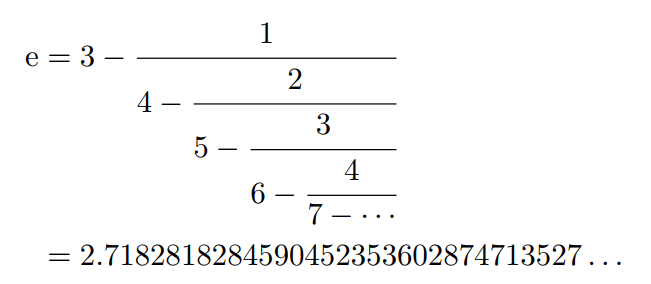 As I understand it, this conjecture has so far not been formally proved, and it prompted me to think about how one might set about proving it. I didn’t get very far, of course, but I thought readers might be interested in what transpired.
A fairly innocuous example of a simple infinite continued fraction is
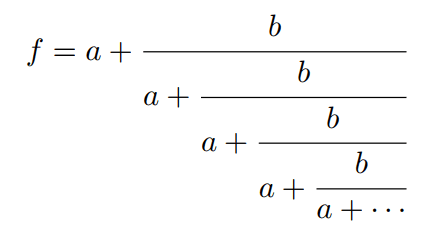 In this case a closed form solution is easily found since
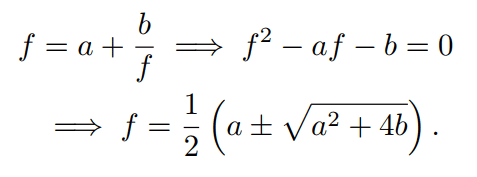 This gives two possible solutions and yet there is only one continued fraction. If a ∈ R > 0 and b ∈ R > 0, the positive square root gives the correct answer, but what about the negative square root? Does it have any significance? Furthermore, if a ∈ R > 0 and b ∈ R < 0 such that a2 + 4b < 0, the solutions for f will be a complex conjugate pair, and yet the continued fraction is real. I could easily dismiss these cases as being anomalous and ignore them, but are they? I wonder if readers can throw any light on this puzzle.
I then had a quick look at more complicated infinite continued fractions, for example:
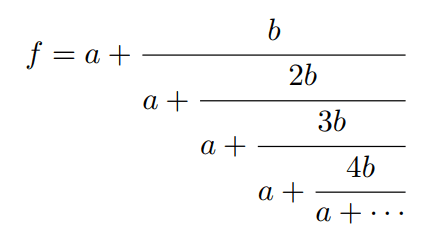 It didn’t take me long to realise that I was now well out of my depth, and I began to really respect the talents of Ramanujan and those who designed and wrote the software for the Ramanujan Machine. A features article on Ramanujan will appear in the April 2020 issue.
This issue features the usual variety of articles covering different aspects of mathematics. The Graham Hoare prize winning article is Paint by Number (about colour theorems four, five and six) by Lucia Karageorghis, who is the first female winner of this competition and I believe the first undergraduate to win it. The prize has existed since 2014 and is usually won by a PhD student or a postdoctoral researcher.
The article In Search of the Optimal Flight of a Golf Ball by Sean McKee and David Mason includes, along with modern mathematical descriptions, historical contributions from the Scottish mathematical physicist Peter Guthrie Tait (1813–1901) and the golfer Freddie Guthrie Tait (1870–1900), who won at least 28 tournament victories in his short life. Urban Maths by Alan Stevens is about Computing Pi – Inefficiently! using colliding frictionless blocks.
A Doctor Writes is concerned with gambling addiction, and possible mathematical models of how it evolved over time. Snezana Lawrence’s Historical Notes is about mathematical children – child prodigies and giftedness, including Pascal and his Mystic Hexagram. Alan Champney’s Westward Ho! is concerned with the 45 bridges of Bristol and Euler’s historic problem about the seven Bridges of Königsberg. This is timely because Alan’s colleague Thilo Gross has just written a book on the subject which was launched at the Clifton Suspension Bridge visitor centre on 8 October 2019, and the article mentions this along with some photos from the book.
I hope you enjoy reading this issue, and as Christmas approaches I would like to wish all our readers a happy, healthy and prosperous New Year with their families and friends. The next issue of Mathematics Today will be in February 2020, one month after the annual New Year celebrations around the world will have taken place.
Edward Stansfield CMath CSci FIMA
References
- Lu, D. (2019) Computer attempts to replicate the dream-like maths of Ramanujan, New Scientist.
Reproduced from Mathematics Today, December 2019
Download the article, Editorial, December 2019 (pdf)