The final weekend of October saw the IMA’s Early Career Mathematicians (ECM) annual conference. It targets mathematicians at early stages in their careers; whether they are still studying, already working in academia or industry, or even just beginning to express an interest in the subject. The main objective is to showcase maths careers, as well as providing a comfortable atmosphere where attendees can discuss ideas with like-minded individuals.
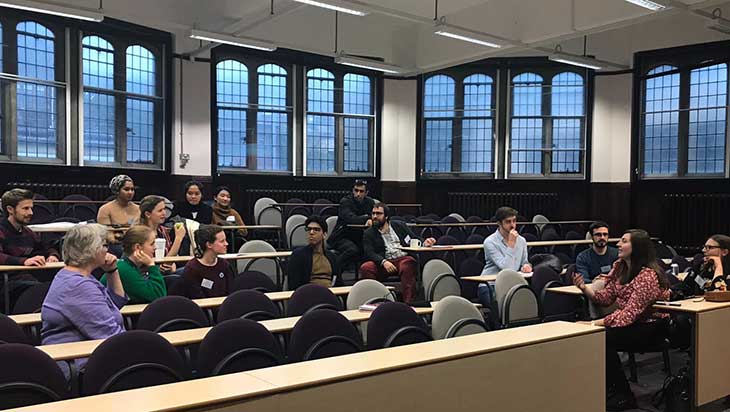
The ECM conference took place on a rather dreary autumnal Saturday, hosted in the contrastingly vibrant city of Bristol at the University of Bristol’s Wills Memorial Building. The day started in a rather lethargic fashion, with delegates arriving cold and sodden having braved the weather. After a brief opportunity to introduce themselves and meet some of their peers, a quick caffeine fix and the rediscovery of feeling in fingers and toes, attendees moved into the lecture hall for the first session.
Following a quick welcome and introduction, IMA Councillor Dr Jenny Macey started the day off with her presentation titled ‘Walk Into a Room and Smile’. Dr Macey presented a unique opportunity for delegates to gain insight into experiences mathematicians suffering from disabilities may encounter. Dr Macey then went on to explain how we can all adjust our behaviours to become more accommodating for those with access requirements, as well as highlighting the fact that our quirks and features do not define us as individuals; everyone is capable of extraordinary feats.
 Following this, Dr Stavros Kasinos from Imperial College London stepped up to give the second talk on the ‘Mathematical Modelling of Structural Systems to Extreme Environmental Loads’. His presentation featured models for characterising dynamic interactions and vibrations of strongly nonlinear oscillators. He further presented novel methods for efficiently quantifying stochastic responses; explaining applications to seismic, wind and oceanic engineering. Dr Kasinos described how his research delivers new insights into the understanding of stochastic responses in structural models, and how one can then determine the probability of structures exceeding a given damage state. He then described how this information can be used in forecasting the impact of extreme events, which designers can then take into consideration.
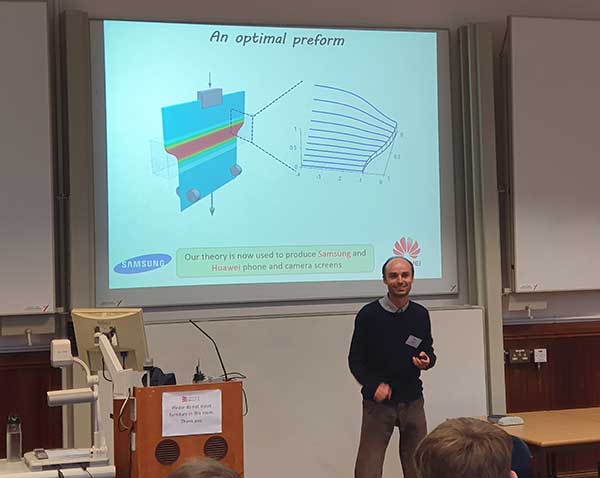
The conference then took a quick recess before returning for the presentation of Professor Ian Griffiths from the University of Oxford. Professor Griffiths delivered a distinctive talk, ‘Cheerios, iPhones and Dysons: How Fluid Mechanics Assist Industry’ which focused on the applications of fluid dynamics in manufacturing. The talk started by highlighting how the shape of the die used during the extrusion process can affect the shape of the extruded product. Professor Griffiths justified this issue by discussing how the use of a square die during the manufacturing of square test tubes results in test tubes with the profile of a concave square, and similarly, how the extrusion of glass for smartphone screens can result in glass sheets which are thinner (and thus more brittle) in the centre. Professor Griffiths went on to explain how this could be overcome by using the temporal symmetry of the dynamical equations for flow in application to the extruded material. He then went on to describe how, whilst undertaking work for Dyson, he had managed to apply other methods from fluid dynamics to create more effective, longer lasting filters for their vacuums (whilst also taking a moment to advocate good hoover maintenance).
Professor Alan Champneys, from the University of Bristol, then gave the last presentation before lunch. With a talk which inspired three breakout sessions, Professor Champneys discussed his experiences with imposter syndrome during his time as a professional mathematician. ‘Mathematical Modelling as a Career and Overcoming the Imposter Syndrome’ gave an extraordinary insight into the mental struggle mathematicians can experience during their careers. Professor Champneys described some of his own encounters with imposter syndrome, and the effect it had on his personal journey to his current academic position. In particular, he highlighted the fact that high level mathematics is, by its very nature, complex and that there will be times in every mathematician’s career when they feel overwhelmed or inadequate. However, Professor Champneys went on to explain that the key to overcoming these internal conflicts is perseverance. Professor Champneys closed his talk by giving his answers to questions he personally had as an aspiring mathematician, including ‘How does one undertake good collaborative work?’ and ‘Where does inspiration come from?’ (the answers for those wondering were ‘network copiously and broadly’, and ‘good old fashioned luck’ respectively).
Following lunch, the famed ‘unconference’ session took place. Delegates voted for topics and a knowledgeable attendee gave a small talk during the breakout session overviewing the chosen subject. Sessions run during the unconference included ‘How to Get a Job After A Maths Degree’, ‘String Theory in a Nutshell’ and an interactive session exploring how mental illnesses can impact the daily lives of affected mathematicians.
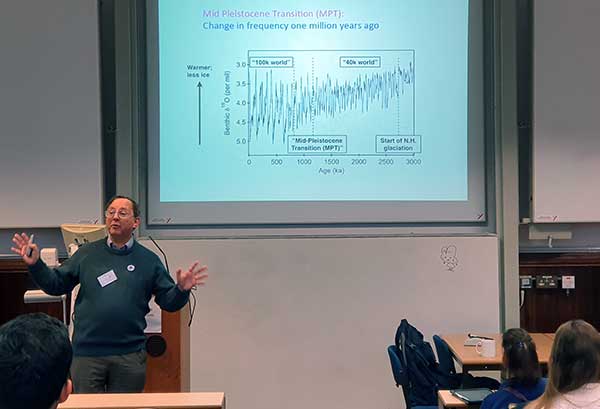
Mid-afternoon saw the conference continue with Professor Chris Budd (University of Bath) kicking off his presentation ‘Mathematical Models for the Ice Ages’. Professor Budd opened by explaining the enormity of work involved trying to discern the behaviour of the ice ages using geological data. He then went on to describe how simplified mathematical models can be used to explain the cyclical nature of the ice ages. Aside from representing a cheap alternative to discovering contributing factors through geological research alone, these mathematical models allow researchers to derive possible influences logically (although this still requires some real-world data); whilst also having the ability to rapidly test the viability of potential theories.
Professor Noah Linden from University of Bristol then gave the final talk of the day, on ‘Quantum Computing’. His talk focused around how algorithms for quantum computers can be markedly faster than classical algorithms for specific operations. For instance, typical algorithms for factoring large numbers on regular computers are known to take exponential time; it is precisely this reason that products of large primes are used in the RSA encryptions. In contrast, quantum computers can implement algorithms to factor extraordinarily large numbers in polynomial time. Professor Linden continued by explaining the massive consequences this has for the typical user of such services, whilst also highlighting the tremendous potential that quantum computing could hold for the future of information technologies. As Professor Linden pointed out, this talk was very timely: a few days before the conference, an article published in Nature presented a quantum computer that solved in a few a minutes a problem that would take 10,000 years on a regular digital computer.
The conference closed with a brief summary of the day’s events. Delegates were then offered the opportunity to continue with an informal networking event at a nearby pub. A sizeable chunk of the attendees, taking up the offer, again braved the still miserable weather for a cold pint and a casual chit-chat, before making their final journeys home.
Declan Bays AMIMA
ECM Engagement Leader
Reproduced from Mathematics Today, December 2019
Download the article, IMA ECM Autumn Conference 2019 (pdf)