Joanna Jordan is a freelance mathematics KE consultant. She is a Registered Technology Transfer Professional (RTTP).
Can you briefly describe your career path to date?
My training began with a BA in Mathematical Sciences at the University of Oxford. Motivated by an interest in applications, I took an MSc in Industrial and Environmental Modelling at the University of Bristol. I stayed in Bristol to study for a PhD in Engineering Mathematics, sponsored by industry, which gave me my first taste of KE in action. In 2008, I was excited to hear that a new group in industrial mathematics – the Mathematics Applications Consortium for Science and Industry (MACSI) – was being set up in Limerick, Ireland, and I moved there for my first postdoc. I subsequently held a postdoctoral fellowship in Galway, before deciding that my true calling was in KE. I returned to MACSI to take up the role of Manager, where I gained several years of invaluable experience of leading engagement with industry and securing research funding.
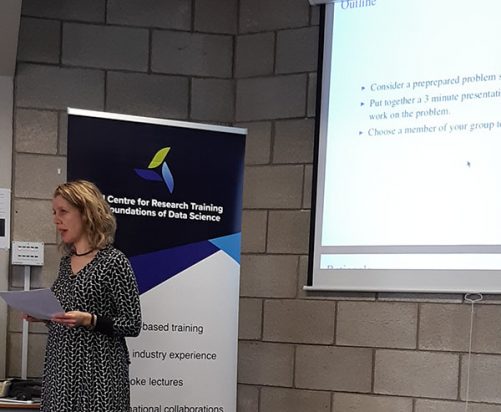
In 2015 I relocated back to the UK, where, as Manager of the University of Bath’s Institute for Mathematical Innovation, I set up a new mathematics KE team. To balance time between my young family and my passion for mathematics KE, I turned freelance in early 2019; a career move that has offered me great variety as well as flexibility.
How would you describe your professional expertise?
I specialise in the development and management of mathematical sciences research at the academic-industrial interface.
What is your experience in knowledge exchange (KE)?
I have over six years’ experience of managing outward-facing mathematics centres in Ireland and the UK. I have established relationships with industrial partners from start-ups to multinationals, including Dell, Airbus, and Philips, via engagement mechanisms from consultancy to Knowledge Transfer Projects (KTPs). I have set up projects across many branches of mathematics and statistics, including optimisation, continuum mechanics, and numerical analysis.
In 2015 I founded and chaired the EU-funded Mathematics for Industry Network (MI-NET) COST Action, a four-year initiative to support industrial maths networking across 32 countries. I have led the organisation of three Study Groups with Industry, and served on the Expert Review Committee for the 2018 Bond Review of KE in the Mathematical Sciences. I am the first Registered Technology Transfer Professional (a PraxisAuril global accreditation for KE professionals) specialising in mathematics.
What would you recommend to an early-career mathematical scientist who is passionate about knowledge exchange?
Prioritise quality over quantity; one or two mutually-beneficial relationships with external partners are likely to be much more fruitful than a large number of informal contacts. Try participating in a Study Group with Industry. Speak with other researchers who have well-established collaborations with external partners. Make sure you get advice on how much to charge for new projects.
Is there a knack to communicating mathematical ideas to people who are not mathematical scientists?
Seize every opportunity to practise! Start with as simple an explanation as possible, and add detail responsively. Understand your audience and what is important to them.
What have you learned that you wish you knew earlier?
I think a mathematics training teaches you perfectionism, but it’s important to remember that even a negative result or a very simple model can have great practical value. When communicating, the glass is always half full!
What is the biggest barrier to Knowledge Exchange (KE)?
Many KE challenges are unique to the mathematical sciences. In my experience the biggest barrier in HE is career structures, both non-academic and academic. Dedicated maths KE roles typically fall outside academic career structures, are not always widely respected by other academics, and often do not offer job security. For academics, the current appointment and promotion systems reward tightly-focused research portfolios, when successful KE often requires a wide breadth of knowledge. These barriers could be overcome by establishing a critical mass, offering training and career development, and considering standard job descriptions and promotion criteria.
Can you tell us an example of knowledge exchange?
To me, the vast range of different sectors where maths can add significant value is what makes KE so special. I think the most powerful examples are ones where the challenges are not obviously mathematical.
What is the most effective mechanism for KE?
In my experience, there is no single mechanism, but excellent customer relationship management is vital. Study Groups with Industry, as long as they are followed up quickly, are often a good mechanism for initiating relationships. Then the mechanism to best suit a particular project can be chosen with the industry partner. It is often the case that different mechanisms, ranging from student project to consultancy, suit the same external partner just at different times.
Do you feel that a change of attitude is required in order for KE to be more effective? If so, who needs to change their attitude?
KE is not for everyone! I think that all students should gain some experience of KE so that they are aware that it can be a valuable and rewarding part of academic or professional life.
What is the distinction between research, education and KE?
I consider that KE can involve research and/or the adaptation and communication of existing ideas. Both are extremely valuable! KE is typically more bespoke and problem-driven than education or training. However, I’ve found problem-based learning, such as student modelling weeks, to be an excellent way of teaching KE methods.
What motivates you?
I firmly believe that maths can change the world for the better, which is why I work in mathematics KE! I am a people person and I am motivated by interesting projects where maths has a real impact.
Who inspires you?
Many people! Hannah Fry makes maths accessible to everyone. Hilary Ockendon is a world-class industrial mathematician and has always been very supportive of my unusual career. Orla Feely is an inspirational leader of research and innovation. Barbara Hepworth created ground-breaking 3D art whilst raising triplets.
How do you decide which activities to pursue?
When choosing whether to accept or pitch for work, I try to balance what interests me versus where I feel I can have the most impact. Often these are not mutually exclusive!
I particularly enjoy contributing to KE strategy – I find it very rewarding to be of help to some of the brightest people and best organisations.
How do you maintain a healthy work/life balance?
Spending lots of time with my family, preferably outdoors! Ceramics, time permitting.
Reproduced from Mathematics Today, October 2020
Download the article, Interview with Dr Joanna Jordan RTTP FIMA (pdf)