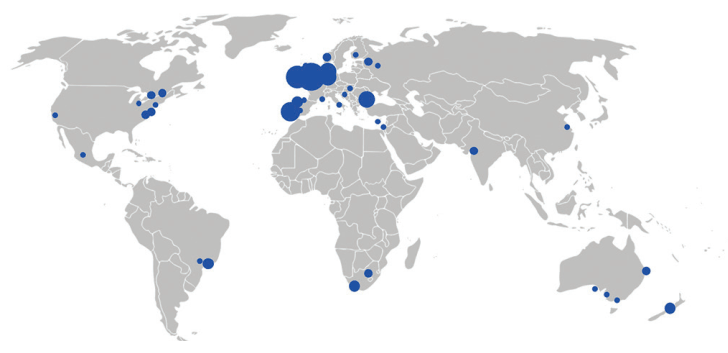
Mathematical Science Study Groups with industry have been running for over fifty years and, having started with pioneering work in the UK in the 1960s, these groups now take place all over the world in a huge variety of shapes and sizes (see Figure 1).
The flexibility of study groups is probably one of the hallmarks of the British spirit and has ensured the spread of the study group model across the world.
Professor Odile Marcotte
Université du Québec à Montréal, Canada
A study group is an open workshop in which academics, PhD students and companies work together as equals, usually for a week, and in particular without any form of Non Disclosure Agreement or Intellectual Property Rights restriction, to share ideas freely, and to engage in very focused discussions. They are based on the premise that industry is a valuable source of interesting problems to stimulate new research and that in addition, the mathematical sciences can solve key industrial and societal challenges of economic and societal value. One of the goals of the study group is to provide companies and institutions with mathematical tools for solving problems.
A study group also allows academics and students in the mathematical sciences (including data science, statistics, optimisation, numerical analysis, mathematical finance, machine learning, etc.) to be exposed to, analyse and solve real-world problems. Through this they become familiar with, and up to date in, some of the latest problems and methods arising in industry. The research started at study groups often leads to long lasting and deep mathematical investigations.
The UK’s position in mathematical Study Groups
The UK is part of a broader network of European Study Groups (ESGI) which has a degree of central coordination and is closely linked to the European Consortium for Mathematics in Industry (ECMI). ESGI workshops are organised regularly across Europe. There are now long-established annual study groups in the Netherlands, Denmark and Ireland, with new countries running study groups every year. In 2019 alone there are study groups in Holland, UK, Spain, Estonia, Austria, Lithuania, Portugal, Denmark and the Basque Country. From 2015–2019, the UK-coordinated EU-funded Mathematics for Industry Network supported the establishment of study groups in new countries, and has written a handbook on how to organise a study group [1].
More recently, the KTN has provided leadership in more focused, three-day study groups, concentrating on a particular area. Examples of these include study groups in agri-science, energy, and health. These three-day Study Groups are seen as ‘strategic’ where gaps in engagement are large and upcoming pots of public R&D budget are driving the need to engage the mathematical sciences. These strategic Study Groups have seen a large number of SMEs and start-ups come through the doors and receive support from the mathematical sciences.
Study groups are an important feature of the knowledge exchange (KE) activity of the UK mathematics community. They represent an area in which the UK is world leading. The recent Bond review – the Era of Mathematics, an independent Review into KE in the Mathematical Sciences [2] recommends:
Resources for workshops with industry should be broadened and increased. In particular the Mathematical Study Groups with Industry should be expanded in scope.
Professor Philip Bond
Case Study 1 – Mathematics of Food
In 2017 a three-day agricultural study group was hosted by the Institute for Mathematical Innovation (IMI) at Bath in close partnership with the Knowledge Transfer Network. One of the problems worked on during this study group was brought by Mondelez and looked at modelling the effects of climate change on cocoa production in Ghana. A report on this was written up. This project was then developed through a Living With Environmental Change grant, an MSc project and journal publications. It is now being worked on by a PhD student at Bath. This work was reported in the Gresham Lecture ‘How Much Maths Can You Eat’ by Chris Budd [3].
At a follow up agricultural study group at the International Centre for Mathematical Sciences (ICMS) a similar problem was brought by PepsiCo looking at the effects of climate variation on orange production in Florida. Using the earlier report as a basis, substantial progress was made on this problem.
Motivated in part by the success on the problem above, PepsiCo brought two problems to the Bath Study Group in 2018. The follow up to these problems has led to two contracts between PepsiCo and Bath IMI, an MSc project at Bath, an Integrative Think Tank at Bath, a further problem posed by PepsiCo at the Cambridge Study Group, a one-day workshop at the University of Huddersfield, and ongoing collaborations between PepsiCo and many of the academics who attended the Bath Study Group, with a paper in preparation. A press release led to further publicity of the PepsiCo problem [4]:
Study groups like this one in Bath are a wonderful opportunity to get the best brains working on your problem in a focused collaborative way, getting initial results in just five days.
Working in this way brings together expertise from a variety of fields with different perspectives on the problem, so the resulting mix is more than just a sum of its parts.
The delegates take the challenge, redefine the problem and focus on solving it. Study groups like the ESGI can really help build a better product and equipment that will help improve the productivity of processes in the long term.
I would definitely recommend that other businesses get involved in these workshops.
Stacie Tibos
Associate Principal Engineer, PepsiCo
What kind of problems are brought?
When the study groups started the problems were typically focused around mechanics, mathematical modelling and differential equations, typified in the first ever summary report of a mathematical Study Group in 1968 [5]:
Mr Herne, from the National Coal Board, came to discuss the problem of the analysis of moving granular material and, in particular the motion of large quantities of coal in a bunker.
However, in the last 20 years there has been an explosive growth in the range of problems considered. The majority of the problems in recent study groups have been in areas such as data science, optimisation, financial maths, and signal/image processing; although mechanics is still a vital component of the Study Group sessions. The increasing mix of mathematical sciences involved in the sessions dramatically increases the range of problems accessible, and allows for multi-disciplinary working at the intersection of the mathematical sciences.
The range of sectors now taking part in these sessions has also been growing; in the past 20 years challenges have come from sectors as broad as manufacturing, energy, agriculture, financial services, food, health, automotive and many more. As an example, the ten problems at the 2019 Cambridge Study Group were a mixture of data and modelling as follows:
- Identification of changes in noisy spectra – to detect incipient problems in rotating equipment (Faraday Predictive)
- Statistical Modelling and Pattern Recognition for Predicting Evolution of Temperature Forecasts (BP)
- Uncertainty in Seismic Inverse Problems (BP)
- Identifying Potential Hardening Techniques for Image Classifiers (Defence Science and Technology Laboratory)
- Limits on Simultaneous Transmit and Receive (Defence Science and Technology Laboratory)
- The Value of Information in Managing the Electricity System (National Grid)
- Conditional Quantile Estimation using High-dimensional Time Series Data (Prudential)
- Improving Weather Models for the Insurance Industry (Aviva)
- Towards Managing Landscapes: How can we Interpret and Design Better Environmental Monitoring Surveys? (Syngenta)
- Analysis of Shear Forces during Mash Disk Formation (PepsiCo)
Who attends, and why?
But even tried, tested and successful schemes such as the Study Groups with such a rich heritage should reflect on current trends and make steps to keep them agile to changes in industry needs. A recent survey explored these ideas; what are the motivations and expectations for business and academia alike to take part? Figure 2 shows the motivation behind industry participation.
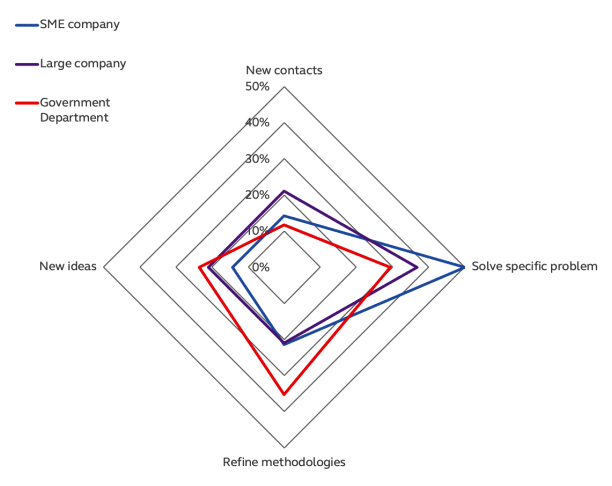
It is important to bear these differences in mind when running a Study Group, smaller companies being more agile and responsive often come with specific challenges which if solved in a few days would be transformative to their business. Larger companies often come with broader questions and what is needed are new ideas which could be applied to multiple questions. These expectations should considered when organising a Study Group.
On the other side, there are plenty of other pulls on a busy academic’s time, what makes researchers give up their valuable time to attend these sessions? Understanding these help us to structure the meetings optimally, and also have implications on who should be funding these?
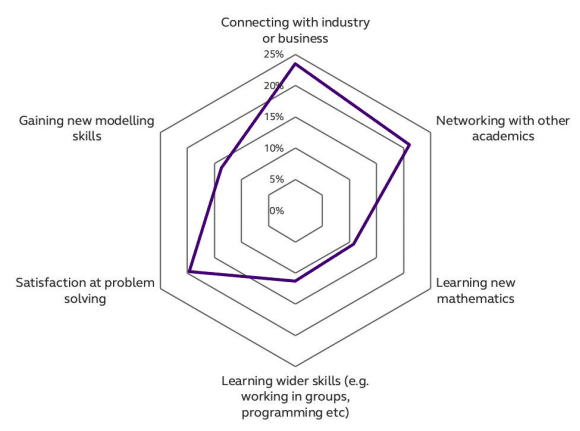
Researchers attend for a variety of reasons (see Figure 3). It is interesting that as well as the benefits of connecting with industry and academics, many attend for the sheer satisfaction of solving problems. This is not unreasonable given that they are mathematicians. Certainly, study groups have a major benefit of stimulating an interest in knowledge exchange through problem solving in both students and experienced academics. All of the academics consulted felt that Study Groups were good value for money.
Case Study 2 – Mathematics of drug discovery
AstraZeneca participated in a Study Group looking at Improved Drug Discovery Through Better Machine Learning Models. Ola Engkvist, Associate Director, Discovery Sciences Computational Chemistry R&D brought the challenge to a group of eager mathematical and statistical research scientists at the University of Warwick. The researchers explored novel descriptors to describe the candidate chemical structures, and a comparison between a number of machine learning algorithms. The activity directly resulted in two PhD students being sponsored through the new HetSys CDT, who are building Study Groups in as a key part of their industrial engagement strategy.
It was a great experience and we were exposed to a lot of new and interesting ideas.
Ola Engkvist
Associate Director, Computational Chemistry, AstraZeneca
Do they work? What is the impact?
In the survey of 64 academics, 46 journal papers were easily identified as coming directly from study group problems. These enriched journals as varied as: New. J. Phys., J. Appl. Math., J. Eng. Math., J. of Colloid & Interface Science, Appl. Phys. Lett., J. Optics, Phys. Fluids, Simulation Modelling Practice & Theory, SIAM Review, SIAM Applied Maths, Phys. Rev. E., J. Nonlin. Mech., Discrete Cont. Dyn-B., Sports Engineering, and topics as varied as: rotor dynamics, crystals, machine learning, vortex dynamics, material science, PDEs, ODEs, network theory, signal processing, inverse problems, environmental science, chemical engineering, rheology, non-smooth dynamics, uncertainty quantification, and financial maths.
Whilst it is difficult to assess the long-term impact of Study Groups on the development of mathematics, it is certainly true that work on problems arising in them have led directly to the development of such areas as free boundary problems, non-smooth dynamical systems, exponential asymptotic, and financial mathematics for example.
The reports of the problems examined at Study Groups, which are maintained on the MIIS archive (www.maths-in-industry.org/miis/view/studygroups/) provide a valuable source of teaching examples for both undergraduate and postgraduate courses and contain nearly 700 reports.
For the businesses, 80% of the companies surveyed have taken part in 1 study group, 15% in 2–4 and 4% in over 5. When asked if the exercise achieved its objectives; 80% of the SMEs said ‘yes’, as did 100% of the Large companies and 67% of the government departments.
It is clear from industry responses to the survey that the study groups both save time and money for the companies and also generate new projects for both small and large companies. In many cases the estimated value in terms of real value of new projects and the value of time saved on existing projects exceeds £100 000! For the companies contacted, there was also evidence that the Study Groups had led to many new partnerships and jobs.
The study group enabled a company staff member and his company supervisor to make contact with the leading academic (and after the study group several other leading academics) in the field of uncertainty quantification and emulation. This in turn influenced several company people (of the order of 10), including senior managers, to modify projects.
To quantify the actual value of new products is dependent on rather many assumptions. However, it is very clear that the study group enabled interactions with several academics that would otherwise have been too difficult and expensive to organise without the help of the study group. The study group mechanism is a unique method of facilitating consultancy and academic interaction that provides benefits lasting many years after the study group.
This happened to me as a result of study groups that I attended from 1973–2008 during my industrial career, and I am still collaborating with students and academics that I met while attending many of these study groups. Long may study groups continue and flourish.
Anonymous Study Group Feedback (2019)
Case Study 3 – Mathematics of aircraft design
In 2007 Airbus came to the Study Group at Bath and brought the problem of shimmy in the undercarriage of aircraft. One of the PhD students who worked on this problem during the week, so impressed the Airbus team that he was offered (and took) a job with them shortly afterwards. The problem itself was then developed as a research project at the Department of Engineering Mathematics at Bristol. This led to a series of papers, and PhD projects with Airbus, on the application of non-smooth dynamical systems to aircraft undercarriage design. One of the PhD projects at Bristol was undertaken part time by the original poser of the problem from Airbus. This work has also been adopted as an evaluation tool for new designs within Airbus.
The Study Group provided us with two main outcomes. The immediate outcome was the discovery of the network of people, who were interested in the topic area and were looking to take the study forward. As a result, we setup a 3-year research associateship at the University of Bristol, to extend the study. The by-product is that our relationships, between the University of Bristol and Airbus, are further strengthened.
Sanjiv Sharma
Modelling & Simulation Expert, Airbus
Summary
Study Groups have been a key part of mathematical science knowledge exchange for the past 50 years. Due to the flexibility of the format, they have evolved to address the pressing challenges of the day, and flourished as a result. They have enriched industrial challenges with tools and solutions, and a growing body of evidence shows that they are transforming academic topics through this interaction.
Martine Barons CMath MIMA
University of Warwick
Chris Budd OBE CMath FIMA
University of Bath
Joanna Jordan FIMA
Freelance Mathematics KE
Matt Butchers
Knowledge Transfer Network
Acknowledgements
The authors are very grateful to Alan Champneys for contributing to the survey design, Hilary Ockendon for assistance with survey dissemination, and all the survey respondents from industry and academia.
References
- Jordan, J. and Vance, F. (eds.) (2017) Handbook for running a sustainable European Study Group with Industry, MI-NET, tinyurl.com/ESGI-Handbook
- Bond, P. (2018) The Era of Mathematics, epsrc.ukri.org/newsevents/pubs/era-of-maths/
- Budd, C. (2017) How Much Mathematics Can You Eat?, Gresham College, www.youtube.com/watch?v=GplDsuHnVXI
- IMI (2018) How number crunching can optimise crisp frying (press release), tinyurl.com/138th-ESGI
- MIIS (2015) Oxford Study Groups with Industry (1968–1988), www.maths-in-industry.org/miis/566/
Reproduced from Mathematics Today, December 2019
Download the article, Study Groups with Industry: What is the Value? (pdf)