A recent government report found that the UK space industry grew in 2014/15 to represent 6.5% of the global space economy. In this same period £13.7 billion was added to the UK economy by space industries, with £1.7 billion of this coming from activities such as satellite and spacecraft subsystem manufacture, and with a further £12 billion income generated by systems that use infrastructure in space such as satellite broadcasting.
Innovation in this prospering industry is underpinned by UK researchers working on cutting edge space research, with much of it relying on advanced mathematical techniques. In 2014/15 there were over 110,000 people employed either directly or indirectly by the UK space industry, demonstrating just how important it is to the UK economy.
Mission to Jupiter
Researchers in the University of Leicester’s Department of Physics & Astronomy are currently involved in a European Space Agency (ESA) mission to Jupiter, called JUICE, planned to launch in 2022. After a seven year journey through space, the mission will spend three years making detailed scientific observations of Jupiter and three of its largest moons.
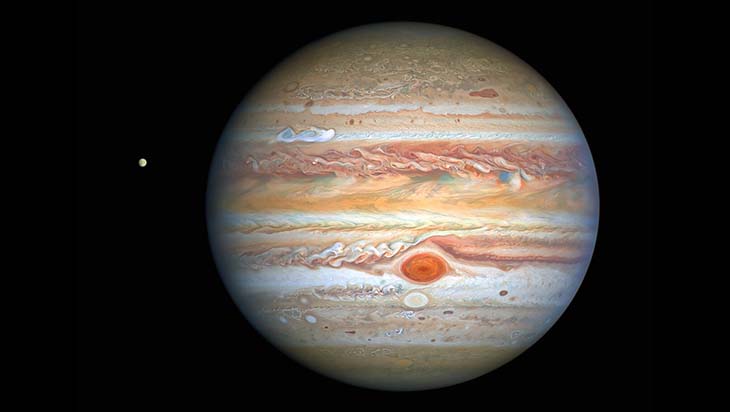 Researchers have been using complex mathematical techniques in order to design protection for the instruments on board the spacecraft. In particular the Leicester team are investigating how to protect an instrument called a magnetometer from radiation damage or destruction during the mission.
Adding even small amounts of extra mass to a spacecraft can add enormous cost, so engineers can’t place a protective box around the whole instrument – it would be too heavy. Instead they need to identify which components are at risk of damage, find out how the radiation reaches the components, and how the risk changes through the lifetime of the mission. They can then understand how changing the position of components, using alternative types, or adding localised shielding, can improve the instrument’s resilience to the radiation damage.
It is very difficult to test the impact of space radiation on a complete spacecraft in a laboratory on Earth, therefore researchers model components mathematically to identify those at most risk of failure. One of the challenges which researchers face is the large number of variables and uncertainties affecting the radiation dose which components receive. These include changes in the spacecraft trajectory; incomplete knowledge of the radiation environment of Jupiter; small variations in the radiation tolerance of otherwise identical components; the wide variety of ways that components can be affected by radiation, and the random nature of the radiation field. The complex interaction of these factors makes it difficult to predict which components will fail and how often. Like weather forecasters, radiation designers deal with probabilities more often than they deal with certainties. At a cost of over €1 billion, missions like JUICE come once in a generation, and it is imperative that the spacecraft survives to complete its investigations.
As part of the magnetometer team (which is led by Imperial College London and includes partners at the Technical University of Braunschweig, Germany, and IWF in Graz, Austria), the Leicester team have modelled what is happening to the instrument at an atomic level – looking at where individual protons of radiation might enter the craft and how they might damage a particular component.
Monte Carlo Simulation
A mathematical technique called Monte Carlo simulation helps to deal with situations where there is a large amount of uncertainty involved and where a slight change in conditions could lead to a dramatically different outcome.
In the case of the magnetometer, a detailed computer model is used to simulate billions of interactions between the charged particles (protons and electrons) which exist in space, and the atoms of the spacecraft and instrument. The model considers how the particles interact with the spacecraft, depositing their energy in sensitive components, and generating further particles and X-rays which also deposit energy as they move through the spacecraft. This leads to a prediction of which components are likely to receive dangerously high doses.
By making changes to the models and re-running them, the team can understand how moving components, or changing materials or parts, can reduce the dose and minimise the amount of shielding mass added to the design.
The JUICE mission has incorporated this detailed radiation analysis technique from the very earliest phases of the mission design. As computing power has increased, Monte Carlo simulation has become a vital tool in many technical and scientific fields, where randomly occurring processes and complex interactions make more direct methods of solving problems difficult or impossible to achieve.
Analysing Orbits
Monte Carlo simulation is such a powerful technique that it finds applications in many fields of science, engineering and mathematics. You might think that it is easy to accurately plot the trajectory of a space craft, however even tiny errors in factors such as the launch speed, or small uncertainties in the position of a planet or moon, can lead to massive errors in the subsequent trajectory of a craft. In a simple example if you were plotting a trajectory of a hypothetical space craft from the UK to the moon, and you varied the launch speed by just 1 metre per second, this could lead you to missing the moon by up to 7000 km.
Monte Carlo simulation has enabled ESA mission planners to calculate the chances of JUICE crashing into the surface of Jupiter’s moon Europa, by helping them to understand how a small error could affect the planned trajectory. This is a vital calculation because by international agreement, Europa is a world that must be protected from possible contamination from organisms from the Earth, such as those which could accidentally be carried there on a spacecraft.
Technical Supplement
Monte Carlo Simulation
Monte-Carlo simulation can be viewed as “experimental” calculation, in which random numbers are used to conduct experiments. Typically, the calculations are performed on a computer using anything from hundreds to billions of random numbers. The basic idea is to run a number of trials, or “experiments”, using a mathematical model of the system of interest. For each trial, specific values are selected for various input parameters from appropriate statistical distributions. Values of the output parameters are collected from all the trials and manipulated to obtain the measures of interest, like the overall average and its variability.
The three body problem
One of the challenges facing space scientists is being able to calculate accurate trajectories for spacecraft. Put simply – if a trajectory is not accurate then the spacecraft won’t reach its destination and the whole mission will fail. One of the reasons that calculating a trajectory is so difficult is that a spacecraft interacts gravitationally with a number of other bodies on its journey, which could include the Earth, Sun, moon and other planets.
If there were only two bodies involved (e.g. the spacecraft and a planet) then it would be straightforward to exactly predict the path of the spacecraft.
Unfortunately the same is not the case for three bodies in what is known as the ‘three body problem’ – for example, calculating the motion of a spacecraft in the presence of the Earth and the Moon. The equations which describe the motion of three bodies cannot be solved exactly, except in some restricted cases such as when the orbits of the two large masses are assumed to be perfectly circular. When more than three bodies are involved, the problem becomes even more difficult. So in general, when three or more bodies are interacting in space, researchers must use computer models to “solve” the problem. Monte Carlo simulation is one of the techniques which can be used to mathematically model millions of different potential starting conditions for the spacecraft and the trajectories which result from them. This allows researchers to find interesting trajectories which will take their spacecraft to its destination. Techniques including Monte Carlo analysis enable planners to land spacecraft very close to a chosen target.
For example, NASA’s Curiosity rover landed less than 2.5 km from its intended location on Mars, after a journey of more than 560 million km (see Raiszadeh & Queen, 2004, for more details).
Note
The IMA would like to thank Dr Nigel Bannister, for his help in the preparation of this document.
References
- Raiszadeh. B. & Queen, E.M. “Mars Exploration Rover Terminal Descent Mission Modeling & Simulation”. 14th AAS/AIAA Space Flight Mechanics Meeting; 8-12 Feb 2004; Maui, HI; USA.
- https://ntrs.nasa.gov/archive/nasa/casi.ntrs. nasa.gov/20040037788.pdf (accessed 18th October 2017)
- Sadlier, G., Flytkjaer, R., Halterbeck, M. & Sabri, F. “Summary Report: The Size & Health of the UK Space Industry”. UK Space Agency, December 2016.
- Summary Report: The Size & Health of the UK Space Industry DECEMBER 2016 (pdf)
Maths in Space: Mission to Jupiter (pdf)