 Oscar E. Fernandez
PRINCETON UNIVERSITY PRESS 2017, 176 PAGES PRICE (HARDBACK) £20.00 ISBN 978-0-691-16863-0
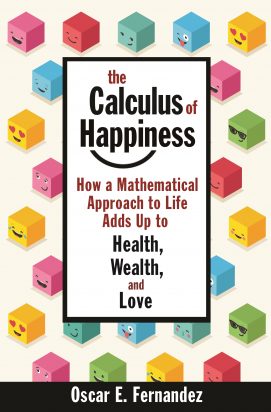
This book consists of a range of entertaining topics that show the surprising real significance of mathematics in three important aspects of everyday life, which the reader of any mathematical ability can relate to. Its three parts corresponding to those aspects: Health, Wealth, and Love. The mathematics is not too demanding (no more advanced than basic differential calculus) and the material is introduced gently.
Part I (A Healthier You Is Just a Few Equations Away) concentrates on issues around diets and nutrition. Considering how many calories are in a particular meal leads naturally to a linear function and its graphical representation. Resting Metabolic Rate is then considered as a function of height, weight and age giving a multilinear equation. Later quadratic functions (for Maximum Heart Rate) and hyperbolic functions (in connection with rational food choice) are introduced, followed by higher order polynomials. These are interesting examples in themselves but they also give the reader practical examples of a mathematical model. Certain problems are discussed as they arise: for example the impossibility of division by zero.
Part II (A Mathematician’s Guide to Managing Your Money) looks at budgeting, compound interest and risk. US Federal Tax bands are used as a vehicle to elucidate piecewise linear functions; inflation and mortgage calculations introduce the reader to exponential growth and logarithms (required when time is the unknown in a financial equation).
Part III (Looking for Love? There May Be an Equation for That) concentrates on issues around finding a soulmate and maintaining a relationship by using techniques such as mathematical approaches to effective joint decision making. The Drake equation (which estimates the number of intelligent civilisations in our galaxy) is adapted by changing parameters to estimate the number of potential partners. This idea of reusing an existing technique by finding an analogy with an unrelated problem is natural for seasoned mathematicians but may appear novel to the uninitiated reader. Similarly quite advanced ideas from Game Theory and Operations Research to optimise mutual benefit in a relationship are introduced. Viewing a relationship as a dynamical system brings an opportune exposure to calculus. The author acknowledges some cultural bias: the stable matching algorithm [1] only works for heterosexual couples. It also favours whichever sex makes the proposals (male in the given example).
Each chapter includes a summary of Mathematical Takeaways and Non-mathematical Takeaways plus a few ‘Practical Tips’. These help to connect the maths used with its practical applications.
More detail about the mathematical techniques and calculations are contained in the appendices and there is an extensive bibliography. The book has an associated website which includes links to online customisable calculators. Some of the equations in the text are marked by a computer icon indicating such a link in available. I had some trouble finding these but they were very instructive and worth the effort.
I enjoyed this book and can see its value for mathematicians and non-mathematicians alike. By focusing on areas which are clearly central to our everyday life the importance of mathematics is highlighted. The mathematician will learn something about the science of nutrition, finance and matchmaking. As a teacher of mathematics to non-specialist undergraduates I envisage using the material to convince students of its relevance not just for organisations or government but to them as individuals.
Francis McGonigal CMath MIMA
REFERENCES
1 Gale, D. and Shapley, L.S. (1962) College Admissions and the Stability of Marriage, American Mathematical Monthly, vol. 69, pp. 9–15.
Book review published directly onto IMA website (May 2021)