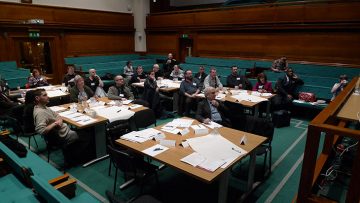
Occasionally I’m asked to lead a workshop with students on professionalism. I always find it interesting and stimulating to discuss with them what a professional mathematician might be and how they might behave. Sometimes their views are positive, using words such as analytical and reliable, but abstruse and impractical also come up in discussion. When we come to discuss such issues as professional codes, I am aware that the IMA codes of conduct are descriptive rather than prescriptive, and rather terse: what exactly does it mean to say, for example that
A Chartered Member shall act in a professional and ethical manner?
It is hardly surprising that students, used to authoritative teaching of provable and examinable facts, might be looking for a set of definite principles that can be written down and applied to any given situation to produce a unique, exact and correct answer.
Our members, and mathematicians in general, apply their mathematics in a variety of contexts: as human beings, as citizens, as employees, as mathematicians and as professionals. Each context poses a range of overlapping, not always compatible, ethical questions: it is not my intention here to try to give an exhaustive analysis, but simply to observe that any discussion of ethics must take them into account – I would expect to find as many ways of striking a balance between them as we have members.
An important aspect of mathematics is the, often surprising, range of applicability of techniques developed for a specific purpose, or indeed, for no definite purpose at all, to a wide range of unforeseen and unforeseeable applications. An example often cited is the path from the differential geometry of the 19th century, via the theory of general relativity, to the remarkable accuracy of GPS-based positioning systems. Were geometers of the 19th century at fault in failing to predict and take account of the implications of their work in the 21st century? I think most readers would agree with me that they were not.
Some questions that members find themselves confronted with have answers that are reasonably likely to be generally accepted. Is it professional, for example, to be told to analyse some data but nonetheless to come to a predetermined answer? Most people would probably say that it was not. But many questions are not so clear-cut.
Is it ethical for a mathematician to help design a more efficient turbine for a jet engine? I have encountered a variety of answers from students in workshops. One common answer is: no, it is wrong to continue to use fossil-fuel powered engines. Another is: yes, it is right to reduce carbon consumption. Yet another view was: only for civilian but not for military aircraft. A fourth was: yes, provided only that the mathematics is correct in itself and correctly applied to the design in question.
Which of these was the right answer? I hope that the present reader will not be as disappointed as some of the students when I decline to offer a simple solution. Indeed, I would ask the reader only to consider which, if any, of the answers might be well-grounded and well-argued, based in knowledge of the various contexts in which the hypothetical mathematician is being asked to operate.
But what I would, and did, say is that precisely because there is not that unique, exact and correct answer we must be ready, as a community, to accept that there will be differences of opinions: and to challenge and defend those opinions on a basis of mutual professional respect.
A fast-expanding application area for mathematics and mathematicians is big data. As mathematics is used to develop new ways of collecting, curating and analysing data sets and streams, so it is also required to reason about and quantify the degrees of reliability and uncertainty in the results of those analyses. The IMA is currently participating in an initiative led by the Royal Statistical Society to develop professional standards in data science, and our President Nira Chamberlain and I have been working both on the steering group for the project and on the working groups for ethics in course accreditation and in professional practice. The remit of those working groups will be to turn the phrase ‘independent professionals working ethically without direct supervision and guidance’ into actionable and assessable criteria. We currently think that these new standards could be an additional qualification which might be held by IMA members as a supplement to the existing membership and chartered grades, but this is not yet certain. What we do know is that as the scope for mathematicians to become involved in data science increases, so will the demand for a clear understanding of how our professional ethics apply to new areas.
Does this mean that the Institute’s code needs to be expanded, made more detailed or more prescriptive? I think not, for several reasons.
Firstly, the domains in which mathematics might be applied are already so wide that a comprehensive code would be impossible to draw up, and would be out of date the moment it was written down.
Secondly, a detailed code runs the risk of becoming a mere box-ticking exercise. A code that supports and informs individual mathematicians using their expertise, experience and personal judgement is more valuable than one which replaces or suppresses the elements of personal judgement and personal responsibility.
Thirdly, any attempt to define comprehensively mathematical applications stifles precisely that innovation and discovery that is at the heart of mathematics, pure and applied. And last but not least, our codes are currently consistent with those of similar professional bodies such as the Royal Statistical Society, the British Computer Society and the Operational Research Society, a consistency which we should not lightly abandon.
What we can do, I suggest, is to develop our common understanding of professional and ethical questions as a community: and to capture that understanding in a series of informal guidelines or supplements to the general principles already laid down by our codes.
Returning, then, to those questions posed in the student workshops. We have a language to discuss such questions and a professional community within which to discuss them. I hope and expect that the Institute will provide its members, and the wider community, with ways to discuss those questions robustly and that it will continue to support them in taking the best decisions they can.
Richard Pinch CMath CSci FIMA
The opinions in this article are those of the author, not necessarily those of the IMA.
Reproduced from Mathematics Today, June 2021
Download the article, Editorial from MT June 2021 (pdf)