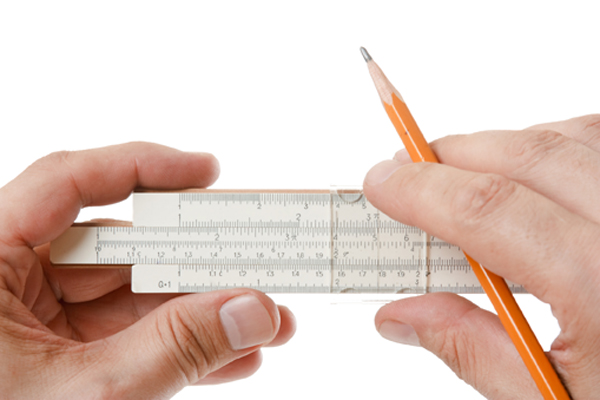
I have written before on the subject of the invention of logarithms by Napier, and their development by Briggs into base  [1]. This year, 2022, is the 400th anniversary of the invention of the slide rule, which took the logarithm from its use in books of tables to being an easily portable and relatively robust calculating device. I am too young to have needed to use a slide rule in earnest, but my teachers, and later colleagues from an older generation, spoke wistfully of them. I am confident that their invention was a great leap forward in enabling disciplines like engineering and marine navigation to become more efficient as a result of their introduction. For those who are unfamiliar, a slide rule is essentially two rods with scales printed on, which when manipulated allows easy calculation.
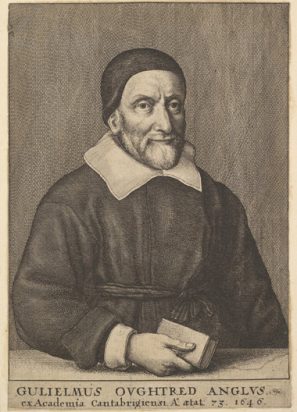
William Oughtred, the inventor of the slide rule, was born at Eton, Berkshire, circa 1574. His father appears to have been a junior master at Eton College, which is where Oughtred went to school. Oughtred entered King’s College, Cambridge, in 1592 when he was in his teens, and became a fellow three years later. Oughtred was a fairly keen writer, and his output included a book about sundials, which he wrote at age 23 and published 50 years later. Oughtred’s most famous book was known as Clavis Mathematicae. Its first edition was a relatively short book of 88 pages but contained the basics of arithmetic and algebra as then understood.
In 1604, Oughtred took up the duties of his chosen profession, that of a priest in the Church of England, becoming Vicar of Shalford in Surrey and later being promoted to Rector of Albury, also in Surrey. Oughtred’s biographer, Florian Cajori [2], makes it very clear that he was not a professional mathematician; he did it as a recreation. Oughtred’s promotion to rector may have assisted with this, as in this period (but not now), rectors were typically paid more than vicars but had less to do.
Little is known of Oughtred’s family life. He certainly married and had at least two children. He also took into his household a number of young men to whom he gave free mathematics tuition. Oughtred died in Albury on 30 June 1660, having burned most of his papers in the weeks before his death.
The property of logarithms that leads to their usefulness as a calculation aid is:
(1) 
For the purpose of this article,  will always be taken to be . The reason that this formula aids calculation is that in the days before calculating aids, the product
  could be a tedious calculation, but with logarithms, it becomes much easier. One simply finds the logarithms of
  and
and  , which can be looked up in a book of tables, and then adds them, addition being less tedious than long multiplication, and hence, less prone to error. Once the sum is known, one can look in the book of tables for the number whose logarithm is that sum, and that is the answer.
Using these books of tables was all very well if one were in a comparatively benign environment, ideally indoors and with a table to work at. One can imagine that in Oughtred’s time, books were costly and precious, and one would not want to get them wet or (frankly) carry them around much.
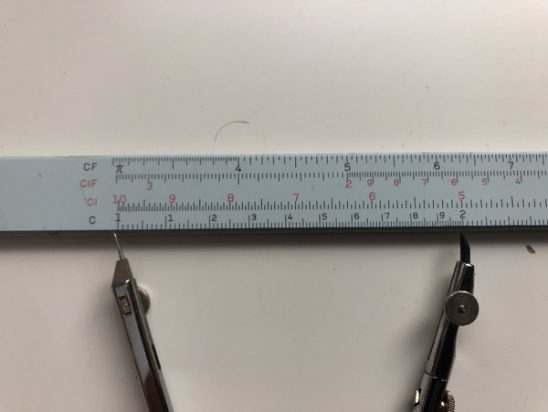
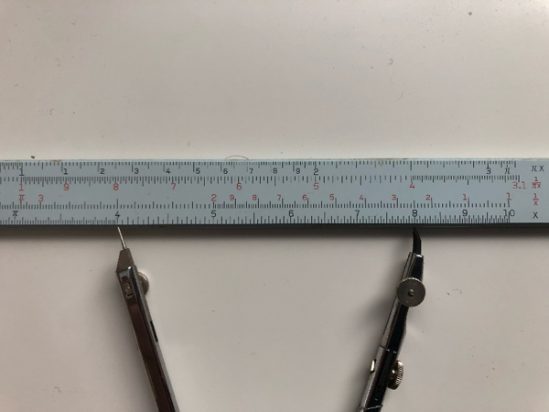
Then in 1620, an English mathematician called Edmund Gunter discovered that one could do simple calculations using a logarithmic scale. Gunter’s approach for multiplying two numbers is illustrated in Figures 3 and 4. In the interests of simplicity, I have used  and
and  . First, as illustrated in Figure 3, one places the left compass spike point at
  and the right at , the first of the numbers we wish to multiply.
The next step is to move the pair of compasses, without adjusting them, and placing them further along the logarithmic scale (Figure 4), so that the left spike is on the other number you wish to multiply, in this case . You can see that the right hand spike points to  , which is, happily, multiplied by .
This is certainly a more robust approach than paper-based logarithm tables, but is a bit fiddly. Two years later, Oughtred realised that the compasses were not necessary. If one had two identical logarithmic scales next to each other, one could simply move the scales for the desired calculation. This is illustrated by the calculation of  multiplied by .
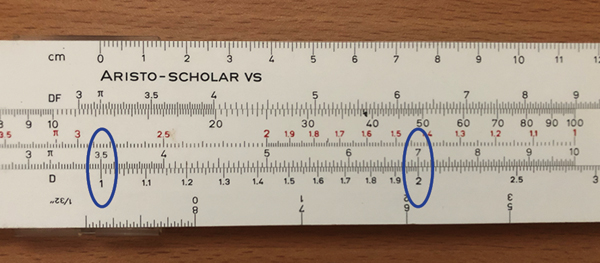
To conduct the multiplication, the upper scale of the slide rule is moved so that the first of the numbers being multiplied is adjacent to , in this case (Figure 5). Then, without moving the rule, one looks for the other number being multiplied, in this case , on the lower scale (ignoring the smaller numbers for decimal places). The answer is the number adjacent to the on the upper scale, in this case,  .
.
Between the 17th century and the mid-1970s, slide rules became the primary means of enabling efficient calculation by engineers, astronomers and others. As time went on, slide rules had additional functionality printed on them, such as trigonometric functions, exponential functions, powers and roots, and multiplication by  .
.
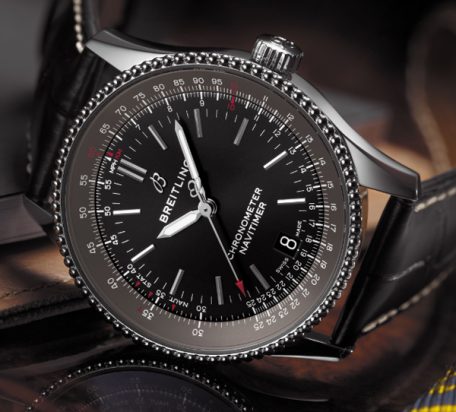
Slide rules to some extent entered popular culture, with the author (and engineer) Nevil Shute calling his autobiography Slide Rule. In the early days of electronic computing, some adverts described computers as being the equivalent of so many ‘engineers with slide rules’. Perhaps, the most pervasive presence of slide rules in modern life is in watches. Many modern watches maintain slide rule functionality, a legacy one assumes of watches designed for aviators in the early to mid-20th century, such as the one illustrated in Figure 6. To use this watch for calculations, one rotates the outer rim of the watch, known as the bezel, whilst the inner rim remains static. Essentially the bezel and rim form a circular slide rule. These watches often also have additional functionality useful to aviators, for example, this one can be used to convert nautical miles to statute miles or kilometres.
Thus, Oughtred created a simple device that used logarithms to enable entire professions to become more efficient and accurate in their work. This invention remained current for over 350 years, and 45 or so years after it became obsolete, it is still a visible part of our world.
Edward Rochead CMath CSci FIMA
Dstl
Acknowledgements
The author is grateful to Mike Lane for reviewing this article.
The opinions expressed in this article are not necessarily those of Dstl.
References
- Rochead, E. (2019) Henry Briggs and his User-Friendly Logarithms, Math. Today, vol. 55, no. 2, pp. 64–65.
- Cajori, F. (1916) William Oughtred, A Great Seventeenth Century Teacher of Mathematics, Open Court Publishing, Chicago.
Reproduced from Mathematics Today, February 2022
Download the article, Historical Notes: Oughtred and the Slide Rule (pdf)