Paul Glendinning is the IMA President for 2022–2023. He is a Professor of Applied Mathematics at the University of Manchester, who specialises in dynamical systems research. He is also a member of the IMA’s Research Group and was also our VP Learned Society, 2011–2014.
Congratulations on being chosen as IMA President. What are your plans for your term?
It’s a really exciting and potentially demanding time to be President. One of the special things about the IMA is just how many different faces it has, so there’s not a simple answer to your question. The membership is not uniform. We’ve got the academic, we’ve got the industrial and public sector, we’ve got education. The membership isn’t uniform in another way: early career and more experienced people. A lot of being President, I think, is about balancing those things and the needs and expectations of those members.
There are three areas, I think, that are really important, which is the internal structure of the IMA, the membership, and the external facing things that we do.
Internally, there’s going to be a massive change. David Youdan has been in charge for 19 years and he has been a great Executive Director. He has given the IMA stability and visibility, but he’s retired, so we will have a new Executive Director, Rosalind Azouzi, and I think one of my roles will be to make her initial period as productive and enjoyable as possible and ensure that the whole of the IMA apparatus is working well and productively.
For the membership, I think there are a number of things that we could do that would provide members with more connections to each other and the broader community and so I look forward to working with the new Executive Director on that front. The five year planning cycle is coming to an end and so one of the things that will need to be done is to review our strategic plan. It’s an opportunity to think about what the membership wants and needs and also to ask the membership to contribute to that.
Externally, I think this is potentially going to be a very demanding period. Lots of stuff has been happening in the mathematical world and the IMA, with others, should be part of a group providing positive and accurate stories; mathematics at the heart of the pandemic policy; big data, AI and machine learning has just exploded; and education at all levels has stresses. So, there’s a huge amount of advocacy for the subject and for the members. We’ve also got things like the prospect of an academy of mathematics to provide a stronger, unified voice to government and policy makers.
I would certainly want to maintain inclusivity, equality and diversity at the heart of everything we do. I think everyone has a voice and part of what I was saying earlier about getting the membership views is about making sure everyone’s voice can be heard and I think that’s absolutely vital to everything we do.
Having been involved with the IMA for many years, what do you think is the most important role of the Institute?
The short answer is representing its members and the long answer is developing the key actions that allow us to do that well. This is possible thanks to our strong, supportive staff including voluntary officers. We shouldn’t forget just how many people give time to the Institute. There’s advocating on the broader stage for the members and the community, and also things like the budget to deliver and so on. What’s the most important role? I think it’s being there for mathematics and being there for the members.
Having different constituencies creates all sorts of stresses but in the most productive way so I think a President forgets the different constituent parts of the IMA at his or her peril. I think one of the things that has always made me feel the IMA is special is that it’s not just another bunch of X talking to itself, it’s actually got these really dynamic, interesting facets. Wherever maths is, we are, and I think that’s great.
How important do you think the recent government investment in the mathematical sciences is for our subject?
This is one where it’s very hard to give a definitive answer because it’s not quite clear what the recent investment actually is going to be. Broadly speaking, it’s hugely important. We’ve been arguing for years that the mathematical science budget for Engineering and Physical Sciences Research Council (EPSRC), for example, is far too small to deliver both the research and the mathematically trained people that the country needs, so this is an enormous opportunity. We’ve been promised £300 million over five years, £100 million of that has been committed and it’s not quite clear whether we’ll get the remainder at the moment, but whatever happens, it’s a significant uplift. That means we, the community, have to show at the end of five years that we’ve actually done something sensible with it and that it has made the difference that we kept saying it would. So, I think there’s a role here for the IMA to help the community to consolidate that funding. There are all sorts of challenges around making sure that narrative is captured and I think that’s something the IMA should also be part of. The case for funding has in many ways never been stronger and maths has been visible in ways that it hasn’t been visible for years. You’ve got all the modelling around the pandemic. You’ve got big data in its many forms suddenly being pervasive within industrial applications and so on.
Can you tell us an interesting application for your research?
I think the most enjoyable applications I’ve done over recent years are about insects, for example dragonflies. It turns out that what the dragonflies do is also relevant to computer games. They have this really cool strategy. Suppose you’re an aggressive dragonfly and there’s another dragonfly that you want to intimidate. What you do is you pick something behind you so that you’re between the peaceful dragonfly and some reference point. So, as the peaceful dragonfly is moving around, you move so that you’re always on the line between that dragonfly and your reference point but you move up it towards the dragonfly. That line is moving and you’re on the moving line between the reference point and the peaceful dragonfly but you’re moving so that you’re getting closer to the dragonfly. What this means is if metaphorically the peaceful dragonfly just glances over its shoulder, it sees you as though you were still at the reference point until suddenly it goes ‘woah, you’ve got so big!’
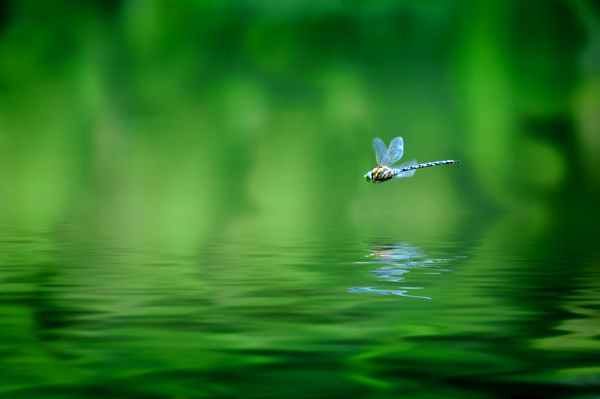
People had talked about this in a variety of contexts and computer scientists had done a step version, I move a step, you move a step, I move a step, but nobody had actually written down the differential equations. So, I wrote down the differential equations and did a bit of analysis on them and so on. It wasn’t hugely hard mathematics but it was a really nice little bit of application of the differential equation stuff that I do.
How does that apply to computer games?
Suppose that you’re designing a tank that’s going to try to attack the player and the tank can’t fire until it’s in range. What you do is get the tank to adopt this strategy (which is called motion camouflage) and the player has to recognise that although the tank doesn’t appear to be moving relative to reference points, it’s actually slowly getting bigger and of course because you’re concentrating on all sorts of other things, you don’t actually notice this until it’s really quite big. It turned out that computer programmers had also been using this sort of idea and again the equations that I wrote down allowed them to formalise that in a nice way.
You recently became a Fellow of the Royal Society of Edinburgh, can you tell us about that?
It’s always nice to get recognition. So, yes, it’s lovely and it’s really been associated with my work at the International Centre for Mathematical Sciences (ICMS) and the visibility of Scotland through that work. The profile of ICMS has expanded a lot within the last five years. We’ve got £8 million odd of new funding, we’ve expanded the things that we do, and that’s going to continue, and so it was a nice recognition.
As the last Director of the ICMS (2016–2021), can you tell us what it does and what you’re most proud of?
The ICMS is based in Edinburgh but it’s funded to support the UK mathematical sciences community in its broader sense across the whole of the UK. The aim is to bring people together to do research. Its standard fare is one week intensive research workshops and historically 50% of those people would be international, 40% would be early career, so it’s the sort of thing that can change lives. It means that people at an early stage of their career mix and meet the established figures, the people whose papers they’ve been reading and so on, so it’s very exciting and it’s been a privilege to have been a part of that and changed it.
I really enjoyed my time at ICMS, it’s been brilliant. One of the things that I’m very proud of is the way that the staff reacted to the pandemic. We very quickly made the decision to work through Zoom in providing connectivity for the UK mathematical science community, so we’ve been hosting a lot of online activity.
I think the lovely thing about ICMS for me was that we have done some things that are classically brilliant and we’ve done things that are innovative and interesting and help people. You have some things that are just utterly mainstream fantastic but also you do some things which are a bit different and give different voices to different people which is really important too. I really enjoyed the eclectic element of being in charge at ICMS.
We can also get some things wrong. I think you shouldn’t underestimate how important it is sometimes to get things wrong, you learn in many more ways through this than getting things right. As part of that, we’ve developed a much more nimble and strategic branch to the workshops which allowed us to respond to specific calls and political and/or scientific changes so we were able to do quite a lot of things that were just interesting and timely.
How has the Virtual Forum for Knowledge Exchange in Mathematical Sciences (V-KEMS) helped society address the challenges of COVID?
V-KEMS grew out of collaborations between ICMS, the Newton Institute (INI), Knowledge Transfer Network, and individual academics. It provided a way for the maths community to engage with industrial and practical issues during the pandemic. Actually, again it fits beautifully into an IMA remit in many ways. I’ve not actually myself been involved in the work. I was very much an enabler rather than a doer, but I think enabling something like V-KEMS was brilliant. They’ve done a series of reports, for example, on the effect of students return to campuses, the spread of COVID in railway carriages, seating arrangements in restaurants and seminars, and some of these reports went back to the Scientific Advisory Group for Emergencies (SAGE) and were used on the national stage so it was a great thing to show how mathematics can actually help practically and in a timely way. It wasn’t, ‘Oh, well we’ll sit for three years having a PhD thinking about this’, it’s, ‘We’ve got to get a report out within the next month’ and that’s not a rhythm that mathematics is used to and not a rhythm that many people are comfortable with but it worked incredibly well.
The IMA launched the Hedy Lamarr Prize in 2021 for outstanding work on knowledge exchange in the mathematical sciences and the first recipient of that prize was Rebecca Hoyle from Southampton. She has done a lot of other things too, but the prize was primarily awarded for Rebecca’s V-KEMS work during the pandemic. She is one of the leading academic voices in V-KEMS. With all these things, you can set up a vehicle that allows something to happen but you need the buy-in of a number of really energetic and talented people to make it work. She was someone that made it happen. I suppose one of the things I hope that I’m quite good at as an administrator rather than as a mathematician is giving people that space. It’s about me setting things up so that the right people can do it and Rebecca was very much a right person.
Another positive from the move online has been improved accessibility. One example is the virtual Black Heroes of Mathematics conferences held by the IMA, ICMS, INI, BSHM and MA. Can you tell us about that?
Every now and again, you’re part of something special, a complete game changer. I think all of us at ICMS felt that way about the Black Heroes of Mathematics first meeting. At the end of it, we sat back and we just went, ‘Wow, we are so proud that we’re part of that’. I think one must pay tribute to our outgoing President, Dr Nira Chamberlain, who has set something up that I think will continue and it will be influential and just so positive. I mean it was just such a good thing and it’s rare that one can simply say, ‘That was great’. I think part of the influence of it is going to be the fact that it was online which meant that anyone who felt interested could take part. You could just take part wherever you were and if you couldn’t attend things, you could catch up or preview. There were some fantastic live plenary sections and some fantastic live talks but there were also recorded talks which you could listen to at whatever stage was convenient. I think the online part of that was a really strong element of getting as many people as possible involved. It was brilliant.
Susan Okereke gave a fantastic talk about the importance of education and in particular maths education for people’s lives and how much of an indicator that was for future prosperity, stability and success. It was a very powerful talk and one of the things raised was how to bring new perspectives by developing a dialogue between academia and teaching. In particular a black perspective there but there are other ones you can think of too and I think that is something that I hope that we can do more of.
Do you think virtual and hybrid models will continue to improve the equality, diversity, and inclusion of the maths community?
I think the move online is here to stay and it’s positive in all sorts of ways. I Zoom with a colleague in New Zealand once a week and we’re on paper three or four of the period so that’s been hugely positive. It works because we know each other very well. We can say when it’s just not convenient, we can say things that are stupid, which I think is so important. There are things it’s not so good at. For example, new academic collaborations, where having confidence in each other to be wrong is actually quite difficult using the current platforms. But for established collaboration, it’s brilliant.
I think it will just make it so much easier for people with caring responsibilities, or who don’t want to travel, for example, to engage. Committee meetings, I think are just brilliant. It means the days when you get back at half ten at night from a three hour meeting in London are gone. I think particularly if you have a young family or something like that, it just means that you don’t have to think, ‘Oh, am I going to do that and if I do that then my partner has to do all these things and is it fair just for that three hour meeting?’, and all that sort of thing. I’m absolutely sure that it is excellent for inclusion and accessibility and just makes sense.
How important do you think this is for improving the sustainability of academic activity?
Yes, absolutely vital. I think environmental sustainability is a major issue for the universities and actually it’s one that they’re not great at acknowledging at the moment. If you look at most universities environmental sustainability pages, they will say, ‘Wow, we’re doing all this fantastic research that will make the world a better place’, they’ll say, ‘Wow, our hospitality groups are using sustainable cups and saucers and food’, but they will not mention the fact that half their academics are flying to the USA twice a year and to China and to India and to wherever.
There is a massive carbon footprint of academics because we value speaking with each other. I’m not saying it’s not valuable but it’s a massive footprint that we need to acknowledge and think about. It goes back to your online issue, how much do we have to do that. I think over the next five years, most universities will have to do a carbon footprint audit which includes academic travel. It wouldn’t surprise me at all if research grants came not just with a financial budget but with a carbon budget which you would have to keep to, and I think it’s inevitable that you would have to make a much stronger case for the need to travel and to do things particularly across the Atlantic and for me to New Zealand.
One of the things we talked about at ICMS was how to have conferences held in different time zones and in different places at the same time. Whether it’s the idea of a 24 hour conference where the baton is sort of handed on around the time zones with some overlap as you go on or just two hubs, one in the States, one in the UK, that get together at the time when it makes sense for them to be together but are apart and then report back. You could imagine parallel conferences as opposed to parallel sessions. We’re quite comfortable with parallel sessions in a conference so why not parallel conferences in a conference.
Bringing it back to the IMA, MT readers will remember your View from the Pennines series which ran from 2002 to 2012. Which of your 50 articles was your favourite?
In many ways, my favourite was the process because you see I was doing it at the time when I became head of school in Manchester in charge of merging the departments at Manchester and UMIST which were two sizeable departments so it was a very big thing to do. In many ways, View from the Pennines kept me sane. It gave me something where I had to think about maths but not my maths. I would give myself two or three days to do them and it was a real pleasure.
The dragonflies I was talking about earlier started life as a View from the Pennines. I spotted an article in the journal Nature that made me think. I have a pond in the bottom of the garden and so I’d been watching dragonflies and I was really enthusiastic about the dragonfly aspect but then it turned into a little mathematical project too so that’s always nice when those things fit together.
The other thing I really enjoyed was the bit I did on Montessori mathematics and teaching. My daughters had a period when they were in a Montessori nursery school and Fiona, my wife, and I went on a training course that they had arranged on Montessori methodology. So out of that, I was thinking, ‘I’ll play with the ideas and create a little Montessori mathematics game of Pythagoras’ theorem’, so taking pieces out of a big square and arranging them in a little square which basically showed that the area of the big square was the sum of the areas of the little squares but also making it colourful and interesting. From a personal point of view, I really enjoyed that.
I was also quite chuffed about my article on the Poincaré hypothesis being proved because it was one of the first articles to talk about the proof, and it was celebrating a pure-ish problem in an applied-ish magazine. I am very pleased that Alan Champneys continues his Westward Ho! column which takes the same principle of ‘oh, I’m going to talk about something that interests me’.
Also on this topic, you also often took inspiration from your landscape – what draws you to the moors?
We’ve got National Trust moorland just across the road from us. It’s a lovely question actually. I like space and air and there’s a lot of that on the moor and we have a dog, so I’m forced onto the moors at times, and in weather, when normally one wouldn’t consider a walk. That is actually quite special because it means that you see the same landscape in all sorts of different lights and weathers and so on. It’s never the same and that’s great. I take a notebook with me and often stop for a minute to jot down a good idea or a good phrase, so I quite like that. I think one of the things I love about the moorland is its human aspect. Usually you think of moorland as these waste lands, sort of heather, scrub, and that’s true but once you get to know the moors, it’s actually much more subtle than that. They’re human creations. The moorland over the road from me was forest. It was people who cut down the forest to use the wood and then grazed sheep on it. We have reservoirs, we have catches, there were stonemasons working in the moorland in the 19th century so everything actually is not completely natural. It’s this interplay between human construction and nature that I find endlessly fascinating. It’s a wonderful, always changing but never simple landscape.
Rebecca Waters
Editorial Officer
Reproduced from Mathematics Today, February 2022
Download the article, Interview with Professor Paul Glendinning FRSE FIMA (pdf)