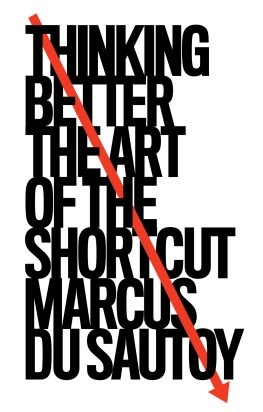
 Marcus du Sautoy
4TH ESTATE 2021, 352 PAGES
PRICE (HARDBACK) £20.00 ISBN 978-0-00-839391-5
‘To find good shortcuts requires an ability to lift yourself out of the geography you’re trying to traverse. If you are in the landscape then often you can only rely on what you can see around you.’ (p. 4). This quotation eloquently sums up this book, written in du Sautoy’s distinctive fluent style, not once resorting to hackneyed phrases such as ‘thinking outside the box’.
Thinking Better: The Art of the Shortcut may be seen as something of a love letter to Carl Friedrich Gauss, who is a running topic throughout, starting with the precocious child finding the smart way of adding up the integers from 1 to 100 by pairing them up and sprinkling in biographical details throughout. More prosaically the book can be thought of as a collection of problem solving techniques woven together, illustrated of course by some of the usual suspects (I’m looking at you, Monty Hall and Four Colour problems) as well as some far more novel examples, as with the chapter on networks which while starting with the ubiquitous bridges of Königsberg problem, moves swiftly into the realms of human heuristics and social shortcuts. I am always wary when an author is brave enough to include a whistlestop introduction to calculus in a book designed for a lay audience, and I leave it to you to decide whether that chapter succeeds.
Each of the ten chapters opens with a tantalizing problem which is addressed later in the chapter using the technique explored therein, such as pattern spotting, recasting the problem in a different context, examining data, or changing the language used. The most successful shortcuts in my experience are born out of diagrams – as covered in Chapter 5 – reminding me of my sixth form maths teacher, Mr. Thomas, and his favourite phrase to scrawl on homework where a simple pictographic representation could have avoided either error or unnecessary labour: ‘Don’t be a wretch, draw a sketch!’ or, simply, ‘Wretch!’ Even teachers need their own shortcuts for their shortcuts sometimes.
A recurring theme in this book, which sets it apart from the myriad miscellanies mathematicians manufacture, is that shortcuts are not universally good. The ‘pitstops’, interleaved between the chapters, look at more real world applications as a reminder that a shortcut sometimes neither exists nor is desirable. For me, it is these pitstops which elevate this book from the status of simply another collection of mathematical curiosities, to a truly original and compelling work. Indeed, examining the raison d’être of shortcuts and acknowledging that sometimes the journey is the point of the exercise, it is a fair conclusion that ‘[w]hat is a shortcut for one … might be completely the wrong path for another, leading people away from what they believe is the correct destination.’ (p.173). The helpful distinction between two types of work exposed by Aristotle: ‘praxis, which is action done for its own sake, and poiesis, or activity aimed at the production of something useful,’ (p. 14) with the latter being the prime target for shortcuts and the former where the joy of the work is found. Without being annoying, du Sautoy is borderline philosophical in places, helping to keep the reader grounded and a sense of perspective, a reminder of the thrill of the chase.
Simply put, this is one of the most fantastic popular mathematics books I’ve ever read, even down to the introduction which could stand by itself as a wonderful essay on the art of the shortcut. I could not put it down, and would recommend it highly. For anyone that may not yet be convinced, perhaps have a listen to du Sautoy’s substantial interview with Stephen J. Dubner, talking about this book on What’s Wrong With Shortcuts?, episode 483 of the popular podcast Freakonomics https://freakonomics.com/podcast/frbc-thinking-better/.
George C. Matthews
Book review published directly onto IMA website