Tiago Hirth et al.
MATHEMATlCAL SOCIETY ARCHIMEDES 2021, 200 PAGES
PRICE (HARDBACK) £10.00, ISBN 978-86-6175-096-0
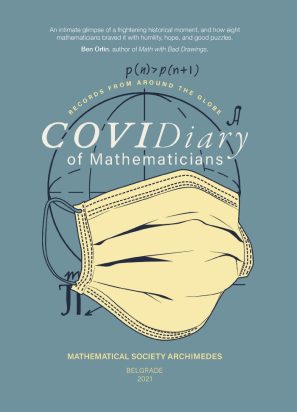
COVIDiary of Mathematicians is a series of diary entries from mathematicians in several countries, all written during the first lockdowns in their respective countries during the early stages of the SARS-CoV-2 pandemic. Mathematicians from Portugal, Spain, Italy, Serbia, India and the USA discuss how the pandemic affected their personal and professional lives, how they had to adjust to teaching via Zoom and how some of them balanced their workload whilst also home-schooling their children, situations entirely relatable for many of us.
The mathematicians all lived rather different lives during the lockdowns in their respective countries. We get to see how the lockdown rules were different between those countries (some countries had very very strict rules on allowing children out, some countries had enforced curfews in the early evening but more relaxed rules for daytime, etc.) but the similarities are stark – all of them had to adjust to teaching from distance via their computer and a Zoom call, and they all struggled somewhat to adjust to spending lots of time at home rather than in the office and going elsewhere recreationally.
The authors all recount very different experiences and how they reacted to suddenly-changing circumstances that affected everyone around the world all at once. One of the mathematicians writes about how his city’s soundscape has changed dramatically, something that he cannot escape as the usual ambient soundtrack to his working day has noticeably become quieter. Another writes about how the pandemic has affected the different members of his family, and another discusses how he started practising magic much more to take his mind off the intense workload coupled with the familiar daily news stories of infection counts.
The book has some maths problems inside that the authors used to keep their minds off the difficult situations they found themselves in as the world changed in spring and summer 2020. Indeed, it is these maths problems that ensure the book stays within the genre of a mathematics book, because first and foremost this book is about the mathematicians and their lives, rather than mathematics. It’s enjoyable, it’s well-written and it’s an interesting quick read about the ordinary lives of a collection of mathematicians, but it’s not a book to pick up if you want to learn about new mathematics.
One really good aspect of the book is that the authors have all published QR codes in their respective chapters to take the reader directly to a topic they talk about, be that further information about something or indeed a webpage that presents a recreational maths problem they’ve tried to solve during some downtime, sometimes even one they have made themselves. This use of QR codes brings the reader into the world of the author much in the same way that Zoom or Teams brought the students and the authors together during the lockdowns. It’s a nice touch.
Overall I enjoyed reading this book, but it needs to be stressed that this is a book about mathematicians, not necessarily about mathematics. The COVID-19 lockdowns caused enormous changes in all of our lives when they began in spring 2020 and those changes ought to be documented. This book does that well, and it includes a sprinkling of mathematics here and there to keep fellow mathematicians amused. It’s an unusual non-fiction book, and it’s very relatable. It’s a quick read but if you’re looking for something different to read in the next few months then this is a good bet.
Dominic Thorrington MIMA
Haute Autorité de Santé
The views and opinions expressed are those of the author and do not necessarily reflect those of Haute Autorité de Santé.
Book review published directly onto IMA website