David P. Landau and Kurt Binder
CAMBRIDGE UNIVERSITY PRESS 2009, 470 PAGES
PRICE £48.00 (HARDBACK) ISBN 978-0-521-76848-1
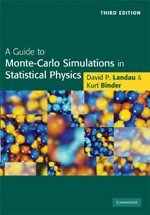 The authors, David P. Landau (Distinguished Research Professor of Physics and Director of the Center for Simulational Physics at the University of Georgia) and Kurt Binder (Professor of Theoretical Physics at the Institut für Physik at Johannes-Gutenberg-Universtät Mainz), consider Monte-Carlo simulation to be “… the ‘time dependence’ of a model for which change, or growth, does not proceed in some rigorously predefined fashion (e.g. according to Newton’s equations of motion) but rather in a stochastic manner which depends on a sequence of random numbers which is generated during the simulation”.
They provide an introductory chapter on thermodynamics, statistical mechanics and probability which is essentially a review of important features underlying the topics presented later in the book. They note that this chapter is not intended to replace other textbooks in the field, but is to refresh the reader’s knowledge. Certainly, though they write lucidly with good use of illustrative examples, one would have difficulty absorbing the concepts presented without having had some prior exposure to them. This chapter also provides an introduction to a few different types of pseudo-random number generators.
Having presented the thermodynamic and statistical background they then provide a few examples of simple sampling Monte-Carlo methods. These begin with the calculation of the area under a curve, and then touch briefly on applications to Laplace’s equation, radioactive decay, neutron transport, fluid flow, percolation and random walks. The next few chapters then get into the ‘meatier’ topics of importance sampling Monte-Carlo methods, which they illustrate using Ising spin models and variants thereof, such as Potts models, spin-glass models, clock models, and other lattice-based models.
The book continues with chapters on off-lattice models, reweighting methods, quantum methods, renormalization group methods, non-equilibrium and irreversible processes and lattice gauge models before very briefly reviewing other, non-Monte-Carlo simulation methods of tackling statistical physics systems. It ends with two chapters, one of which considers Monte-Carlo simulations at the periphery of physics – including astrophysics, materials science, chemistry, biology, sociophysics, traffic simulations and others – and one dealing with biological models – including protein folding carbohydrates and macromolecular structures. An appendix contains Fortran listings of some of the programs mentioned in the text.
The book will prove useful to graduates and researchers in the field of statistical physics; but I will end with the six points of advice proffered by the authors that should be considered by anybody using Monte-Carlo simulation:
- In the very beginning, think!
- In the beginning think small!
- Test the random number generator!
- Look at systematic variations with system size and run length!
- Calculate error bars!
- Make a few very long runs!
Alan Stevens CMath FIMA
Mathematics Today August 2011
A Guide to Monte-Carlo Simulations in Statistical Physics can be purchased at Amazon.co.uk