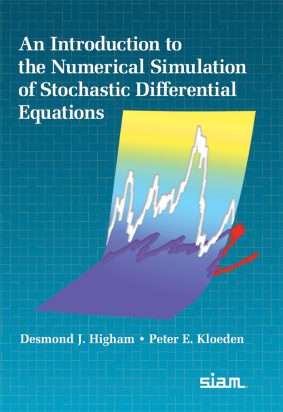
Desmond J. Higham, Peter E. Kloeden
SIAM 2021, 277 PAGES
PRICE (HARDBACK) £86.00 ISBN: 978-1-61197-642-7
An Introduction to the Numerical Simulation of Stochastic Differential Equations does exactly what it says on the tin: it truly is an introductory work, explored through numerical simulations (backed up by a solid survey of the underlying principles), of stochastic differential equations (SDEs). SDEs, in the broadest sense, are differential equations with at least one stochastic process term, i.e., a term which introduces an element of randomness into a model of a system which appears to behave in a random manner, such as molecular dynamics or financial derivative pricing with a ‘noisy’ underlying asset. The book was born out of one of Professor Higham’s articles published two decades earlier, with the aim to create a ‘self-contained, elementary text that puts across the fundamentals as succinctly as possible… [with] heavy use of computational examples and illustrative figures’ (p. xi) without getting bogged down in endless lemmata on convergence and error analysis.
The book is split into 20 chapters, which fall into four implicit non-continuous parts. Chapters 1 to 7 deal with necessary background and SDE fundamentals, through the usual suspects of random variables, Brownian motion, stochastic integrals, SDEs and the Itô formula. The second part – chapters 8 through 10 – start the serious discussion of SDE simulation with the Euler–Maruyama method as the widely-used and de facto canonical technique, covering both weak and strong convergence in sketch. The remaining chapters deal with more recent developments such as steady states and exotic options (chapters 11 to 16 and 20), and advanced classical applications such as systems of SDEs and higher order methods (chapters 17 to 19).
There are a number of aspects of this work which make a refreshing change from other books on SDEs. There is an unapologetic level of accessibility and brevity in lieu of more comprehensive and rigorous works, while acknowledging this approach with numerous pointers to the more technical literature that is available to those for whom the details really matter. There is also broader motivation for the studies of SDEs beyond the ‘classical’ applications to financial derivatives, central though they have been to the development of the field in no small part due to the lucrative nature of the results. In addition, there is a real effort to showcase some of the most modern topics in an accessible way outside of being forced to read the original research, with the authors covering areas such as simulation regimes in chemical kinetics, SDEs with jumps, and modelling with coloured noise.
Each chapter concludes with exercises and, more importantly, with MATLAB code. The programs, while not necessary to follow the core results and flow of the book, add chunks of code in digestible chunks to help illustrate and model the concepts introduced in the chapter to deepen understanding. The code is annotated with commentary throughout which will be of particular assistance to those less familiar with coding syntax in general, as well as a ‘walk-through’ for each section of code giving an overview of the code and tying it back to specific sections of the accompanying chapter. It is this additional detail which really makes the code come into its own as both an aid to comprehension and takes the book from a mere textbook to more of a handbook.
The study of SDEs is not an elementary subject and will always require a solid background in several aspects of undergraduate mathematics, but having said that this book makes the subject as intuitive and accessible as possible in under 300 pages. It would have certainly been a welcome addition to my bookshelf when I struggled with the subject over a decade ago, and will be helpful for anyone who may have a passing acquaintance of the subject and wishes to gain a greater understanding without wanting all the nitty gritty while being assured that the results are both sound and well referenced in the extensive yet thoughtful further reading.
George C. Matthews
Book review published directly onto IMA website