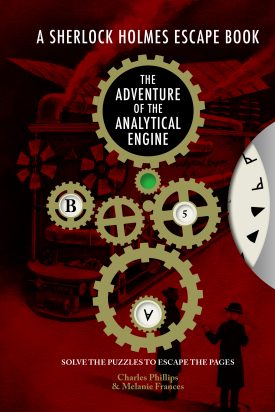
Charles Phillips and Melanie Frances
AMMONITE PRESS 2022, 152 PAGES
PRICE (PAPERBACK) £9.99 ISBN 978-1-78145-441-1
This is the third in a series of similar ‘escape books’ which combine puzzles with the structure of a choose-your-own-adventure novel. The reader takes on the character of Sherlock Holmes, and the story unfolds differently according to the choices made and the solutions found. This is a very attractive book, printed in colour throughout, and with a ‘code wheel’ embedded in the front cover, which is vital to solving several of the puzzles.
The premise of the book is that Holmes and Watson are invited, seemingly by the long-deceased inventor Charles Babbage, to a private viewing of his now-completed Analytical Engine. Once trapped inside the London house to which they are lured, they must solve puzzles in order to move from room to room, all the while gathering clues as to the solution of the overall mystery of who has really imprisoned them there and why. What makes the book quite pleasing to Sherlock Holmes aficionados is that the story is slotted neatly into the sequence of original Holmes stories, namely just after Holmes’s apparent return from the dead in The Adventure of the Empty House (which may or may not have relevance to the plot).
The puzzles are mostly of the deductive kind found in books of logic problems (for example, figuring out which of a series of interlinked statements must be the true one, or navigating a maze). There is also some codebreaking, and very occasionally a little calculation. One or two of the puzzles are a bit simplistic, but mostly they are pitched at a good level for the general reader, and some are quite tricky. Early on, the reader seems to be nudged back onto the right path if a wrong answer is given, but later in the book there is a danger that incorrect solutions by Holmes (or, rather, the reader!) will give Inspector Lestrade the opportunity to solve the mystery first. It was surprising how anxious it was possible to get when our heroes were in peril within the story, with their salvation resting on the solution of a particular puzzle!
It is clear that a great deal of thought has gone not only into the puzzles but also into the storyline, which is genuinely intriguing, and more than just a framing device. It is populated with familiar characters from the Holmes stories, as well as with real-life historical figures. Moreover, the fact that the reader does not work linearly through the book means that it is difficult to gauge how far through the story you are, and this adds to the overall mystery.
Neither the book itself nor the publisher’s website give any clear indication of the age range at which this book is aimed, and this perhaps suggests the hope of a broad appeal – one that I think the authors have achieved. Most of the puzzles could be tackled by a 10-year-old (say), and yet there is also plenty here to interest adult readers. As I hope this review makes clear, I really enjoyed working through this book, and I recommend it highly. I’m certainly going to go away and tackle the other books in the series.
Christopher D. Hollings FIMA
University of Oxford
Book review first published in Mathematics Today February 2023