James D. Stein
WO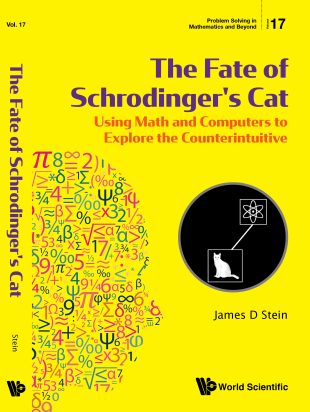 RLD SCIENTIFIC 2020, 172 PAGES
PRICE (PAPERBACK) £25.00 ISBN 978-981-12-1815-6
Normally, I find it quite easy to categorise a maths book. There are ones full of specialist detail, intended to help researchers in a particular field. There are others that are easily accessible, presenting the joy of mathematics to a wide audience. And, there are many other types, as well. However, I have to admit that I found it quite difficult to decide quite where to place The Fate of Schrödinger’s Cat. It’s certainly not intended to be a weighty tome, at the forefront of a specific field. Conversely, whilst the text is generally engaging, I suspect it’s more accessible to mathematicians than it is the general public. Some may find this book’s slightly unusual nature irritating or unsettling, personally, I found it interesting and invigorating.
The text comprises twelve chapters, organised into four sections. The first, and largest, section is entitled The Realm of the Counterintuitive. This establishes a key theme: the notion that simple mathematics, which only uses ‘high school algebra’, can provide interesting and surprising results. Within that context, it’s not surprising that the first chapter is based on the Monty Hall problem. Here, the description is functional but, perhaps, could have been clearer, especially if the intent were to engage a broad audience.
The next two chapters build up to a description of Blackwell’s Bet. They show how combining two independent probability distributions can produce decision-making strategies that are unexpectedly effective. The remaining three chapters in this section illustrate applications of Blackwell’s Bet in a number of situations, including the one from which the title is drawn. There’s enough explanation and proof material to allow the reader to keep up, but on occasion this can be somewhat brief, rather like notes scribbled on the back of coffee shop napkins. And, for me, that’s the easiest way of describing this book: it feels like a chat in a coffee shop with an old friend, which meanders along a number of different directions.
The second section focusses on the interaction between mathematics and sport. It contains an entertaining discussion of some poorly chosen statistics that have been presented during televised matches. It also includes practical examples from American football, where the choice of either a one-point or a two-point conversion is investigated, as well as a description of how tennis scoring (points, games and sets) magnifies small differences in player ability.
The results of a number of computer simulations are included in this section (and elsewhere). These are accompanied by helpful descriptions of relevant topics, including the importance of pseudo-random number generators. However, it’s curious that the author writes these simulations in BASIC, rather than something like Python. This doesn’t detract from the text, but it’s another thing that made the book a little bit unusual, at least from my perspective.
Building on the earlier material, the third section asserts that mathematics and computers can help inform our intuition. It includes a brief description of why the ‘hot hand’ or ‘sticking with a winner’ might be a sound strategy. This might have been a good point on which to conclude but, almost as a free gift, the reader is offered one more section. This is very brief, being only a single chapter of eight pages, focused on advertisements. Although interesting, the explanation is short and the material seems out of step with the rest of the book.
Overall, despite the occasional quirk and eccentricity, I found this an interesting work. It made me think about old things in new and different ways, for which I am grateful.
Rob Ashmore CMath CSci FIMA
Defence Science and Technology Laboratory
The views and opinions expressed herein are those of the author and do not necessarily reflect those of the Defence Science and Technology Laboratory.
Book review published directly onto IMA website