Act I: SCENE I
PhD students across most universities in North America play a key role in the teaching of mathematics. As a graduate student at the University of Toronto, I taught many classes, and a large number of my contemporaries had extensive lecturing experience before graduating. Anecdotally, the teaching contribution from PhD students to mathematics teaching at British universities is increasingly important, and this is particularly true at the University of Sheffield where I lecture.
Sheffield’s School of Mathematics and Statistics’ (SoMaS) service teaching to Engineering students uses a flipped classroom which necessitates many teachers to help consolidate our engineering undergraduates’ mathematical understanding (see [GM] for more). Thankfully, PhD students at Sheffield have filled this enormous hole with evidenced success and great enthusiasm. However, mathematical pedagogy is deep, and challenges in the teaching of mathematics manifold. So, offering opportunities for our educators to develop their understanding and knowledge of mathematical pedagogy is of fundamental importance.
In 2019, Natasha Ellison, then a University of Sheffield PhD student, in collaboration with Dr Alison Poulston succeeded in winning an IMA/RSS Higher Education Teaching and Learning Series 2019/20 grant. They would organise a workshop to support the much-needed development of PhD students who teach mathematics at university level. We were all excited to see their success, and to grow our postgraduate students’ enthusiasm for mathematical education.
ACT II: SCENE I
On the first of January 2020, the IMA/RSS workshop at Sheffield was organised, the speakers confirmed, and participants registered for attendance at a fantastic event on the 22nd of April 2020. On the 31st of January 2020, the United Kingdom had its first two cases of Covid-19. By the end of March, the country’s first lockdown was announced, and by the end of the year the ONS reported 72,178 deaths in England and Wales due to coronavirus (see [ONS]). The workshop was necessarily cancelled, but the need and desire to enable the development of mathematics PhD students with interests in teaching mathematics remained equally pertinent.
ACT II: SCENE II
A lot can change in three years, but a lot can stay the same too. By 2023, the world had mostly recovered from its global pandemic, and the UK still needed to do more to support our mathematical PhD students develop as educators. While Natasha and Alison had left Sheffield, SoMaS remained full of PhD students and staff who are passionate about mathematical education. So, when the opportunity came up to take over the IMA/RSS legacy grant to support PhD students develop as educators, many at SoMaS were interested, finding a large group of people with diverse backgrounds was easy, and the appetite to do something special was clear.
We settled on a team of nine, with varied backgrounds, perspectives and experiences. Our team of mathematicians varied from PhD to professor levels (see below), and mathematical interests ranged all the way from theoretical cosmology to geometric topology. Ideas varied, but held the consistent theme of wanting our event to be as welcoming and diverse as possible. To do this, we tripled our funding through generous contributions from both SoMaS and the University of Sheffield’s Faculty of Science, we went very heavy on promotion, and embedded social activities as an essential part of the 2023 conference. More on the organisers’ experience will appear in an upcoming Elevate blog post.
Organisers:
- Brad Ashley (PhD student)
- Poppy Jefferies (PhD student)
- Matt Lennard (PhD student)
- Dr Wodu Majin (teaching and scholarship)
- Constantinos Papachristoforou (PhD student)
- Dr Fionntan Roukema (teaching and scholarship)
- Dr Dimitrios Roxanas (teaching and scholarship)
- Dr Rosie Shewell Brockway (teaching and scholarship)
- Professor Markus Szymik (teaching and research)
ACT III: SCENE I
The IMA/RSS Higher Education Teaching and Learning Series 2019/20 Effectively Teaching as a Mathematics as a Postgraduate took place on the 25th of May 2023, just 1128 days late. However, it took place with great anticipation, meticulous planning, and a series of talks to broaden our visitors’ pedagogical horizon, and social activities to meet as broad a range of PhD students as possible. The conference was oversubscribed with diverse uptake from across the country. Including speakers, we accommodated our full capacity with 66 participants from 18 universities across England, Scotland and Wales. Full details of the day’s events can be found on the Effectively Teaching Mathematics as a Postgraduate webpage.
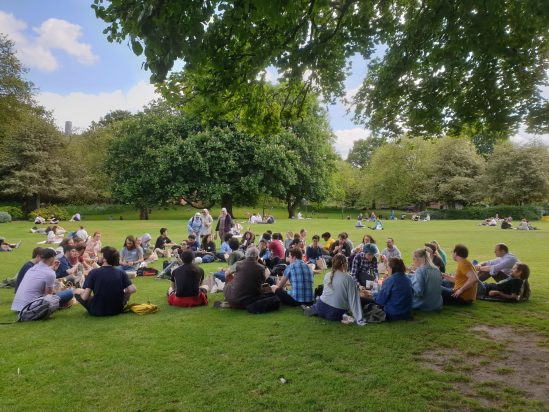
Headlines included tremendous speakers who gave extremely engaging talks (see below) which were complemented by a long afternoon picnic. While South Yorkshire’s omnipresent grey sky was absent (see Figure 1), all the other classic British picnic clichés of football, Frisbee, bad sandwiches, and great company were present! This facilitated lots of interactions between different university groups and fuelled mathematics and mathematics education conversations.
Speakers and talks:
- Giving Engaging Classes – Professor Lara Alcock (University of Loughborough)
- Embedding a scholarly approach to your teaching practice – Professor Michael Grove (University of Birmingham)
- Reflecting on the Learning context – Dr Joel Haddley (University of Liverpool)
- Digital tools to support mathematics teaching – Jenny Hughes and Sarah Plumb (University of Sheffield)
ACT III: SCENE II
Certainly, the most important feedback was the atmosphere on the day. I could sense the attendees’ enthusiasm, their interest in developing as educators, and their desire to connect to other mathematics research students with shared teaching interests. My sense is that our hope to foster a friendly, welcoming conference undoubtedly worked.
This is backed up by the feedback gathered from 30 of the participants. In numbers, 97% of our participants felt that they benefited from being in a community of PhD students from across the country who were interested in teaching mathematics, and 97% said they will use the ideas they encountered on the day to inform the way that they teach in the future. In words, our participants said:
“a really lovely event to start the summer with, and I’d love more.”
“I thought all speakers were excellent, and gave me a lot of new ideas for how to approach teaching in the future”
“Every talk was great. I feel like I can take something away from each of them that I can think about when I am preparing to teach again next semester”
“I feel very enriched and energised to keep working at developing as a teacher”
“Really lovely atmosphere that made it feel welcoming, an easy but engaging environment, with people who know what they’re talking about.”
Further perspective on the day is offered by Martin Hansen from the University of Derby, who wrote up a candid perspective on his blog, available at Number Wonder.
References
[GM] Gurski, N., MARSH, S., Flipped Learning as a Method for Boosting Engagement and Performance, Sixth International Symposium of Engineering Education.
[ONS] OFFICE for NATIONAL STATISTICS, Deaths due to Covid-19, registered in England and Wales: 2020