I don’t want to alarm anyone with what I’m about to write, so it’s important you understand there’s a reasonable delay between me writing this (in early autumn) and you reading it (in late winter). It’s also important to know that my wife and I have been married for over 25 years. With those foundations in place I now feel it’s safe to say that earlier today my wife and I painted our garden shed together.
Arguably, that’s significant because I try to avoid DIY. I like to say it’s one of those things I just don’t have the knack for. It’s more reasonable to say it is one of those things I haven’t taken the time to learn. This produces a vicious cycle, where I have little experience, so things don’t go as planned and that makes it even less likely I’ll try again any time soon. Of course, that means I don’t build up any experience and the cycle repeats.
My wife and I painting the garden shed together is also significant because we have very different ways of tackling the job. She wants to achieve a near perfect result, so takes a considerable amount of time over the task. Conversely, for me, at least when doing DIY, ‘good enough is good enough’. Fortunately, our garden shed is positioned such that two sides are close to boundary fences, whilst the other two sides are the ones that get seen.
This arrangement allowed for a fortuitous allocation of labour, with my wife’s attention to detail meaning the visible sides of the shed look near perfect, whilst my approach meant the whole job got done in a reasonable amount of time.
There’s another, subconscious, reason why this division of labour worked for us. My wife is outgoing and sociable, happy to be the centre of attention whereas I tend to prefer to be the person behind the scenes. The person operating the sound system, rather than the one out on stage, or the stoic defender rather than the glorified goal scorer. I wonder whether people see mathematicians as more like me and less like my wife and if we mathematicians have encouraged them to do so.
Over the years, our institute has done an excellent job in explaining to people that ‘mathematics matters’. Typically, at least from my perspective, this has involved highlighting the mathematics that’s hidden in everyday things. This is hugely important but it’s only a partial perspective on why mathematics is significant.
Colleagues who work in higher education would be much better placed than I to offer meaningful comment, but I suspect something similar might also apply with interdisciplinary research. Don’t get me wrong, I’m hugely in favour of things like mathematical biology. It’s great to see the practical applications of such endeavours. It’s also great to be able to showcase the utility of mathematics to an ever-increasing number of other disciplines. But, despite these attractions, I’m not sure these approaches exemplify the full value of mathematics.
In saying this, I’m painfully aware that we live in a competitive world. Competition may be between different organisations or between academic subjects, for example, when trying to obtain funding. So, there’s an obvious advantage to highlighting mathematics’ practical uses. In the modern vernacular, it’s important to show impact.
There are many reasons to continue to highlight and champion those uses of mathematics that may be hidden, or those cases where it plays a partnering role with another discipline. But, whilst this is important, I suspect it misses a key part of mathematics. More directly, I think we need to do more to highlight the value of mathematics for mathematics’ sake.
The utility of mathematics means it is difficult to provide clear examples of what I have in mind. I was going to refer to the Clay Mathematics Institute’s Millennium Prize Problems, but several of these problems would likely yield significant practical opportunities. For example, solving the Navier–Stokes equation should have profound impact for most modes of transport.
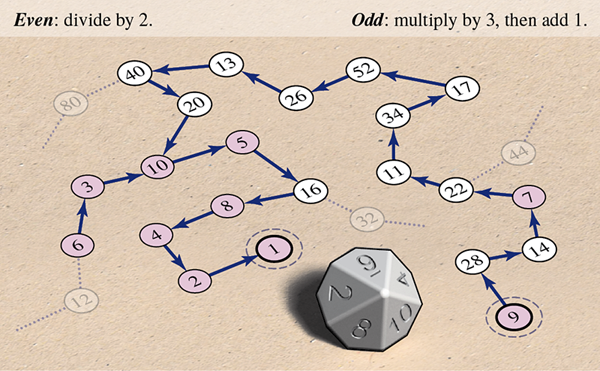
The best example I’ve found is the Collatz Conjecture. It’s so simple that it can be explained to primary school children but it has been impossible to prove. Of course, I don’t know whether a proof would immediately yield significant practical applications, but it seems likely it will yield significant mathematical applications, especially if the proof relies on a new type of mathematics. From an impact perspective, this unpredictability appears unattractive. Or, perhaps, its attractiveness is not fully appreciated.
In elite sport there is often talk of marginal gains, those small things that give an edge over the opponent, leading to victory. Such gains are important and they’re definitely the sorts of things we need in our competitive world. I’d argue that’s precisely what we get when we apply mathematics to deliver real-world solutions or to advance knowledge within other disciplines.
However, in sport there’s always the opportunity for something radical, like the approach to high jumping introduced by Dick Fosbury. I think we need to embrace and encourage this type of ‘doing things differently’ because if we make it work then we’ll have gained a significant competitive advantage. And, doing mathematics for its own sake is a key way to achieve this.
If we’re to make this happen then I suggest we can’t only (metaphorically) work off-stage, or hide behind the garden shed. We need the confidence to take mathematics and shine spotlights on it. We need to make mathematics and mathematicians front and centre stage, as exemplified by our new IMA President, Hannah Fry.
Rob Ashmore CMath CSci FIMA
Defence Science and Technology Laboratory
Crown Copyright © 2024 Dstl. This information is licensed under the Open Government Licence v3.
The views and opinions expressed herein are those of the author and do not necessarily reflect those of the Defence Science and Technology Laboratory.
Reproduced from Mathematics Today, February 2024
Download the article, Maths: Front and Centre (pdf)