Open access (OA) has transformed scholarly publications and we at the IMA want to help you understand the benefits and opportunities. Martha Bailes, the IMA’s Publisher at Oxford University Press (OUP), explains how it works.
An established publisher of mathematics research across its books and journals programmes, OUP is proud to work with the IMA to publish rigorously peer-reviewed, world-leading, trusted research, upholding the highest standards of publication ethics and integrity. All of the IMA journals published by OUP offer you the opportunity to publish your paper open access. In addition, thanks to over 50 Read and Publish deals at OUP, you may be able to publish open access at no personal cost. Read on to find out more.
What is Open Access?
Open access is a worldwide movement that seeks to grant readers free and open online access to academic information. OA publishing is among the ways that OUP fulfils its mission – furthering the University of Oxford’s objective of excellence in research, scholarship and education by publishing worldwide.
Publishing your work OA allows you to broaden your reach and contribute to open research, and you will find that some funders require open access publication as a condition of funding. The IMA journals have seen an increase in open access publishing over recent years with more than 1 in 5 articles publishing open access in 2023.
Quality Open Access Publishing At OUP
Quality lies at the heart of our work in the open access space – all articles are subject to the same rigorous academic assessment, regardless of whether they publish open access or under one of our non-open access licenses.
OUP open access articles have:
- The highest policy and patent citation rate for OA articles among major competitors, an example of the utility and influence of our publishing (Source: Altmetric).
- The second highest mean lifetime citation rate for OA articles among major competitors, demonstrating the reach, quality and impact of our publishing (Source: Dimensions).
Publishing Open Access in the IMA Journals
As open access articles are free for anyone to read, publishing them requires payment of an Article Processing Charge (APC). There are currently multiple routes for securing open access funding. For some authors, funders or universities may cover this charge. Alternatively, many authors in the IMA journals can benefit from a growing number of Read and Publish deals that OUP has negotiated with institutions and consortia, allowing eligible authors at participating institutions to publish OA at no cost to themselves.
OUP has over 50 Read and Publish deals in place, covering around 1000 institutions in almost 30 countries. Find out more at tinyurl.com/OUP-OA-list
In 2023, 90% of all OA articles in the IMA journals were funded through Read and Publish agreements. For many mathematicians, this introduces the possibility of publishing open access for the first time.
Am I Eligible for Read and Publish OA Funding?
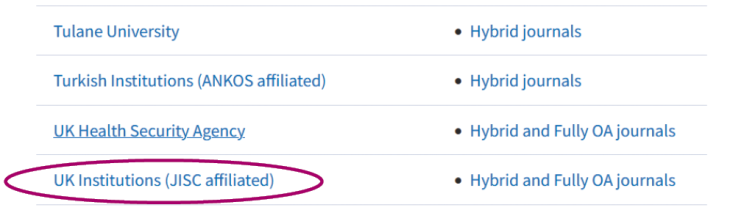 You can find out if your institution is participating in a Read and Publish deal by visiting the OUP website. If it is participating, you can find out more about your eligibility to publish your article open access by clicking on the relevant link on that page.
Once you’ve clicked on the link associated with the relevant deal, scroll down that page to find the heading ‘How do I know if I am eligible?’ and you will find the various eligibility criteria. You should check these carefully but generally you must be:
- the corresponding author of the article.
- publishing a research or review article (though some other content types are eligible, depending on the individual agreement).
If I Am an Eligible Author, What Do I Need to Do?
On submission, the corresponding author should ensure that their institution is correctly stated in the submission system as this is essential in confirming eligibility later on. If your article is accepted for publication, you will be directed to OUP’s licensing system, which will verify your eligibility. If confirmed, you will be guided through a series of simple steps to request use of open access funds.
Eligible authors won’t see any prices because they are not required to make a payment. If the system does not verify your eligibility, you will see the prices indicated on the system, and you will need to find another way to pay the charge.
Follow our step-by-step guide to accessing funds.
What Happens Next?
Once you have selected your open access licence and your article has completed the production process, your article will be published online and will be instantly readable and citable by all readers!
We hope this information will encourage you to consider open access publication when submitting to an IMA journal. Additional information can be found here.
Martha Bailes
Oxford University Press