This was a two-part workshop series, organised and delivered by Owen Hooper and Professor Elena Nardi of the University of East Anglia. These workshops were also supported by Dr. James Van Yperen of the University of Sussex and Thomas Hobson of the University of Lincoln. Workshop One was help on Wednesday 17 April 2024 with Workshop Two taking place on Wednesday 5 June 2024.
The aim of the workshop was to give early career mathematicians a space to explore innovative pedagogies to help broaden and diversify their teaching repertoire. The workshops were run in an active learning style which ensured all participants were able to get involved and explore potentially new pedagogies and tools to encourage active learning within their own teaching. Workshop one was an introduction to different tools and pedagogies with workshop two being an opportunity for participants to share their ideas and any attempts they had made between the two workshops to diversify their teaching.
Workshop One started with lunch and an informal chance for participants to meet each other. The structure of the day was designed to have as many opportunities as possible for active learning and participant engagement. Talks were no longer than 30 minutes (even then, there was participant engagement throughout). Between the talks there were several group and independent reflection activities. After the welcome by Owen and Elena – participants were given a short introduction to the mathematics education research scene whilst exploring the ways in which research and development could help inform and support new early career mathematicians. We then got the participants talking about issues related to student engagement with three key prompts to spark discussion (What challenges do you face teaching using chalk and talk? What does student engagement mean to you? How might the students experience of mathematics be affected by chalk and talk?). The aim of this was to get participants to share reflections and insights from their current teaching and to get a feel for what engagement means to each person (as this could vary depending on course, experience, institution etc). The responses to this first discussion can be found on the padlet that was used for Workshop one. There was a general consensus that student enthusiasm if often hard to maintain throughout the semester. Some also reported that it was sometimes hard if there was lack of consistency across modules (e.g. they are not expected to engage in other modules so why do they need to in this one). After this, only led a brief talk introducing participants to active learning, pedagogies (e.g. flipped and blended classrooms) as well as exploring some tools/resources that may be helpful to diversify their teaching repertoire. We then wanted participants to appreciate the link between active learning and research in university mathematics. So, we set them a task to read a case study in each of their respective groups. These case studies were produced by Owen Hooper – which were condensed versions of longer research papers. Each of the papers dealt with active learning in slightly different ways (either a change in the pedagogy, the utilisation of different tools and resources, or both). We gave them a set of 5 questions to consider with the aim of reporting back a summary of the case study to the other participants in the room. The hope for this task was twofold – to get them engaged with research and explore how different pedagogies and tools could be utilised in the university mathematics classroom. The case studies can also be found on the Padlet. The case studies were from three different branches of mathematics: Multivariable Calculus, Graph Theory and Proof production. This was a deliberate choice to highlight the versatility of the active learning pedagogies and the different tools and resources. Each group had several minutes to feedback, discuss their case study, and answer any questions from the other participants. We as organisers appreciated there was potentially a lot of information to take in and process throughout the day. So, after a break we gave participants an opportunity for individual self-reflection. The aim was to get them to think about their own teaching and how active learning and digital resources may (or may not) work in their modules. We then finished the session with a Twitter/X challenge in which they had summarise what they had learned from today in one tweet (150 characters). To close, we set up what we’d like participants to do between workshops. We wanted them to have an opportunity and time to think about how they might diversify their own teaching practices. We asked participants to come to the next workshop with a short presentation on either a planned intervention or with a case study of some active learning they were able to introduce between the workshops. The aim of this was for them to have an opportunity to implement what they had engaged with in this first workshop. We hoped for at least 3 volunteers to contribute towards workshop 2 (we had four in the end). This workshop was attended by 12 people. We note that UEA is not a nice journey to make from most parts of the UK (either must go via Peterborough, Cambridge or London). We did get participants from universities like Edinburgh, Warrick, Lincoln, Sussex. We have 6 people who had registered for the event who did not show up with only 1 of these sending an apology for absence. There were enough people at these workshops to ensure that we could complete all the activities we had planned. To help participants prepare for lecture 2 we did make available a briefing sheet which gave them a rough structure on how they might want to set out their presentations.
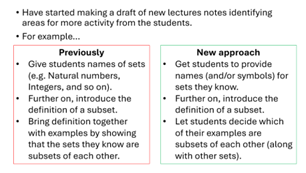
Workshop two started with lunch and an informal meet and greet type format. This workshop was attended by 12 participants. There were 2 from WS1 that could not attend but we had 2 who could not make WS1 who came to part 2. Participants had roughly 5/6 weeks between WS1 and WS2 to reflect on their previous teaching (or current depending on their schedules) and think of ways that they could incorporate active learning and different digital resources into their own teaching. The overall aim from WS2 was for participants to have an opportunity to present ideas/changes they have made to the group. This followed by a speed dating type activity where participants got to spend roughly 20 minutes with each presenter to answer any questions they have. This was also an opportunity for the presenters to get feedback, suggestions etc from their peers regarding their proposed interventions. We heard presentations from three participants (James Van Yperen, Thomas Hobson and George Witty) – these PowerPoints can be found on the Padlet linked above. James focussed on utilising group work to encourage students to produce flowcharts regarding hypothesis testing in a data science module. Since James had implemented this into his teaching there were also some even better ifs he recorded if he was to do this again. Some of these included – using Padlet as a way for students to easily share their results. Also, that there may be some additional scaffolding needed to help students get started. Thomas Hobson focussed on trigonometry and vectors for foundation year students. Students in Tom’s module interacted with a game (teams owned a small drinks company and they needed to compete with other teams in the room to win). Tom’s presentation is attached in the Padlet linked above. Tom reflected that the game helped students practice their calculations especially of trig equations. Students however struggled with the graphing element to show multivariable relationships. I would encourage you to look at Tom’s PowerPoint to understand fully the context of the game. The last presenter was George Witty – whose intervention was theoretical at this point (unlike the previous two) and was an ambition of what he would like to incorporate into his lectures from September 2024. Again, George’s PowerPoint presentation is available on the Padlet linked above. George detailed in his presentation the process of reflecting on his previous teaching – noting important definitions, concepts and where interactive exercises happened. He then showed us an example of a section that he shifted from chalk and talk to be more active, inquiry orientated (See Fig.1). After the presentations had finished, we split the non-presenting participants into three groups (I also joined a group for this activity). We spent 30 minutes with one of the participants discussing their intervention, asking questions, and giving feedback. These discussions were left to be open ended, but we did have some question prompts to help (What challenges could you potentially face? How could this intervention help support mathematics learning? Could digital (or other) resources be utilised to enhance the intervention experience?) After 30 minutes the groups shifted to the next presenter. Each group spent 30 minutes with the presenters. After a refreshment break, we came back together for our final activity of the workshop which was a 3-member panel session. The three members of the panel were James Van Yperen (ECM with an interest in active learning), Dr Irene Biza (Researcher in Mathematics Education) and Professor Fabio Erico (Director of the Centre for Higher Education Research Practice Policy and Scholarship, Economics lecturer). These 3 members were selected as they had a different niche they filled. James in a teacher of mathematics, Irene is a researcher of mathematics education and teaches this to undergraduate mathematicians and Fabio is a professor of economics who uses active learning to support his teaching of mathematics to non-mathematicians. By non-mathematicians we mean those not enrolled on a mathematics course. The aim of this panel was to hear from those with experiences of utilising active learning, resources or both in their teaching. Irene focussed on student’s use of digital resources to help with problem solving. Fabio presented partly on the institutional challenges of implementing active learning whilst also drawing on examples from his own experience of teaching mathematics to non-math specialists. Finally, James shared his experiences as an ECM who has faced challenges implementing active learning into his learning and teaching of mathematics. After the short presentations the floor was opened to questions from participants regarding a whole range of issues. To close the session, we asked the question Where do we go from here? Here we discussed what participants would like to see going forward – there was some agreement that having more of these CPD, hands on type sessions would be beneficial
In addition, we also asked participants to complete a feedback form, and the feedback appeared positive (they may have chosen not to complete the form if they didn’t like it).
Some comments included:
- It was useful to see some academic context, and to hear about the ongoing efforts being made.
- I really liked the relaxed approach that Owen took to the session, and it was nice that we were a small group so everyone could speak. However, more people present (and those who didn’t already know each other!) would probably have made for better discussions.
- It was good! Maybe more ‘forced interaction’ between people from different backgrounds and from different locations would have been good.
- It was worth my time, and I will definitely come to the next one. More participants would be good, but appreciate it is hard to get people to travel from all over for a short amount of time.
From these comments I think the workshops were generally well received and a helpful experience for those who attended. There are several points I take away and consider for the next workshop I potentially run. The first being better mixing of groups. There was a large cohort from UEA (the university hosting) which is to be expected but I could have done a better job at splitting these people up and mixing with those from different institutions. To this end, I think potentially an ice breaker to start with could help with this. Secondly, trying to advertise in plenty of time to ensure we can reach and hopefully bring in a larger crowd of people to the workshops.
As a result of this workshop, several attendees have stayed in contact and are still supporting them with their aims of shifting from chalk and talk to active inquiry-based learning. Further to this, because of this workshop – we have been contacted by other institutions running similar workshops to exchange experiences etc. I think this type of workshop could potentially be beneficial (and in demand) in the future as part of a wider CPD program. For me personally, this was a great professional experience organising and delivering to colleagues.
Owen Hooper
University of East Anglia