Ramón Nartallo-Kaluarachchi won the 2024 Graham Hoare Prize for his article on Mathematical Memory Machines. His prize-winning article can be found at Mathematical-Memory-Machines.
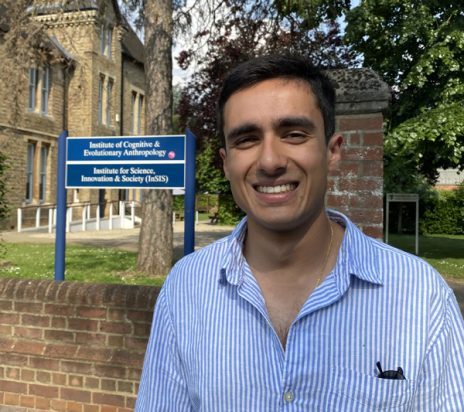
How would you describe yourself and your research?
My name is Ramón and I am a third-year DPhil in Mathematics at the University of Oxford. I am broadly interested in the dynamics of complex systems with a particular interest in methods that relate to real-world data, especially from neuroscience. My DPhil thesis focuses on the analysis of neural dynamics from the perspective of nonequilibrium stochastic processes and network science.
What do you find attractive/engaging about mathematics?
As an applied mathematician, I find the ability to abstract real-world systems, and the complex phenomena that they exhibit, with mathematical constructions very beautiful. I think all applied mathematicians enjoy developing a simple model that can explain an empirical observation or phenomenon, and I am no exception. I think it is more unique that I also enjoy considering behaviours that exist in theoretical dynamics and looking for them in data.
How did your interest in mathematics begin?
My interest in mathematics began in secondary school. In particular, I was drawn to the difference in studying mathematics compared to other subjects. Whilst I was more interested in science than mathematics, I enjoyed actually solving problems, in class and at home, much more than memorising facts and formulae. It was only later on at university that I realised that mathematics is much more than prime numbers and π, and that the applied mathematician’s approach to science, a unique blend of rigour and empiricism, is my favourite of all.
What advice would you give to your younger self?
One of the reasons I decided to study the brain was because I wanted to work on the biggest and most challenging of problems as I thought they were the most worthy of my time. During my DPhil, I have realised that solving a ‘small’ problem well can be far more important and fulfilling than attempting to solve a large problem poorly. With this in mind, I would advise myself to be more humble in the face of science and to work on problems that I find motivating but where lofty goals do not preclude me from achieving something that, at first glance, seems less important, but instead stands the test of time.
Where do you see yourself in the future?
Whilst I do not know what the future holds, my DPhil has stimulated ideas that I would love to pursue further in a research career. The freedom of academic research, particularly in mathematics departments, is something that, for the moment, I cannot pass up. As a first step, I would love to complete a postdoctoral fellowship on the inference of stochastic processes and network structures from noisy data, hopefully with applications to complex biological systems that I have not yet studied.
What hobbies do you have?
Outside of science and mathematics, my two passions are basketball and the acoustic guitar. The guitar has also led to a long-standing love of folk and rock music. However, when not working, much of my time is spent reading fiction – which, somewhat surprisingly, I prefer significantly to science books.
What makes a good day for you?
A good day for me begins with good weather. If I am lucky enough to get this wish, then the rest of the day is instantly easier. I enjoy a variety of different tasks in my research and I usually have a number of ongoing projects, all in different stages. This means that I can spend a little time on each phase such as thinking and doing calculations by hand, coding algorithms and simulations, and writing up my results as part of a scientific piece. If it’s a perfect day, then I won’t work too long and I will have time to cook, to read and to spend some time outside, preferably in the sun.
Why did you decide to write about the topic of your article?
Since getting interested in neuroscience, I found learning with Hopfield networks particularly beautiful. I find the simplicity of the formulation very accessible as well as the simulations very satisfying. Later on, as I discovered links to the Ising model and other areas of statistical physics, I realised their fundamentality. This article turned out to be serendipitous as Hopfield was awarded the Nobel Prize in Physics shortly after, for his work on such networks.
What advice would you give to someone who wants to write an article for Mathematics Today?
When deciding to write for Mathematics Today, I was particularly inspired by last year’s Graham Hoare prize winners, who are members of my department. The key to an article as good as theirs is to choose the perfect topic. If you can find a focus that uses elementary mathematics, but with sufficient sophistication to be interesting, as well as some application beyond mathematics, then a good article will certainly follow.
Jack Reid MIMA
ECM Special Issue Guest Editor
Reproduced from Mathematics Today, December 2024
Download the article, Interview with Ramón Nartallo-Kaluarachchi AMIMA (pdf)