The Isaac Newton Institute’s (INI) recent two-day event on Inclusivity in the Mathematical Sciences (Cambridge, March 2025) proved to be a powerful gathering of minds committed to embedding equity, diversity and inclusion (EDI) at the very heart of mathematical practice, culture and governance.
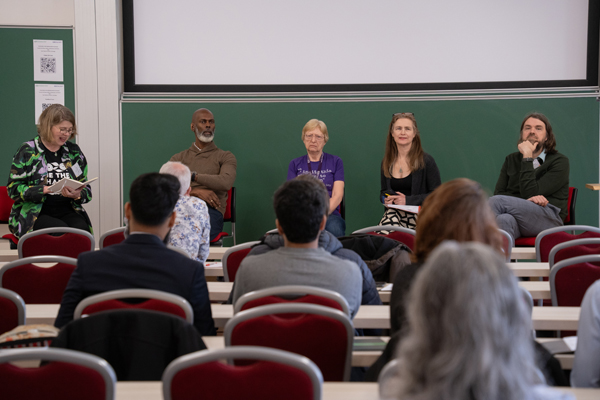
As Diversity Champion for the IMA, I had the honour of chairing the opening session and contributing to the final panel discussion (see photo). These moments offered rich opportunities not only to listen and learn, but also to help shape the broader conversation around the role EDI must play, not as a peripheral consideration, but as a central, measurable strand in the DNA of our institutions.
What struck me most was the scope of the event, from empirical analysis of bias in research funding, to deeply personal reflections on navigating academia. Katie Severn’s presentation on an EPSRC/RSS study was particularly sobering. Despite strides in some areas, the data revealed that ‘ethnic minority’ researchers, particularly those who are non-UK nationals or over 55, consistently faced lower odds of securing funding. Even when successful, their grant values tended to be significantly lower. The study not only quantified disparities but highlighted how perceptions of institutional prestige, reviewer bias and structural barriers conspire to shape career trajectories and mental wellbeing.
It was also refreshing to explore what EDI looks like from the perspective of funders. Katherine Davis (Wellcome) highlighted how thoughtful structuring of calls, better communication of timelines and provision for flexible career paths can help widen participation and nurture long-term engagement. She reminded us that funding bodies must lead by example, whether by adapting policies to accommodate global South researchers or by offering observer roles on funding panels to demystify the process.
Other sessions showcased practical interventions at the grassroots level. Rachel McCrea’s presentation on the STOR-i CDT at Lancaster University demonstrated how consistent leadership, peer support and space for student-led initiatives can generate inclusive cultures organically. Rosie Evans’ workshop on allyship encouraged attendees to explore what it really means to act in solidarity, not just in theory but through everyday behaviours and institutional design.
Equally inspiring was Brigitte Stenhouse’s work on contextualising the mathematics curriculum through history. Her approach, co-creating content with students that foregrounds the contributions of marginalised mathematicians, embodies the kind of pedagogical reimagining that can shift perceptions of who mathematics is for and who gets to shape its narratives.
During the final panel, I made the case that EDI should no longer be seen as a ‘bolt-on’ or moral gesture. We must instead embed it into appraisal systems, institutional governance and strategic frameworks, holding individuals and structures accountable for measurable progress. Failing to do so risks perpetuating the very exclusions we are trying to address. As I noted, many universities already demand impact and public engagement in promotion cases; it is only fitting that inclusive leadership be evaluated just as rigorously.
I also referenced the IMA’s EDI Strategy 2024–2029, which was developed under my direction and offers a structured, outcome-focused framework that could serve as a basis for other learned bodies seeking to move beyond aspiration. The strategy includes clear metrics and indicators, integrates EDI into performance reviews and establishes lines of accountability, ensuring that progress is measurable, monitored and meaningful. Rather than being a static policy, it is a dynamic tool designed to embed EDI across the IMA’s operations and set a high standard for the wider mathematical sciences community.
What set this event apart was its tone: rigorous, yet reflective. There was space for data, policy, storytelling and self-scrutiny. From sessions on tackling implicit bias (led by Nico Gubernari) to the strikingly candid reflections from early-career researchers and doctoral students, the overall message was clear: inclusivity is everyone’s responsibility, but leadership matters. Without strategic vision and courageous action from the top, even the best local initiatives can stall.
Further details, including the talks and initiatives mentioned, can be found online at: INI Inclusivity in the Mathematical Sciences and INI Diversity in Mathematics.
Inclusivity in the mathematical sciences cannot be a project confined to committees or events. It must be how we do things, how we recruit, how we teach, how we fund and how we listen. If this event is any indication, we are beginning to do these things better. But we must keep going.
Howard Haughton CMath FIMA
IMA EDI Committee Chair
Reproduced from Mathematics Today, June 2025
Download the article, Reflections on the INI Inclusivity Event (pdf)