Joseph O’Rourke
CAMBRIDGE UNIVERSITY PRESS 2011, 190 PAGES
PRICE £19.99 (PAPERBACK) ISBN 978-0-521-14547-3
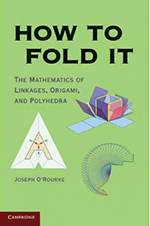 This book is a triptych, unsurprisingly consisting of parts on linkages, origami and polyhedra.
Linkages, such as those found in a desk-lamp, or those which turn linear motion into rotary motion in order to move a car, are covered in the first three chapters. Ideas about the range of motion available to a robotic arm are covered through the use of vectors and elementary geometry. The book is stuffed full of colour diagrams and illustrations, which aid comprehension and really help bring the text to life.
The second part is on the more familiar subject of origami. This starts by formalising the treatment of the so-called ‘mountain’ and ‘valley’ folds, and then moves onto bigger questions, such as whether it is possible to fold a map flat, conforming to a given crease pattern. The second part then builds to the central result known as the fold and one-cut theorem, which states that any straight-line drawing on a sheet of paper may be folded flat in such a way that one straight scissors cut completely through the folding cuts all the segments of the drawing and nothing else. We have all cut out paper people from a folded piece of paper, with the intention that they end up linked at the hands, however I certainly found it surprising that this could be generalised to any line drawing, requiring no symmetry whatsoever.
The final part of the book is on polyhedra, which explores the folding and unfolding of the surface of a polyhedron. A net for a cube is elementary, one for a truncated icosahedron (football) can be found with a little work, but does every polyhedron have a net? With some thought it is not too difficult to find an example of a non-convex polyhedron that has no net, and one is given in the book. However, the case of convex polyhedra is still an open problem. The rest of this part is dedicated to nets of orthogonal polyhedra (think stacks of Lego bricks).
After providing a fast-paced introduction to the subject matters under discussion, a final section entitled ‘Above & Beyond’ is included in each chapter. These consist of more advanced material designed to make the reader really think, as well as some open problems. These sections can be skipped over on a first reading without detracting from the reader’s overall enjoyment of the book. Some of the open problems posed are, like so many open problems in combinatorics, so simple to state, and could possibly yield an elementary solution, given the right approach, which makes them all the more tantalising.
Each chapter is littered with graded problems – from those that help consolidate what has just been read, to those that present the reader with something meatier. Full solutions are provided for all the exercises.
The website accompanying the book provides a wealth of resources, such as templates to illustrate some of the ‘fold and one-cut’ examples, such as a turtle, as well as videos which help to visualise some unfolding orthogonal polyhedra. It also includes updates on the open problems posed in the book, such as the flattening polyhedra problem: Can every polyhedron be creased and then continuously flattened? This problem has now been solved, and the answer is yes.
This is a fun book and has minimal prerequisites, so really is suitable for anyone with an interest in the subject matters.
George Matthews AMIMA
Book review published directly onto IMA website (April 2013)