Guido Caldarelli and Michele Catanzaro
OXFORD UNIVERSITY PRESS 2012, 136 PAGES
PRICE £7.99 (PAPERBACK) ISBN 978-0-19-958807-7
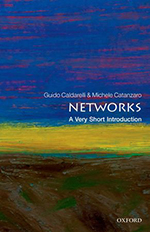 This short introduction to Networks is a good way to introduce the ideas of Networks and how widespread they are in our lives. The text is part of a series of ‘a very short introduction’ books, however it is independent in terms of the topic – Networks. It is written in a formal but relaxed tone, talking through each point in present tense allowing the reader to follow along as if in a conversation.
The author provides many examples of networks and introduces specific terminology as and when needed. The book discusses networks in social networks such as Facebook, ecosystems, food chains and more. Looking at connections in each of these networks the book, through brief descriptions and diagrams, explains these connections. It looks through history, such as Euler’s bridge dilemma, and explains the ideas behind networks.
Taking the Euler’s bridge dilemma: in a Russian city Kaliningrad, the island of Kneiphof stands in the Pregel River which three centuries ago had seven bridges connecting them together. A common riddle is: was it possible to walk across the seven bridges without crossing any of them twice? In 1736 Leonard Euler represented the riddle as what is known as a graph (using dots and lines) which made the riddle easier to solve and thus proved that it was impossible. Now this is just a riddle.
The book also considers real life networks such as Henry Beck’s London Tube map which is in essence a graph (dots and lines). To create this network, Beck exploited the fact that what is connected is more important than how far apart points are and even today the London Tube map is used, somewhat successfully (if we put aside delays and rush hour), to allow many people to travel from one place to another.
The author has included a ‘further reading’ chapter with texts ranging from 1994 to 2009 to allow the reader to further research the topic if desired. Some texts are general books, others academic texts and some articles and reviews.
The 128 page introduction to networks priced at £7.99 is, in my opinion, slightly dear as the majority of this information can be found from simple Google searches. However, I would recommend buying it second hand or from an online retailer as it is a very good, concise, text to give a short introduction to a topic.
With very little technical and mathematical language this book is designed to give the reader, be that students, professionals, or someone with little (or many years of) mathematical knowledge, a good introduction to networks and get them thinking about how networks are present in our lives.
Harsimrat Kaur
Book review published directly onto IMA website (October 2013)