E. Weinan
CAMBRIDGE UNIVERSITY PRESS 2011, 488 PAGES
PRICE (HARDBACK) £48.00 ISBN 978-1-107-09654-7
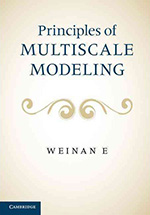 Children delight in responding to an explanation with ‘Why?’, and it takes few iterations to get from candles to quarks. Their natural curiosity vividly reveals a hierarchy of models and explanations. Multiscale modelling is the formal version of this child’s game, in which through analysis and computation the levels in this hierarchy of physical models are connected, and information is rigorously passed between them. Principles of Multiscale Modeling is a lucid, well-written, and broad introduction to the field aimed at mathematical scientists and engineers. It is attractively illustrated in colour and contains many useful and relevant references for further study.
Of course, the underlying physical laws are known: the problem is one of scale. The bulk motion of a stirred cup of tea can be derived from the Navier-Stokes equations of fluid mechanics, but the tea contains too many water molecules for its analysis or simulation to be practical if the tools of kinetic theory are used. These in turn rest three orders of magnitude down in both extent and duration on molecular dynamics and we have to descend a similar scale of orders of magnitude to reach the quantum realm. Typically, then, we ‘coarse-grain’ so that, for example, molecular diffusion of momentum becomes encoded in bulk (macroscale) properties of a fluid, such as the viscosity.
A multiscale approach is needed both for more complete understanding of a given problem and for problems in which microscale features can dominate, such as the cracking of solids. After setting the scene with a broad spectrum of referenced examples, the book introduces analytical methods of multiscale modelling, including averaging methods, homogenisation methods, renormalisation group methods, and matched asymptotics. All require further detail, and these can be found in the good textbooks and papers the author recommends. Important numerical techniques are introduced next, followed by a chapter on fundamental physical models, from the quantum realm to continuum mechanics.
The author rightly states that ‘multiscale modeling is not just about developing algorithms, but about developing better physical models’ and examples of such models are given in Chapter 5, including multiscale models of polymer fluids, and coupled continuum-atomistic models of the spreading of fluid drops. Next, the book covers two common uses of multiscale modelling: capturing macroscale behaviour and resolving local events. Three more specific and detailed examples get their own chapters, covering both theory and numerics, before a final reflective chapter on other perspectives.
The book is a great starting place for anyone seriously interested in learning multiscale modelling. Neither the analysis nor the numerics could possibly be fully explained in a book of this length, but the discussion, notes, and large and well-chosen reference lists (given for each chapter) ensure that the reader can fill in the details themselves. Their appetite for doing so and for employing these methods will certainly have been stimulated by this easy-to-read and attractive book.