Further Mathematics (FM) is a qualification designed to broaden and deepen a student’s mathematical knowledge, and can be taken to either AS level or A-level alongside AS or A-level Mathematics courses. It is valuable for a number of reasons, including:
- the increased time spent engaging with mathematics and developing greater fluency;
- the study of important topics in pure mathematics not covered at A-level, such as complex numbers and matrices, that are essential for anyone going on to study maths, physics or engineering;
- the opportunity to study a broader range of applications of mathematics;
- the development of increased confidence and resilience in tackling demanding mathematical problems.
Further Mathematics is required to access many mathematics-rich degree courses in STEM subjects and it gives students a head-start in others where specific mathematical skills are taught during the degree, such as economics. Recent growth in entries has been welcomed by government and industry, however, it has not redressed a long-standing imbalance; girls achieve just as well as boys in FM, with similar proportions gaining the top grades, but fewer of them choose to study it. International trends [1] suggest we should not be complacent about this: in the USA, girls now choose advanced mathematics courses at school and university in equal proportions to boys.
This article considers some of the ways in which schools and colleges might promote girls’ participation in FM.
1. Who studies Further Mathematics?
In 2013/14, 66% of state institutions who offered A-level Mathematics also offered Further Mathematics, up from only 40% in 2005 [2]. The work of the Further Mathematics Support Programme (FMSP) has been central to this change, providing online and face to face tuition, as well as comprehensive professional development support for teachers.
During this time student numbers in FM have increased significantly for both boys and girls. Girls’ entries to AS Further Mathematics rose from around 1000 in 2003 to almost 8000 in 2015; and at A-level Further Mathematics they increased from approximately 1500 to over 4000. Despite these large increases, girls have consistently formed only around 30% of the cohort for both qualifications. Since the average entry size for Further Mathematics A-level in a mixed school is seven students, this means that a girl studying FM is likely to have only one female peer in her class and many will have none. This proportion is slightly lower than A-level Mathematics, for which the 2015 figure was almost 40%. By contrast for Chemistry, a gender neutral science subject, 49% of entries were from girls and for Biology the figure was 61%. In fact, out of all A-level subjects, the only ones that show smaller proportions of girls than Mathematics are Physics (21.5%) and Computing (8.5%). A-level English has a reversed gender imbalance to FM with boys making up only 28% of the 2015 cohort [3].
Another way of considering the figures is to look at the A-level choices made by students. In state-funded schools in England 35.5% of boys take A-level Mathematics compared to only 18% of girls, meaning that boys are twice as likely to choose A-level Mathematics. They are over 3.5 times as likely to take A-level Further Mathematics (7% compared to less than 2% of girls) [4].
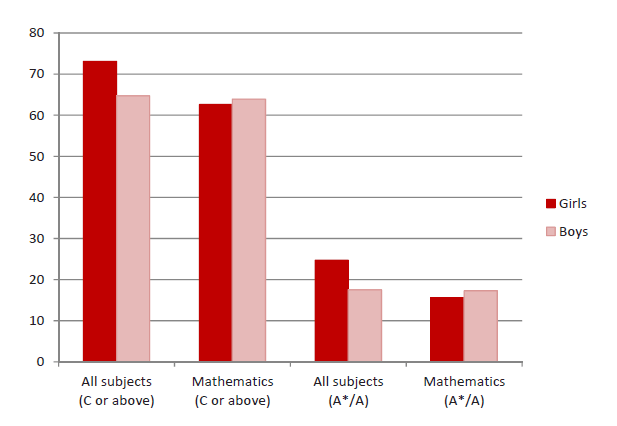
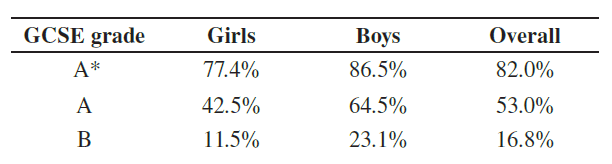
However, research data on progression based on GCSE Mathematics grades indicate that girls are much less likely than boys to continue with mathematics unless they achieve the top A* grade at GCSE (see Figure 2). FM typically requires an A or A* for entry, so this data suggests that we are losing girls in two ways: first in the A-grade girls who are not choosing mathematics at all, and then amongst both grades who choose only the single subject.
2. Factors affecting girls’ participation in FM
There is little published research specifically relating to girls’ participation in FM. The FMSP, in conjunction with UCL IoE, recently published a literature review and preliminary case study findings focused on girls’ participation in A-level Mathematics and Further Mathematics [7-8]. Key messages of these two publications are summarised below, alongside other relevant research (where indicated).
As outlined above, gender disparity in participation is not unique to FM. Our case studies selected five state schools and colleges with high levels of participation by girls in A-level Mathematics and Further Mathematics and found a strong culture of encouraging students to aspire to continue with mathematics post-16, which was supported by senior leadership and careers guidance. This agrees with statistical research by the Institute of Physics (IoP) [9] that gendered progression to Physics within a school correlates with gendered choices in other A-level subjects, indicating a whole school effect.
Girls need to be inspired towards mathematics in early secondary school, as after the age of 13 their attitudes are unlikely to change [10]. At departmental level, this means engaging early with Key Stage 3 students to promote awareness of the usefulness of A-levels in Mathematics and Further Mathematics for a range of careers, both in STEM and non-STEM fields. Girls are more likely than boys to take non-science subjects and need a strong message that Further Mathematics A-level complements such choices. Girls in the case studies chose mathematics post-16 to support career ambitions in a wide range of fields including the armed forces, youth work, sports science, neurobiology, orthoptics and aeronautical engineering.
Despite the strong take up from girls, the case study teachers and students reported no specific initiatives to attract girls into mathematics, rather a policy of preparing all able students to continue. Other research reviews have indicated that specific interventions targeted at girls have a limited impact on those who already had low STEM aspirations, and recommended emphasising the diversity of uses, replacing messages that ‘STEM is for girls too’ with ‘STEM is for everyone’ [11].
Nevertheless we found aspects of school practice that teachers and girls considered more influential for girls than boys. Some schools actively promoted a statistics option in Year 12 as they thought this was important for students studying social science A-levels, a high proportion of which were girls. Girls noted the importance of having access to a teacher who provides personal encouragement and help, both within and outside the classroom. This echoes the UPMAP survey [10] finding that
young people are more likely to take mathematics and / or physics post-16 if a significant adult – typically a family member or a teacher – has, over time, conveyed to them the worth of mathematics and physics, along with a belief that the student can do well in the subject.
 We can see this as an exercise of ‘science capital’, which describes a family’s science-related qualifications and understanding of and interest in science. Families with low science capital do not have the network of support that is needed to sustain girls’ engagement in maths and science careers [10]. This is perhaps more likely to be true for FM than other STEM A-levels and underpins the need for direct encouragement from teachers, and interventions which address families as well as students, providing information about the benefits of FM. Even in these high-participation case studies, teachers reported that Further Mathematics A-level is not suitable for students considering medicine and highlighted this to able girls for whom medicine is a likely aspiration. This is a message that the FMSP addresses in their information and advice for mathematicians who are prospective medics [12].
One intervention seen in all four case study schools was to run additional qualifications alongside GCSE for all able year 11 students (such as the AQA Level 2 Certificate in Further Mathematics) . This provided opportunities for students to evaluate their interest in the topics they would meet at A-level and to experience challenge and success with this material. Girls reported it as particularly significant in reducing the perceived risk of committing to a difficult A-level subject.
Many studies report girls having lower levels of self-concept in relation to mathematics than boys, and find this is an important factor in their lower levels of participation. There was a different feeling in the case study schools, with one Year 12 female mathematician emphasising support and resilience:
I don’t think it’s about boys and girls, I think it’s about support to help you struggle and keep going – no-one can do that breakthrough moment for you, when you eventually find something that works. And then you feel so good about it – it’s like ‘I’m a genius’, even if I’m going to get stuck on the next question I try.
Girls’ positive perspectives were founded on experience and relationships – they had encountered experiences of struggle and knew that their teachers would help them overcome.
Each of these research findings underline the importance of disseminating clear messages about what ‘works’ in increasing girls’ participation in Mathematics and Further Mathematics. Indeed, many of the strategies identified above as being beneficial for girls’ participation can be considered as general good practice, beneficial for all students but especially for girls. This is important in the drive to accelerate the annual rate of increase of girls’ participation in such a way that it more closely reflects that of boys.
3. 2017 and beyond
In 2017, new A-level syllabuses in Mathematics and Further Mathematics will commence. Modular examinations are removed and both statistics and mechanics will be compulsory. This presents opportunities and threats to participation, both generally and in particular for girls who are already underrepresented on these courses. After a catastrophic fall in participation in A-level Mathematics and Further Mathematics following the last major reform of mathematics specifications in Curriculum 2000, it will be vital for all teachers, senior leaders and those involved in maths education to maintain a vigilant scrutiny of the impact of the new changes and ensure they are used as a vehicle to enhance the appeal of advanced level study of Mathematics to girls.
Claire Baldwin
Sue de Pomerai
Cathy Smith
References
- Ceci, S. and Williams, W.M. (2010) The mathematics of sex: how biology and society conspire to limit talented women and girls, Oxford, New York: Oxford University Press.
- Further Mathematics Support Programme (2014) Further Mathematics Briefing for Higher Education, http://tinyurl.com/FM-in- HE (accessed 13/09/2015).
- Joint Council for Qualifications (2015) A, AS and AEA Results, Summer 2015, jcq.org.uk/examination-results/a-levels (accessed 25/08/2015).
- Department for Education (2015) A level and other level 3 results: 2013 to 2014 (revised), http://tinyurl.com/2013-14-Alevel (accessed 25/08/2015).
- Joint Council for Qualifications (2015) GCSE and Entry Level Certificate Results Summer 2015, jcq.org.uk/examination- results/gcses (accessed 25/08/2015).
- Noyes, A. (2009) Exploring social patterns of participation in university-entrance level mathematics in England, Research in Mathematics Education, 11, no. 2, pp. 167-183.
- Smith, C. (2014) Gender and participation in mathematics and further mathematics A-levels: a literature review for the Further Mathematics Support Programme, IoE UCL, http://tinyurl.com/FM-Smith (accessed 19/10/2015).
- Smith, C. and Golding, J. (2015) Gender and participation in Mathematics and Further Mathematics: Interim Report for the Further Mathematics Support Programme, IoE UCL, http://tinyurl.com/FM-Smith-Golding (accessed 19/10/2015).
- Institute of Physics (2013) Closing Doors: Exploring gender and subject choice in schools, http://tinyurl.com/IoP-girls (accessed 25/08/2015).
- TISME (2013) ‘What influences participation in science and mathematics?’ A briefing paper from the Targeted Initiative on Science and Mathematics Education (TISME), http://tinyurl.com/TISME-STEM (accessed 25/08/2015).
- CaSE (2014) Improving Diversity in STEM, http://tinyurl.com/CaSE-diversity (accessed 25/08/2015).
- The Further Mathematics Support Programme (FMSP) www.furthermaths.org.uk/medicine (accessed 25/08/2015).
Reproduced from Mathematics Today, February 2016
Download the article, The Participation of Girls in Further Mathematics (pdf)