Background
A working definition of academic malpractice is “An attempt by students to submit work wholly or partly done by others with a view to gaining credit”. Malpractice can, of course, take several forms
- Plagiarism : Submission of work previously published by others without appropriate reference – students effectively claiming that the work is ‘their own’
- Collusion : Process by which two or more students work together and submit results to which not all students have contributed.
- Other forms e.g. straightforward cheating, smuggling materials into exam room etc.
Plagiarism, as defined as above is something which affects the general community more than the mathematics community whereas the mathematics community is affected more by collusion (with exceptions such as projects). Often, institutional support centres around plagiarism with software such as “Turnitin” able to detect when material has been taken from another source.
A subtlety when dealing with collusion is to encourage students to discuss the relevant subject matter and to present their ideas to each other without simply answering the question for each other.
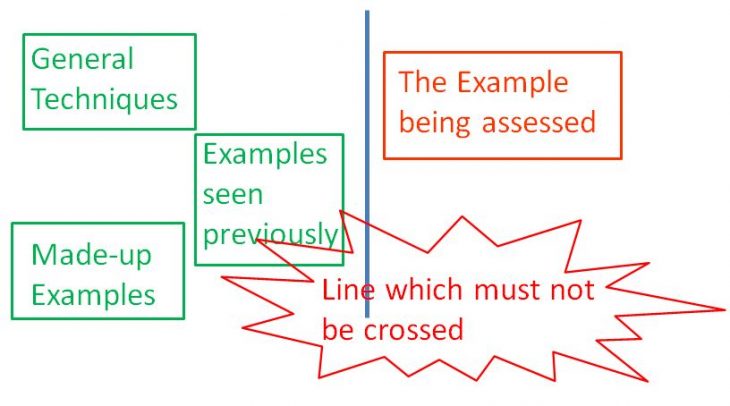
Distinction between general work and examples to be attempted individually.
Often collusion is addressed after it has taken place with students interviewed and marks annulled. This process drives divisions between staff and students and perhaps only deals with some of the cases. Other schemes involve turning take-home assignments into in-class tests but this can compromise the academic aims of the assessment e.g. preventing the students having a detailed exploration of a sub-topic. The intelligent design of coursework to discourage collusion can be regarded as a “stage 2” model (below) with stage 1 being to deal with it after the event (de-emphasized in the figure below).
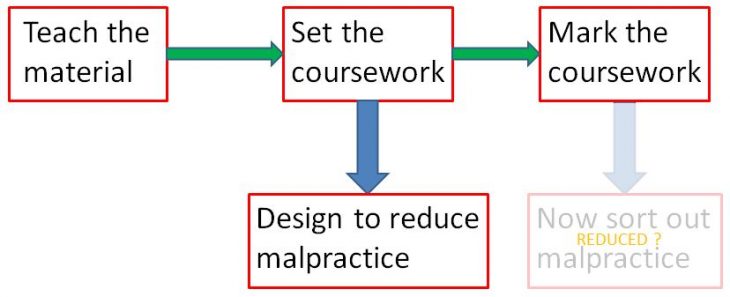
Stage 1 and Stage 2 models for collusion
Accounting for these factors, to keep abreast of collusion, the mathematics community needs to take its own action and the meeting, sponsored by the IMA was set up to do this.
Meeting
The meeting took place on Monday 21st May in the Alan Turing Building at the University of Manchester and was attended by about 25 delegates from around 18 UK universities. There were also some delegates unable to come on the day who were very much interested. There were several talks of differing lengths and some time for discussion. On the basis of a survey sent out to the Mathematics community, themes and speakers were chosen.
Randomisation and other factors in Computerised Assessment : Dr Colin Steele, University of Manchester
One facet of computerised assessment is the ability to use parameters within questions so that the same question stem can be used many times e.g. by different students or by the same student practicing many times. This can be utilised e.g. students carry out practice attempts where the best attempt counts followed by an assessment attempt where the single attempt counts. However, there are still suspicions that students are colluding on the assessment attempts (e.g. pooling experiences and utilising pattern recognition). While keeping a few ‘assessment questions’ which are not part of the practice may go some way to combating malpractice, there may be a case for the assessment sessions to be supervised (resource implications e.g. large enough clusters).
Malpractice and Mathematica : Dr Simon Pearce, University of Manchester
The speaker described a system used for submission of assignments using the computer package Mathematica. Each student was assigned a value for a parameter, m, for use in all the questions so that each student would have slightly different questions. In addition, the speaker set up a system whereby he was able to measure the ‘distance’ between files from different students. The value of ‘m’ provided a disincentive for students to carry out malpractice while the ‘distance’ measurement enabled processing of any cases that did exist.
A Novel Assessment method with Implications for Misconduct ? : Dr David Sirl, University of Nottingham
The speaker mentioned a scheme used at Nottingham where students take a share in the marking process and hence see the assessment from other angles. Students are given some questions in advance of a particular class and submit work during the class in question. Following this, and some initial marking by staff, students are able to compare (and record the result of the comparison) work by pairs of other students. There are incentives for students to carry out the work seriously and honestly. As well as a fascinating project in its own right, this project has implications for student perceptions of malpractice.
How can students work together without indulging in academic malpractice ? : Professor Chris Good, University of Birmingham
The speaker gave many thoughts on the situation starting with the one on “why is it so important to avoid malpractice”. A ‘devil’s advocate view’ could state that students who indulge in malpractice are, in the long term, disadvantaging themselves through not benefitting from the feedback and not performing well in a subsequent exam. However, there is a moral duty to students to be guided away from malpractice. Furthermore, with students having a strong sense of justice, the innocent student may feel aggrieved by the short-term gains of the dishonest student.
Approaches to the situation are multiple and range from a tightening of existing rules, use of exams only (as opposed to coursework tests – perhaps to the disadvantage of certain groups of students), conduct coursework tests under supervision (similar), allowing students to work together and acknowledge sources (this links in with the “Plagiarism” rather than the “Collusion”). There are indeed many ways forward but agreeing which is best may not be easy.
Can malpractice be minimised by Assessing Mathematical Thinking ? Dr David McConnell, University of Cardiff
This speaker, too, emphasised the dichotomy between students working together constructively and those involved in malpractice and also noted that the type of assessment is critical.
The speaker then described the “Problem Solving” module that took place at his university. Key in the assessment of this module was the part where students explained how they had carried out a piece of mathematics rather than simply going through the stages. In addition, there were many different problems and so there were simply often not sources for students to copy. Such an approach is clearly effective but is a very resource-intensive one and can only be used for a small number of modules.
This talk introduced the concept of a ‘stage 3 model’ where the teaching style is designed with the prevention of collusion in mind.
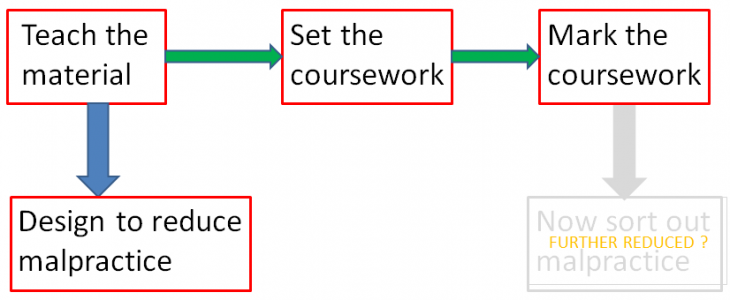
Stage 3 model for collusion
Confident Students do not cheat : Professor A.V. Borovik : University of Manchester
A question rarely asked is WHY students cheat or indulge in malpractice. It was suggested that such activities are among “the psychological defences of a student who does not otherwise know whether his/her solution/answer is correct.” Students should be active in checking answers and teachers should include such checks as integral parts of describing examples. Some areas of mathematics may be more fruitful than others on this e.g. linear algebra normally provided a few ways of checking answers. Several cases of how to check answers were presented.
Often seeing an error can leave a subconscious impact with the student. Not only are the subconscious signals very powerful but, as a result of the checking process, they can rise to the surface.
Assessment and Plagiarism : Prof Jeremy Levesley : University of Leicester
The speaker opened with a thought-provoking question “Is an exam a test of the ability to plagiarise from memory ? ” Examinations tend to be a fairly similar process each diet of exams and are set by the same category of people i.e. those who taught. In fact, many others should have a share in assessment e.g. employers, government etc.
Computerised assessment has a role to play but a goal should be the introduction of more oral examinations with the possibility of secondary questions to students so that they can justify particular methods etc. This also helps further the process of getting to know students.
Directions and Conclusion
Opportunities for discussion took place at the end of talks and informally at breaks. Towards the end of the day, there was a session for discussion. While several lively views were expressed, some conclusions reached were
- Create and maintain an e-mail list of those interested (including those unable to come on the day)
- Use of the above for pooling of ideas
- Setting up of a comparative project