Particle Segregation in Dense Granular Flows

Event


Date:

Event time : 6:00pm

Please Note: Coffee will be available from 5:30pm

University of Glasgow

Room 116, Mathematics & Statistics Building, University Place, Glasgow, G12 8QQ, UK

Organiser: Helen Stimpson (Branch Secretary)

Organiser Email: ima.scotland1@gmail.com

Wednesday November 6, 2019 6:00pm Wednesday November 6, 2019 6:00pm Europe/London Particle Segregation in Dense Granular Flows University of Glasgow, Room 116, Mathematics & Statistics Building, University Place, Glasgow, G12 8QQ, UK Particle Segregation in Dense Granular Flows, a talk by Professor Nico Gray (University of Manchester) Abstract Granular materials composed of particles […] Event Link: https://ima.org.uk/12123/particle-segregation-in-dense-granular-flows/ Helen Stimpson (Branch Secretary) ima.scotland1@gmail.com

Particle Segregation in Dense Granular Flows


Particle Segregation in Dense Granular Flows, a talk by Professor Nico Gray (University of Manchester)

Abstract

Granular materials composed of particles with differing grain sizes, densities, shapes, or surface properties may experience unexpected segregation during flow.  This review focuses on kinetic sieving and squeeze expulsion, whose combined effect produces the dominant gravity-driven segregation mechanism in dense sheared flows.  Shallow granular avalanches that form at the surface of more complex industrial flows such as heaps, silos, and rotating drums provide ideal conditions for particles to separate, with large particles rising to the surface and small particles percolating down to the base.  When this is combined with erosion and deposition, amazing patterns can form in the underlying substrate.  Gravity-driven segregation and velocity shear induce differential lateral transport, which may be thought of as a secondary segregation mechanism.  This allows larger particles to accumulate at flow fronts, and if they are more frictional than the fine grains, they can feedback on the bulk flow, causing flow fingering, levee formation and longer runout of geophysical mass flows.
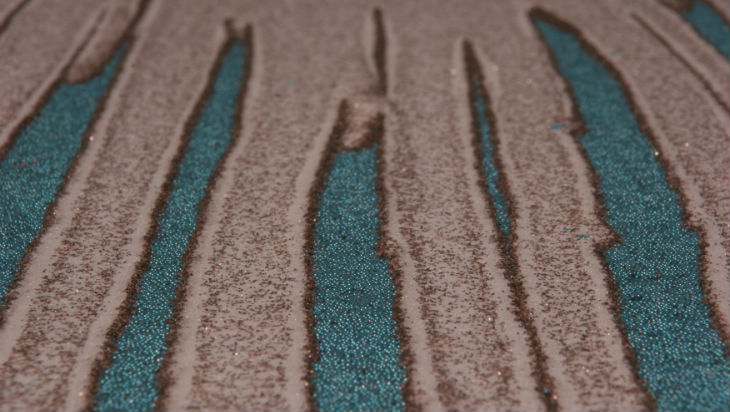
A series of leveed fingers that have been triggered by a segregation induced instability.
A series of leveed fingers that have been triggered by a segregation induced instability. The avalanche is composed of bidisperse mixture of spherical (white) glass ballotini (75–150 μm) and irregular (brown) carborundum grains (315–350 μm) on a chute inclined at 27° and made of monolayer of (turquoise) glass ballotini (750–1000 μm).

No charge is made to attend meetings; non-IMA members are welcome.
Image credit: Speaker’s own
Published