George is so fond of lightning. … He puts his head under all the waterspouts he can find. … He flew about, now up, now down, trying to find a better path; he quite enjoys dangerous places and looks so happy when his neck might be broken. [1, p. 16]
At first glance these read as a parent’s indulgent descriptions of a playful and inquisitive child. But they are not. They are taken from the journal of George Gabriel Stokes’ wife, and are all the more remarkable because they were written on honeymoon. They give a hint of Stokes’ omnivorous and lifelong curiosity.
Similarly, with respect to lightning, his daughter said: ‘He would go any distance to see houses and trees that had been struck’ [1, p. 32]. Despite his apparent lifelong interest in thunderstorms, Lord Kelvin, in his obituary of Stokes, stated that electricity was virtually the only area of natural philosophy to which he did not make a significant contribution [3]. The term natural philosophy translates to what we today call physics, and in the 19th century for people such as G.G. Stokes, Lord Kelvin and James Clerk Maxwell that meant being engaged both experimentally and theoretically, with the mathematics being driven by the need to solve physical problems.
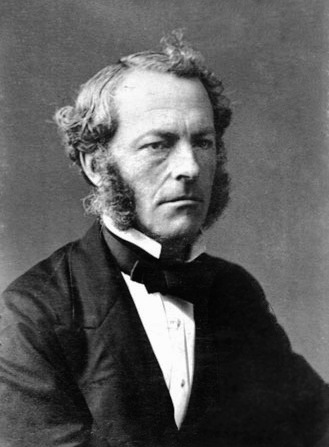
While today Stokes is remembered by undergraduates because his name is attached to mathematical results such as the Navier–Stokes equation and Stokes’ theorem (see box), in his lifetime he could also be found in his home in Cambridge experimenting on fluorescence with ‘strange infusions which smelt horribly, horse-chestnut bark and leaves and all sorts of other things’ [1, p. 35]. Or he could be found on holiday on the north coast of Ireland, in the sea, trouser legs rolled up, checking if the maximum angle of wave crests agreed with his calculations. On one occasion as a young man, he had to apologise for not bowing to a group of ladies in a Cambridge street because his hat was full of beetles. It seems virtually all aspects of the natural world held a fascination for him.
Early life
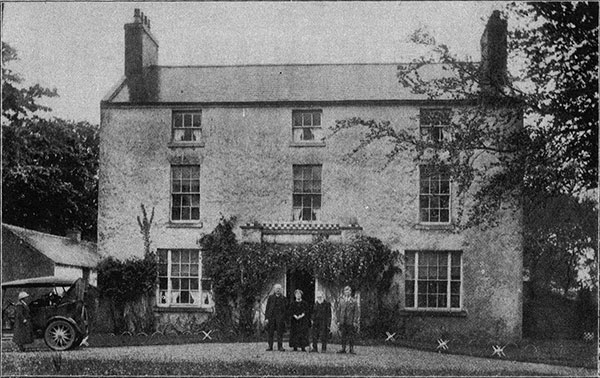
George Gabriel Stokes was born on 13 August 1819 into a family with a habit of producing Church of Ireland clerics and academics. His father was rector of Skreen parish church, which was a couple of kilometres from the Atlantic Ocean in County Sligo. He was the youngest of eight children, two of whom died in infancy. His three brothers all entered the church. His early education was at home and overseen by the parish clerk. In 1832, aged 13, he was sent to Dublin to live with his uncle and attend school there. Then in 1835, he moved to Bristol College. His mathematical ability was commented on in Skreen, Dublin and Bristol, with his sister Elizabeth claiming that: ‘There is a tradition that he did many of the propositions of Euclid as problems, without having looked at the book’ [1, p. 5].
Cambridge
In 1837, Stokes entered Pembroke College, Cambridge. As was typical for any student who wanted to appear high on the examination lists, he studied under a private tutor. The tutor, William Hopkins, had an eye for strong students and a reputation for converting their strength into becoming Senior Wrangler (i.e. obtaining the highest marks in the Mathematical Tripos examinations). A significant number of major figures in 19th century mathematics and natural philosophy passed through Hopkins’ hands, including J.J. Sylvester, Arthur Cayley, William Thomson (later Lord Kelvin), E.J. Routh, P.G. Tait and James Clerk Maxwell. In 1841, Stokes’ studies paid off and he was announced as Senior Wrangler, and shortly afterwards also took first place in the Smith’s Prize examinations. Such a strong performance meant that a fellowship at Pembroke inevitably followed.
Stokes went on, in October 1849, to be elected the 13th Lucasian Professor of Mathematics. P.G. Tait, a student at Cambridge at the time, declared that he and his fellow undergraduates had not even heard of Stokes before his appointment. The suggestion that Stokes was a relative unknown is backed up by the fact that The Times and two Cambridge papers erroneously announced that it was Stokes’ elder brother, Reverend W.H. Stokes, Senior Fellow of Caius, who had been appointed. Stokes was amused rather than piqued by the error.
Today the Lucasian Chair is seen as a stellar appointment, associating the incumbent with previous holders such as Newton, Dirac, Hawking and Stokes himself. However, it was not quite seen that way in his day. A Lucasian Professor from 20 years before Stokes, George Biddell Airy, complained that he had to take a one-third cut in pay to take the role, and matching his action to his complaint stayed in the job for scarcely more than a year. While in post, Airy cunningly used his position to arrange an increase in the salary of the Plumian Professor of Astronomy and Experimental Philosophy at Cambridge, before switching chairs. Early in his time as Lucasian Professor, Stokes augmented his inadequate salary by lecturing at the Royal School of Mines in London, but unlike Airy, he remained in the chair until his death.
Research
In 1901, near the end of his life, Stokes recalled that after graduation in 1841 [1, p. 8],
I thought I would try my hand at original research; and following a suggestion made to me by Mr Hopkins while reading for my degree, I took up the subject of Hydrodynamics, then at a rather low ebb in the general reading of the place [i.e. Cambridge].
From that suggestion flowed over 20 papers, clustered at the beginning and end of his life (1842–50 and 1880–98), covering the nature of fluid flow and the theory of water waves. Interestingly the work he considered his most important in the area of fluids was an 1851 paper, ‘On the effect of internal friction of fluids on the motion of pendulums’ [5, pp. 1–141] (see box). Certainly an accurate understanding of pendula for timekeeping and geodesy was important in the 19th century, but it is not the paper where he writes down what we now call the Navier–Stokes equation. This appeared in 1845 in ‘On the theories of the internal friction of fluids in motion, and of the equilibrium and motion of elastic solids’ [4, pp. 75–129]. Stokes was not the first to write the equation down. Claude-Louis Navier had done so in 1822, and in between then and 1845 so had Cauchy, Poisson and Saint-Venant. Stokes notes that on finishing the paper [4, p.77]:
I afterwards found that Poisson had written a memoir on the same subject, and on referring to it I found that he had arrived at the same equations. The method which he employed was however so different from mine that I feel justified in laying the latter before [the Cambridge Philosophical Society].
He then adds in a footnote that Navier has also written them down ‘but his principles differ from mine still more than do Poisson’s’ [4, p.77]. Navier had built his model on ideas of molecular forces, whereas Stokes preferred to avoid any molecular speculations. The work by Stokes and his predecessors was little enough known to be rediscovered again by Helmholtz in 1859, and you can read textbooks up to the mid-20th century which, while giving due credit to Navier and Stokes, do not name the equation after them.
Three cases of Stokes
Stokes’s name is associated with a number of phenomena and equations. Here are three of the best known.
Stokes’ theorem
For a vector field  and surface
  bounded by a simple curve
  :
:
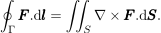
Actually, Stokes did not come up with this theorem! It was his long-term correspondent William Thomson. Thomson put it in a letter to Stokes in 1850, and Stokes put its proof as a question in the Smith’s Prize examinations in 1854.
Stokes’ law
The drag  on a small sphere of radius
  , moving with speed
  through a fluid with viscosity
  is given by

This result appears in a 141-page paper entitled ‘On the effect of internal friction of fluids on the motion of pendulums’ [5, pp. 1–141]. Stokes points out that the result explains why very small particles, including those that make up clouds, are suspended in air. At the beginning of the 20th century, the result was key to enabling Robert Millikan to indirectly measure the size of oil drops in his famous experiment to determine the charge on the electron.
The Navier–Stokes equation
For an incompressible fluid, the velocity field  of a fluid, where
  is the fluid density,
  is the pressure,
  is the dynamic viscosity and
  are external forces, is given by

The ubiquity of fluids makes the Navier–Stokes equation a cornerstone of modern physical science and engineering. Its nonlinearity makes it hard to solve, rich in dynamics and the subject of one of the Clay Mathematics Institute’s Millennium Prize Problems.
While in contemporary science the name of Stokes is best known for fluid dynamics, in his lifetime he also had a high reputation in optics. In this his contributions ranged across the whole subject, encompassing theory, experiment and instrument design. Stokes was an excellent and elegant experimentalist. J.J. Thomson stated: ‘It has been said that if you give Stokes the sun and three-quarters of an hour there is not an experiment in optics which he cannot perform’ [6, p. 370].
Those aspects of his work which were entangled with that most Victorian snare, the ether, have not aged well, but other studies have stood the test of time. Thus, in his work on aspects of interference and diffraction, he was able to bring new depths of mathematical and physical insight. However, one of his most significant contributions contained no mathematics whatsoever.

In 1845, John Herschel noted the blue glow produced within a thin layer near the surface of a quinine solution. Under the then current understanding that monochromatic light was immutable, this phenomenon was difficult to explain. Stokes realised that if he took the dramatic step of assuming monochromatic light was mutable then the phenomenon was easily explained. He performed a series of experiments to test the hypothesis, and tracked the matter down to the absorption of ultraviolet. He then went on to find a similar effect in ‘solutions made directly from various parts of vegetables’ [5, p. 262] (hence the foul smelling infusions mentioned earlier). In a footnote to the 140-page paper where he laid out his results, Stokes stated: ‘I am almost inclined to coin a word and call the appearance fluorescence’ [5, p. 289]. The work won him the Royal Society’s Rumford medal in 1852.
While the vast majority of Stokes’ over 130 papers are on fluids and optics, he did publish seven papers on more directly mathematical work. In a paper published in 1847 he considered the nature of the convergence of a Fourier series near a finite discontinuity, and in the same paper introduced the idea of uniform convergence. He also made use of what we now call the Riemann–Lebesgue lemma seven years before Riemann.
In 1850 Stokes considered the integral

whose zeros Airy had shown corresponded to dark bands in the theory of caustics. Airy had been able to find zeros close to the origin, but Stokes, ‘after many trials’ [7, p. 330], produced an asymptotic analysis which allowed the position of larger zeros to be found efficiently. In this work he was again anticipating Riemann, this time by a decade, by using the saddle point method for integrals in the complex plane. This work led on to what we now call Stokes’ phenomenon, the varying asymptotic behaviour of functions in different sectors of the complex plane; a key idea in the modern research areas of super- and hyper-asymptotics.
Conclusion
There was much more to Stokes than the science and mathematics he has left behind. He served for more than 30 years as Secretary of the Royal Society. As such he devoted much time to editing its Philosophical Transactions and acted as one of the gatekeepers of Victorian scientific standards. A committed Christian, he thought deeply about his faith and its relation to science, writing at book length on theological issues. He acted as MP for Cambridge University, and in the last months of his life he served as Master of Pembroke; and it was from Pembroke that his coffin was finally taken, processing round the Chapel Court, on to the University Church, and then to the Mill Road Cemetery. Strangely, if you go looking for his grave today, you will not find his name on any headstone. But it hardly matters, his name is cut into equations that will last longer than any granite.
Mark McCartney
University of Ulster
Further reading
A readable and warm recollection of Stokes, written by his daughter, can be found in the first 90 pages of [1]. D.B. Wilson provides a fine set of perspectives on Stokes’ life and work in [8]. [9] gives a collection of chapters on many aspects of Stokes’ life and work written by a range of experts. For those wishing to delve more deeply into Stokes’ work the five volumes of his Mathematical and Physical Papers are freely available at www.archive.org.
References
- Larmor, J. (ed.) (1907) Memoir and Scientific Correspondence of the Late George Gabriel Stokes, Bart, Vols. 1 and 2, reprinted 2010, Cambridge University Press, Cambridge.
- Greer, J. (1924) The Windings of the Moy with Skreen and Tireragh, Alex Thom, Dublin.
- Thomson, W. (1911) Mathematical and Physical Papers, Cambridge University Press, Cambridge, vol. 6, p. 339.
- Stokes, G.G. (1880) Mathematical and Physical Papers, Vol. 1, Cambridge University Press, Cambridge.
- Stokes, G.G. (1901) Mathematical and Physical Papers, Vol. 3, Cambridge University Press, Cambridge.
- Thomson, J.J. (1899) The Stokes jubilee, Camb. Rev., vol. 20, p. 370–371.
- Stokes, G.G. (1883) Mathematical and Physical Papers, Vol. 2, Cambridge University Press, Cambridge.
- Wilson, D.B. (1987) Kelvin and Stokes: A Comparative Study in Victorian Physics, Adam Hilger, Bristol.
- McCartney, M., Whitaker, A. and Wood, A. (eds) (2019) George Gabriel Stokes: Life, Science and Faith, Oxford University Press, Oxford.
Reproduced from Mathematics Today, August 2019
Download the article, Fluids, Fluorescence and a Hat Full of Beetles (pdf)