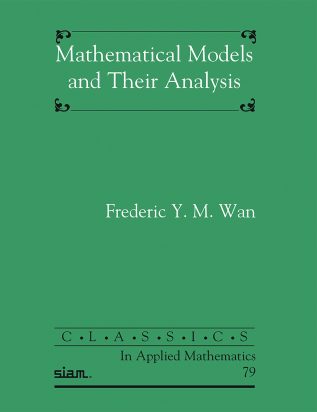
 Frederic Y.M. Wan
SIAM 2018, 402 PAGES
PRICE (PAPERBACK) £77.50 ISBN 978-1-61197-526-0
This book is one of the SIAM Classics series which means it is a faithful reproduction of a previously issued volume, in this instance published originally by Harper and Row in 1989. The readers of Mathematics Today really do not have to be told that very little mathematics dates, so mathematics written thirty years ago is still going to be relevant today. However, style and presentation do date so let’s get the main point out of the way first before delving into the contents. There is a problem with the reproduction, certainly in the copy that I have. Throughout the book there are short sections, often just single sentences but sometimes longer, printed bold they are presumably considered important passages, and they are printed over a light grey background. In the original text I imagine these would have been reproduced as if highlighted for emphasis, however in this SIAM reprint the light grey background has become granulated and looks dirty, the bold overlaid writing looks fuzzy and is sometimes difficult to read. The entire text also has a slightly blurred look of a poor photocopy which is unfortunate. One can see the contrast to how it should look by turning to the new Appendix to the Classics Edition on page 379, a modern addition that has an altogether clearer more professional appearance.
Back in the late 1980s when this book was written, ‘Mathematical Modelling’ was certainly still relatively new but already recognised as a user-friendly vehicle for students of other disciplines that desired a palatable introduction to how mathematics can be applied to their particular discipline. This was especially true if this discipline was outside the more usual applications of mathematics to problems in engineering and the physical sciences. Time has passed and now thirty years on books such as this can no longer be considered innovative, but they are definitely still necessary. Nowadays there is more user-friendly software available, and quantitative modelling is now more securely embedded in disciplines such as geology, geography, biology, medicine, economics and even in the social sciences than it used to be. There is however in my opinion still room for a book such as this on our shelves.
Now to content. There is an opening chapter on the planning of mathematical modelling including how to teach general principles. This chapter also includes a section on dimensional analysis that is very useful, and very necessary. The rest of the book is divided into five large ‘Parts’ each part containing several chapters. Part 1 covers dynamical systems such as the pendulum and planetary motion, these are both traditional vehicles for modelling and are covered reasonably well, but without the usual detailed derivations as might be found in a more traditional dynamics text. This mild criticism can be levelled throughout the book, the reader is asked to take the equations more or less on trust, as it is the modelling using the equations and solving them that takes precedence. The mathematics of this section begins to tell you whether the level of the book is correct for you; familiarity with ordinary differential equations and surrounding notation is certainly essential here. Later in the book a similar familiarity with partial differential equations becomes necessary, as is knowledge of some special functions.
Part 2 is on stability and Part 3 on waves, both are dealt with in a good deal of mathematical detail, but again without background derivation. There is an overlap with material in the excellent book on Wave Motion by Billingham and King [1] here and the comparison stands up reasonably well particularly in the account of traffic flow modelling. There is more traffic flow modelling in the diffusion section (Part 4) that follows. This section also contains the more traditional diffusion modelling of heat conduction. Less familiar will be the chapter on modelling fish populations that arise from assuming a logistic growth but are, not entirely convincingly, here knitted together with reaction-diffusion modelling. An opportunity was lost at this juncture by the exclusion of more practical population and food web modelling. The last section (Part 5) is all about modelling control and optimisation and may be considered a more specialist application to economics. There are persistent themes in the modelling. One is the use of the boundary value problem and its solution, usually using Fourier methods. Secondly, where the problem is essentially an optimisation one, use is made of results from the calculus of variations, sometimes using matrix methods together with a hint at numerical techniques, although the author’s attitude to these now seems a little old fashioned, stemming from the age when the student had to do his or her own programming in order to use a computer. The solution of problems less reliant on classical techniques would, if written now, probably look different with more emphasis on the use of proprietary software. The addendum is a section on linear control theory that further reflects the interest of the author.
In summary, this is a very good book from 1989 that has aged reasonably well but suffers from the poor reproduction and a somewhat dated attitude to numerical modelling, though this latter is a milder criticism. It deserves a place on the shelves of any library that is in an institution that delivers modules and courses that contain quantitative mathematical modelling in the final two years of a degree course, or perhaps delivers specialist MScs that include modelling. There is also useful material here for both final year and MSc project students. Just remember, if you are a student, when consulting a text such as this on a particular model, couple your consultation with background reading to fill in more of the context.
Phil Dyke FIMA
REFERENCES
1 Billingham, J. and King, A.C. (2001) Wave Motion, Cambridge University Press.
Book review published directly onto IMA website (May 2020)