Kit Yates
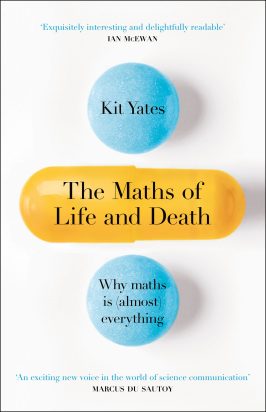 QUERCUS BOOKS 2019, 352 PAGES PRICE (HARDBACK) £20.00 ISBN 978-1-78747-542-7
Kit Yate’s broad overview of the application of mathematics touches on mathematical epidemiology, mathematical biology and a host of other subjects, aiming to introduce the non-mathematician to the importance of mathematics to everyday life. It is a really well-written book and a great read which I recommend to the readers of Mathematics Today, and which I will recommend to my friends and family.
Yates deliberately set out to cover a wide range of topics without having to include any equations in his manuscript. This point made me chuckle: he clearly took onboard the famous advice given by Professor Simon Mitton to Professor Stephen Hawking upon reviewing the manuscript to A Brief History of Time…avoid equations for the benefit of the lay audience.
After a strong introduction to the book, in which Yates outlines his motivation for writing the book (‘…maths is or everyone…we can all appreciate the beautiful mathematics at the heart of the complicated phenomena we experience every day’), he tackles seven main subject areas: exponentials, mathematics in the medical domain, mathematics in the legal domain, interpretation of statistics and spotting common flaws in methodology of mainstream reports of science, number systems and time, algorithms and some computational mathematics, and mathematical modelling in epidemiology.
The chapter on mathematical epidemiology and within it the introduction to the SIR model of ordinary differential equations (all presented excellently without the use of equations, mind) was, in hindsight, a brilliant chapter to include given the media’s focus on mathematical modelling of infectious diseases during 2020. Yates also manages to include discussions on herd immunity, Wakefield and the MMR saga in the late 1990s, and some modelling experience through the Ebola outbreaks in west African nations and the evaluation of the place of human papillomavirus vaccines in the UK vaccination programme. It’s a packed chapter, without falling into the pitfalls of being too dense for the lay audience. I was also delighted that Yates included so many examples of mathematical epidemiology and infectious disease modelling in this chapter given my interest in this field. Bravo.
Other highlights include Yates’ description of the P vs NP problem, which also introduces the reader to the Clay Institute’s millennium problems. This is an essential topic in a computational mathematics discussion, and the discussion was skilfully written for a broad audience. The best part of the book, in my opinion, is the presentation of the topic of sensitivity and specificity in diagnostic testing. It’s a brilliant topic to include in a book like this due to the counterintuitive nature of problems in this domain (e.g. the prevalence of a disease in a population is 13%, and a diagnostic test will tell you with 87% accuracy if you have or do not have the disease. What is the probability that you have the disease if your doctor tells you that you have tested positive?) and very topical, but Yates’ use of diagrams gives the clearest description of the nature of these problems that I have seen yet. A simple but elegant addition to the book that hopefully leaves these problems less daunting to a broad-ability audience.
One issue I had with the book is in the fifth chapter, focused on time and number systems. At several points during my reading of this chapter, however well-written and enjoyable it was, I thought I was reading Matt Parker’s latest book Humble Pi [1,2] on mathematical mistakes. The chapter was an interesting read, outlining some important and consequential mathematical mistakes like the NASA Mars Orbiter and the crash in September 1999, as well as issues in the coding of the US Patriot missile defence system that led to several Iraqi scud missiles striking American troops in the Gulf in 1991, and of course highlighting these very visible consequences of mathematical mistakes is an excellent tool to use to demonstrate the importance of mathematics in different domains. Is it really a problem to say that this chapter reminded me of another excellent mathematics book? No, probably not, but it made me wonder if there was a different way to discuss the mathematics of time and number systems without using the examples highlighted in the chapter, given that this approach has already been done.
Overall, this is a book on the applications of mathematics that I will be recommending to friends and family who want to understand a little bit more about mathematical biology, epidemiology and the applications of mathematics in general. Yates writes very well in an engaging manner and I hope that he is already working on a follow-up book. He didn’t shy away from including plenty of details for some complex topics, but always in an extremely approachable fashion. This is a very good example of a mathematics book for a broad audience, and I hope the author has more in him for the future.
Dominic Thorrington MIMA Haute Autorité de Santé
The views and opinions expressed are those of the author and do not necessarily reflect those of Haute Autorité de Santé.
REFERENCES
1 Parker, M. (2019) Humble Pi: A Comedy of Maths Errors, Penguin Books.
2 Rochead, E. (2020) Review of Humble Pi: A Comedy of Maths Errors, Mathematics Today, vol. 56, p. 34.
Book review published directly onto IMA website (October 2020)