
I read with fascination Michael Sewell’s article describing a ‘Coffee break problem’ [1]. It reminded me of a problem that Brian ‘Benny’ Leonard (computational fluid dynamicist and musician; see e.g. [2, 3]) raised in a coffee break during a visit to the Met Office, namely: ‘How many different (musical) chord types are there?’ Somewhat surprisingly, the musical chord problem and Michael Sewell’s coffee break problem turn out to be remarkably similar. Here we give some methods of calculating the solution to these problems.
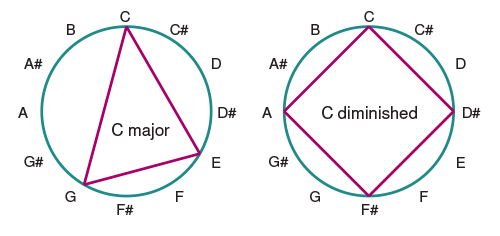
The musical chord problem can be interpreted in various ways, but Benny Leonard had the following interpretation in mind. We regard a chord as a subset of the  notes of the chromatic scale, i.e. we ignore any information about which octave or octaves the notes are in, and we regard a chord type as an equivalence class of chords under (musical) transposition. If we depict the notes as points on a circle then, for example, the C major chord gives rise to the triangle in Figure 1 and the chords of the same type (the major chords) can be obtained by rotating the triangle.
The problem of evaluating the number of chord types is then almost the same as Michael Sewell’s problem [1], in which he considered how many different polygon shapes could be made by joining a number of points chosen from a set of points spaced equally around a circle. If we extend the musical problem to equi-tempered scales with other than notes to the octave (for example, some gamelan scales), then the only difference is that, in Michael Sewell’s problem, polygons are regarded as equivalent if they can be made the same by reflection and/or rotation, whereas in the musical scenario we are (mostly) interested only in rotations. If we reflect the triangle corresponding to a major chord, we get a minor chord, which one would not normally want to regard as the same type of chord.
The total number of chords is  because each of the notes is present or not (being mathematicians we count the ‘empty chord’ as a chord and we also include one- and two-note chords, although musicians generally think of a chord as having at least three notes). One might think the number of chord types is then
  , but this cannot be right as it is not an integer. The reason this simple calculation is wrong is that chords with some transpositional symmetry (i.e. in terms of our diagrammatic representation of chords, some rotational symmetry) generate fewer than distinct chords under transposition. An example is the diminished chord shown in Figure 1.
The chord types containing fewer than distinct chords play an important role in music. Examples are the diminished chord, the augmented triad (think equilateral triangle) and the notes of the diminished or octatonic scale (think octagon with alternate long and short sides – see Figure 2). Olivier Messiaen, in particular, often used a variety of ‘modes of limited transposition’ (i.e. modes with less than transposed versions) in his compositions [4].
Let us consider an equi-tempered scale with  notes to the octave. Let us write
  , where
  divides , for the number of chords that have distinct transposed versions (there are no such chords if does not divide ). The and notation is illustrated in Figure 2.
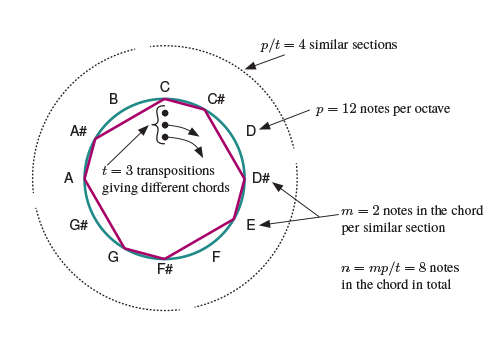
A chord/polygon with transposed/rotated versions is invariant under rotations of  . is independent of (provided divides ) because, for any , a chord with distinct transpositions is determined by the on/off status of consecutive notes.
Expressing the total number of chords  in terms of gives
![\[2^p = \sum_{t\mid p} J_t.\]](https://ima.org.uk/wp/wp-content/ql-cache/quicklatex.com-3572d19d8a1c53fd10e756a0343836cd_l3.svg "Rendered by QuickLaTeX.com")
By using this equation repeatedly with different values of , we can evaluate  ,
,  ,
,  ,
,  ,
,  and
and  , where we have focused on the cases relevant to the classical chromatic scale with
  . The number of chord types consisting of transposed chords is then
  .
.
For (the classical chromatic scale) we then have  (the empty and full chords),
  (the whole tone scale),
  (diminished chord and octatonic scale),
  (augmented triad, its complement and the combination of two augmented triads a semitone apart),
  and
and  , giving the total number of chord types as
  .
.
It is not immediately obvious from the equation for that is divisible by , and there is an interesting connection here to Fermat’s little theorem. Suppose we allow each note, instead of being just on or off, to adopt one of  different volumes or tone colours. There are then
  chords in total and, if is prime, the only chords of limited transposition are the chords in which all the notes have the same tone colour. It follows that
  must be divisible by , which is just Fermat’s little theorem.
As well as considering the number of polygon shapes, Michael Sewell’s problem asked for the number of triangular, square, pentagonal etc. shapes separately. This also has musical relevance in that it relates to the number of  -note chord types. If we write
  for the number of chords with distinct transpositions and
  notes per
  th of an octave, so that there are
  notes altogether (see Figure 2), then , regarded as a function of and , is independent of (provided
  ) and
) and
![\[\begin{pmatrix} p \\ n \end{pmatrix} = \sum_{t\mid p} J_{t,nt/p},\]](https://ima.org.uk/wp/wp-content/ql-cache/quicklatex.com-4d750293d3840965c192b2ebbf5d8c84_l3.svg "Rendered by QuickLaTeX.com")
where  is zero if
  is not an integer. The can be evaluated by using this equation repeatedly as before. We can then calculate the number
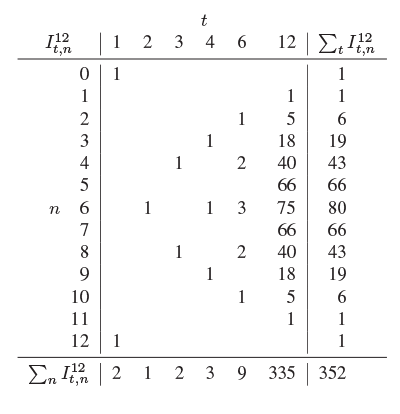
  of chord types consisting of chords with transposed versions, each with notes, in an equi-tempered scale with notes per octave, by using
  . For this gives the results shown in the table. Only non-zero entries are shown.
Although the above approaches work, and can be extended to include equivalence under reflections as in Michael Sewell’s original problem, they are quite complicated and involve quite a lot of calculation. However (at least if we are not interested in classifying the chord types or polygon shapes by their degree of rotational symmetry ), a more abstract approach using Burnside’s lemma in the theory of group actions can give a simpler solution.
Burnside’s lemma is concerned with counting equivalence classes of objects where the equivalence is induced by a group of symmetry operations. As an example (but one much more complicated than the application considered here), it was used to count the number of ‘essentially different’ completed sudoku grids [5]. If  is the group of symmetry operations on the polygons (i.e. the group of rotations, or of rotations and reflections) and
  is the set of polygons, then an orbit in generated by is an equivalence class of polygons, all with the same shape. The number of polygon shapes is then the number of orbits
  where
where  is the set of orbits. This can be calculated from Burnside’s lemma:
![\[|X/G| \, |G| = \sum_{x \in X} |G_x| = \sum_{g \in G} |X^g|,\]](https://ima.org.uk/wp/wp-content/ql-cache/quicklatex.com-56c4015266280d54d3d7c5dbabec7a78_l3.svg "Rendered by QuickLaTeX.com")
where  is the set of elements of that fix
  and
and  is the set of elements of that are fixed by
  . The
. The  are reasonably easy to compute and it follows that the number of chord types for a -note scale is
![\[\sum_{g = 1}^p \frac{2^{\operatorname{hcf}(g,p)}}{p}.\]](https://ima.org.uk/wp/wp-content/ql-cache/quicklatex.com-6247031e9c121a22d19a7df1d57af7ce_l3.svg "Rendered by QuickLaTeX.com")
The number of -note chords and the results where we equate chord inversions (polygon reflections) are more complicated. However, with some familiarity with Burnside’s lemma and a pencil and paper, it is just about feasible to derive solutions to these problems during a coffee break (or two)!
The above is perhaps an illustration of how mathematical ideas, because of their abstract nature, often have applications to problems (e.g. chord types) that are very different from the problems where the ideas first arise (e.g. polygon shapes), and how taking a more general approach (in this context using the theory of group actions) can often lead to simpler solutions.
David Thomson CMath MIMA
Met Office
References
- Sewell, M. (2019) A coffee break problem, Math. Today, vol. 55, no. 2, p. 63.
- Leonard, B.P., Lock, A.P. and Macvean, M.K. (1996) Conservative explicit unrestricted-time-step multidimensional constancy-preserving advection schemes, Mon. Weather Rev., vol. 124, pp. 2588–2606.
- Leonard, B.P. (1994) In-line double attachment slide trombone, US Patent 5365823.
- Wikipedia (2021) Mode of limited transposition.
- Russell, E. and Jarvis, F. (2006) Mathematics of Sudoku II.
Reproduced from Mathematics Today, April 2021
Download the article, Musical Polygons (pdf)



Thanks for this interesting article. For reference, the Mathematics Today Letters cited below note additional results, including:
• an alternative approach to the problem by noting that the musical polygons described for a p-note equi-tempered musical scale are isomorphic to p-bead necklaces with two colours;
• explicit formulas for the article’s implicitly defined functions J(t) and J(t,m); and,
• an alternative formula for the number of chord types that also allows for a direct proof of the article’s formula for this number.
1. Ollerton, R.L. (2021) Musical necklaces, Math. Today, vol. 57, no.3, p. 109.
2. Ollerton, R.L. (2021) Musical necklaces reprise, Math. Today, vol. 57, no.4, p. 158.