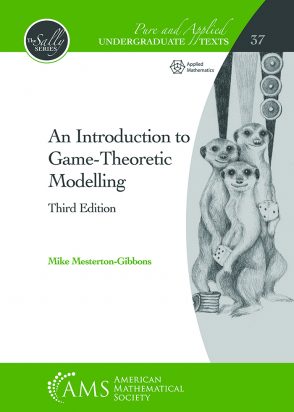
Mike Mesterton-Gibbons
AMS 2019, 398 PAGES
PRICE (HARDBACK) £76.95 ISBN 978-1-4704-5029-8
This book is organised into eight chapters, each describing different kinds of games, modelled via different assumptions.
Chapter 1 – Community Games. These are games that involve specific individuals, known as actors. Examples include motoring behaviour at junctions, and pricing of goods between rival stores. As these games are non-cooperative games Nash equilibria are introduced. These games are limited to the extent it is assumed that all players have explicit knowledge of each other’s rewards for winning. Other options exist, but are beyond the scope of the book.
Chapter 2 – Population Games. This chapter introduces the idea of an individual strategist interacts with another but the second being taken from a large population of other strategists. These are called population games. The aim is to be able to distinguish between different types of Nash equilibria.
Chapter 3 – Cooperative Games in Strategic Form. This chapter is focused on a type of community game, so is a form of continuation of Chapter 1. The strategic aspect involves players making binding agreements with each other if it benefits them. The result is that the concept of Nash non-cooperative equilibria is superseded and replaced by cooperative solution concepts.
Chapter 4 – Cooperative Games in Nonstrategic Form. In these games strategy is implicit, which means coalitions are given less importance. The focus here is on a benefit distribution or a coalition structure. Formation of coalitions in nonstrategic games is considered only from the viewpoint of which ones form, rather than why they form. Characteristic function games and their concepts are studied.
Chapter 5 – Cooperative and the Prisoner’s Dilemma. The prisoner’s dilemma is introduced in various formats as a means of exploring the evolution of cooperation. There is a lot of literature on reciprocity that has been generated as a result of the Iterative Prisoner’s Dilemma. This is described in some detail with references for further information.
Chapter 6 – Continuous Population Games. The chapter is focused on continuous population games, as suggested by the title. Two aspects of this are covered: demonstrate the importance of these games as tools to study animal and human behaviour; and also to display the diversity of possible models of these games. The point is made that the literature on the study of animal conventions is almost non-existent.
Chapter 7 – Discrete Population Games. This topic involves the study of games involving different numbers of pure strategies. Games with 2, 4 and 6 strategies are considered in this chapter. This serves as a means of applying game theoretic concepts to behavioural ecology, resource management amongst other areas. Games are often used to study fisheries management but the use of these methods in other forms of wildlife conservation is almost entirely undeveloped.
Chapter 8 – Triadic Population Games. Up to this point all the games described have involved two parties, or two groups of parties, competing in some way. The simplest level of game theory beyond the two party situation is the three party case. It introduces significant complications. In this chapter triadic games are introduced and are limited to continuous population games, analogous to Chapter 2. These kinds of games can be related to social eavesdropping and intervening in neighbourhood disputes.
In conclusion the book is a good introductory survey of modelling situations using Gaming Theory. It begins with the work of John Nash, with discussion of Nash equilibria and continues well beyond that point. It mentions the limitations of applications of gaming theory at the time of writing and suggests areas where there is significant opportunity for research. It is aimed at the undergraduate market.
John Bartlett CMath MIMA
Book review published directly onto IMA website