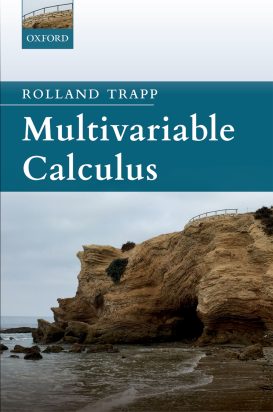
 Rolland Trapp
OXFORD UNIVERSITY PRESS 2019, 480 PAGES
PRICE (HARDBACK) £74.00 ISBN 978-0-19-883517-2
Rolland Trapp’s book provides a very readable account of the subject for an audience of mathematics and physical-sciences undergraduates. It takes the reader on a 480-page journey from curves and surfaces all the way up to grads, divs, and curls in polar coordinates.
There are five chapters: Introduction to Three Dimensions, Introduction to Vectors, Differentiation, Integration, and Vector Analysis. They contain essentially everything needed to acquire a strong handle on multivariable calculus and, crucially, how to solve a wide range of problems. Each chapter follows a similar format. Concepts and terminology are introduced and explained, some carefully chosen worked examples are given, and a set of exercises follows. Key results are highlighted in boxes, and occasional ‘Things to know’ summaries provide extra pointers for study. The exercises are well thought out, starting at an elementary level then progressing towards more difficult questions.
Chapter 1 covers the description and visualisation of curves and surfaces in three-dimensional space. Chapter 2 introduces vectors, detailing their algebraic and geometric properties and closing with the basics of vector fields. Once these preliminaries are safely dispatched, the calculus aspect starts in Chapter 3 and attacks all the important topics: from functions and their limits, through tangent planes and partial derivatives, to the chain rule and some applications. Chapter 4 deals with integration, focusing on double and triple integrals. The generalisations underpinning multiple integrals are developed by way of Cartesian coordinates, before moving on to integrations over domains in cylindrical and spherical polar coordinates. Applications include calculating the mass and centroid of simple bodies.
Chapter 5 naturally moves on to more advanced material with vector calculus, including topics such as line and surface integrals, gradients, divergences, Laplacians, curls, and the theorems of Green, Gauss, and Stokes. The final section gives a brief introduction to curvilinear coordinates; emphasis is placed on cylindrical and spherical systems, complementing material from the previous two chapters.
Multivariable Calculus is, in my view, extremely well written and an all-round superb book from which students of mathematics and the physical sciences can gain an excellent understanding of the subject. The exposition is relaxed and informal, reading more like a conversation in parts, but the technical content and rigour survive intact. Indeed, it is refreshing to see definitions and terminology explained in simple (but not simplistic) language, and the theorem–proof explanations are clear and concise. This choice of narrative style will, I imagine, appeal to a wide target audience and ensure as far as possible that the book remains accessible for all.
The level of detail given in the worked examples is probably just about right, lest the book transform into a tome. Application themes of mechanics, electromagnetics and fluid dynamics are interweaved throughout much of the text, which is also a good thing: it reminds mathematics students that all the abstract symbols often mean something physical, and reiterates to physical sciences students the essential power of mathematics. From an instructor’s perspective, the book could easily be used either as a basis for writing a first course on multivariable calculus or as a supplement to existing teaching materials.
Another of the nice touches with Multivariable Calculus is its accompanying Math Apps suite, available to both hardcopy and eBook readers. Downloadable from the Oxford University Press website is a set of interactive figures, taken directly from the text, and which open in the free Maple Player software (running on Windows, Mac, and Linux systems). Graphs may be manipulated within applet-like environments which can be an enormous benefit when visualising, for instance, regions in different coordinate systems, level surfaces, tangent planes, vector fields, fluxes, etc.
As a final comment, it would be remiss of any review not to mention the book’s presentation and stunning visual appeal. Beautiful colour figures have been painstakingly prepared with the utmost care and attention, helping the reader engage with conceptually demanding ideas that students often find challenging to absorb. The addition of Math Apps makes that whole process even easier and more instructive, not to mention much more enjoyable. There is a fine line between the textbook requirements for students of mathematics and of physics; Trapp walks it particularly well. A concluding remark? One for the reading list of both, I think.
James Christian CMath FIMA
University of Salford
Book review first published in Mathematics Today April 2022