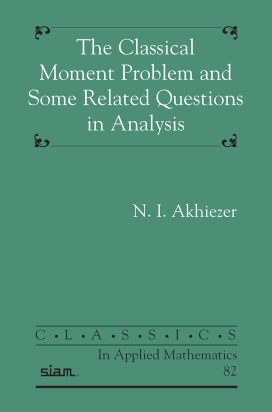
N.I. Akhiezer
SIAM 2020, 253 PAGES
PRICE (PAPERBACK) £76.00 ISBN 978-1-61197-638-0
The first use of the term ‘moment problem’ was by Stieljes in 1894/95. He defined his use of the term in his memoir on continued factions. This book is concerned with a detailed investigation of the moment problem and its relation to the mathematical areas of functional analysis, theory of functions and spectral theory of operators. Certain generalisations and continuous analogues of the classical moment problem are also considered.
The book contains the following chapters. Chapter 1 – Infinite Jacobi Matrices and Their Associated Polynomials. This chapter is concerned with infinite matrices as they are related to certain algebraic continued fractions with many applications. These continued fractions were also the means by which the idea of orthogonal systems of polynomials was introduced and are the algebraic apparatus of subsequent development. The chapter contains the sections: Basic Concepts, Properties of the Polynomials, Theorems of Invariance and Analyticity and Quadrature – Continued Fractions.
Chapter 2 – The Power Moment Problem. The chapter is focused on criteria of solubility and determinateness of the Power Moment problem. Investigation of various analytic functions that relate to the indeterminate case is also considered. Finally, the functional analytic aspect of the power moment problem is analysed. The following sections are in the chapter: Solubility Criteria, The Isometric Operator, Some Criteria of Completeness, The function rho(z) and the Nevanlinna Matrices, Extremal Properties of rho(z) and M. Riesz’ Method.
Chapter 3 – Function Theoretic Methods in the Moment Problem. This chapter interprets the Power Moment problem from the perspective of a limited case of a general interpolation problem in the theory of functions. If the power term under the integral in the expression of the problem is generalised to include other forms then other cases of interpolation can also be analysed in this manner. Nevanlinna obtained a formula that enabled further questions relating to the indeterminate problem. The following sections are in the chapter: An Interpolation Problem, Reduction of the Power Moment Problem, An Algorithm for Consecutive Linear Fractional Transformations, The Indeterminate Hamburger Problem.
Chapter 4 – Inclusion of the Power Moment Problem in The Spectral Theory of Operators. This chapter is concerned with the operator approach to the moment problem. The moment problem can also be used to commence more general constructions in the Theory of Operators. This last part is outside the scope of the present book. The following sections are in this chapter: The Operator Approach to the Moment Problem, Symmetric Operators and J-Matrices, Integral Representation of a Positive Functional.
Chapter 5 – Trigonometric and Continuous Analogues. This chapter follows on directly from chapter 3. It focuses on the trigonometric moment problem, which is strongly related to the Caratheodory coefficient problem. The other areas covered include trigonometric analogues of orthogonal polynomials, integral representations of Hermitian-positive functions as a continuous analogue of the trigonometric moment problem. The sections are: The trigonometric moment problem, orthogonal polynomials on a circle, Hermitian-positive functions and monotonic and exponentially convex functions.
There is an Appendix relating to Stieltjes’ continued fractions. The book is very much focused on pure mathematics and reads very much like a classical book, rather than a more modern format.
John Bartlett CMath MIMA
Book review published directly onto IMA website