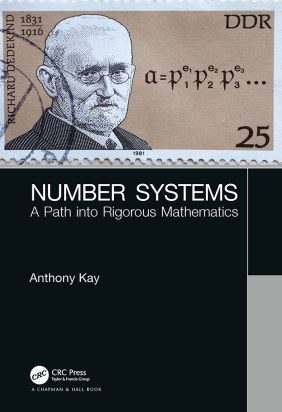
Anthony Kay
CHAPMAN & HALL 2021, 304 PAGES
PRICE (PAPERBACK) £56.99 ISBN 978-0-367-18061-4
This text grew out of a module for first year students at Loughborough University. According to Abel Prize Winner Dennis Sullivan Mathematics is built on two fundamental concepts: counting and space. Here Kay has provided in this text those foundations of number theory that parallel the developments that gave us both Algebra and Analysis with Geometrical aspects kept to a minimum.
He begins in the first of eleven chapters with a short Introduction in which the purpose of the book is clearly presented. His aim is to give a rigorous theory of numbers as a way into rigorous mathematics through the five major number systems, from the Natural to the Complex numbers. Computerised printing has kept all the text neatly presented from subscripts to superscripts everything clearly delineated and avoiding confusing contradictions as far as possible.
Chapter 2 covers the basics of Sets and Relations and, although elementary, students should read this to observe the author’s notations which at this stage are fairly standard. He gives a plentiful number of illustrative examples together with exercises for the student which is a feature of the whole text.
Chapter 3 begins with the first of our number systems and deals with the Natural Numbers. Kay lays down five axioms due to Peano and Dedekind that give us the basis for Addition of such numbers. Then via commutativity, associativity, binary operations and so on leads us to Subtraction as the Inverse of Addition. As well as the sprinkling of exercises throughout the chapter he ends it with a section of Investigations that are appropriate to its contents and this textbook style part becomes a nice feature of the whole book.
Chapter 4 is concerned with the Integers. These are defined by using ordered pairs and a preliminary notation of circled symbols for plus and minus is adopted initially. The isomorphic connection to the Natural Numbers is made and the Algebraic Structure is noted. This leads on to the definitions of groups and rings. He concludes by the ‘surprising’ theorem that the integers are countably infinite so that they have the same cardinality as the natural numbers. Two investigations then round off this chapter.
Chapter 5 takes a breather to look at the implications of Number Theory given so far. The Division Theorem is introduced as foundational and number bases other than ten are also given. Prime numbers and some of their properties are all presented and further details are then explained in the Investigations at the end of the chapter. We also have Congruences and Modular (or Clock) Arithmetic and the Algebraic Structures of groups, rings and fields are again pointed out.
In Chapter 6 the Rational Numbers are defined as an equivalence class of ordered pairs of integers under the equivalence relation defined by an appropriate cross multiplication. Then from positive and negative rationals we have their addition and multiplication using the number pairs followed by the fraction notation that we are more familiar with. That the rationals are countably infinite is given together with interesting illustrations. The rational numbers are however, incomplete in two senses and so Analysis and hence the Calculus needs more than the rational number systems. So there will need to be an ‘axiom of completeness’ in which ‘every set that is bounded above/below has a supremum/infimum’. Before immediately jumping to the Reals he shows how to express the Rational Numbers in any Base and use the decimal point notation.
Chapter 7 brings us to the Real Numbers. The ‘good’ properties of the Rationals are combined with having the Axiom of Completeness so that addition, multiplication and order may be performed. The author prefers the Definition devised by Dedekind arguing that the usual Cauchy sequences require some knowledge of Analysis. Dedekind Cuts are defined and satisfy the Axiom so that our real numbers form a continuum and he gives appropriate exercises. We have the result that the Reals are an ordered field but that they are uncountable. He also discusses the Continuum Hypothesis. The chapter concludes with a discussion of Algebraic and Transcendental Numbers showing that not all real numbers are algebraic and many transcendental numbers cannot be specified!
Instead of jumping into Complex Numbers straight away Chapter 8 brings us to the first of two sections on Quadratic Extensions. Using the integers and the rationals as a number system he defines ordered pairs (a,b) that behave like a+b sqrt (k) and having suitable addition and multiplication rules. The Extensions of the Integers are considered first and then follows the Extensions of the Rationals and their connections to the set of certain algebraic numbers. Algebraic Numbers in Quadratic Fields are considered with algebraic integers defined and the Eisenstein integers as an extension of a particular quadratic ring also defined. The concluding Investigations cover determining primes in the Integer extension with various k values and also the connections with the Fibonacci sequences and numbers.
The second part of Quadratic Extensions is given as Chapter 9 in which the number system is the Reals and k is -1 to produce the Complex Numbers in the form x+yi (not the usual x+iy) for the (x,y) pairs. We now have a number system in which exponentiation is closed and in which each of our given systems is noted to form a hierarchy from the Naturals to the Complex Numbers. The first steps to exponentiation are made, and the principal square root is defined. The complex plane is introduced (the Argand diagram is not mentioned) together with the unit circle and the principle value of the argument. Our author covers the usual properties of exponentiation, logarithms, trigonometry and polynomials and considers also the Cardinality question.
Chapter 10 introduces us to yet more Number Systems. From having ordered sets of two real numbers one can look at systems of ordered sets of more even real numbers. So under Constructible Numbers we have quaternions and the Caley–Dickson algebras with Lipschitz and Hurwitz integers and these are concluded with some relevant investigations.
In keeping with the author’s aims he has a last chapter on how number systems lead on to Abstract Algebra and Analysis. A bibliography of appropriate texts rounds off his book. This is a textbook and the author expects the student’s interaction with the material through both the exercises and investigations. Prospective and beginning students would benefit from the first four chapters as a preparation. Those doing Number Theory courses have lots of material available here and those who have already done a first course on Complex Numbers might appreciate this author’s more non-Geometric approach as a helpful alternative.
Laurence Nicholas CMath FIMA
Book review published directly onto IMA website